Best Foods for First Trimester Nausea (That Actually Work)
Real relief strategies for morning sickness - because "just eat crackers" isn't always enough. What to eat when nothing sounds good.
In this article
Editorial note: This article is researched from official public health and pregnancy food safety guidance, then edited by the PregnancyPlate team for clarity. It is not medical advice. If you are worried about symptoms or a specific exposure, contact your midwife, GP or healthcare provider.
Let's be honest: first trimester nausea is one of those things that nobody fully prepares you for. You've probably heard "eat some crackers" about a thousand times by now, and if you're anything like most pregnant women, you're ready to throw said crackers at the next person who suggests them.
Here's the thing - morning sickness (which, let's be real, can strike at any hour of the day or night) affects somewhere between 70-80% of pregnant women. For some, it's a mild queasiness that comes and goes. For others, it's an all-consuming experience that makes just surviving the day feel like a victory.
The good news? There are strategies that actually help, and they go way beyond the generic advice you've probably already googled.
Looking for the full picture? Read our nausea-safe first trimester dinner guide, which covers this topic in more depth.
Why Does First Trimester Nausea Happen?
- Hormonal Changes: The rapid rise in hCG during early pregnancy is the main culprit
- Heightened Sense of Smell: Suddenly, everything smells stronger
- Blood Sugar Fluctuations: An empty stomach often equals a queasy stomach
- Fatigue: Exhaustion and nausea go hand in hand
The Best Foods for Morning Sickness Relief
Ginger (The MVP)
Ginger isn't just an old wives' tale - it's one of the few remedies that has actual clinical evidence supporting its effectiveness for pregnancy nausea.
🫚 Ways to Use Ginger
- Ginger tea (steep fresh slices in hot water)
- Ginger biscuits (with real ginger, not just flavouring)
- Crystallised ginger - keep some by your bed
- Ginger ale (brands with real ginger)
- Ginger capsules (250mg up to four times daily)
Plain, Starchy Carbohydrates
Bland, starchy foods are gentle on the stomach and help absorb excess stomach acid.
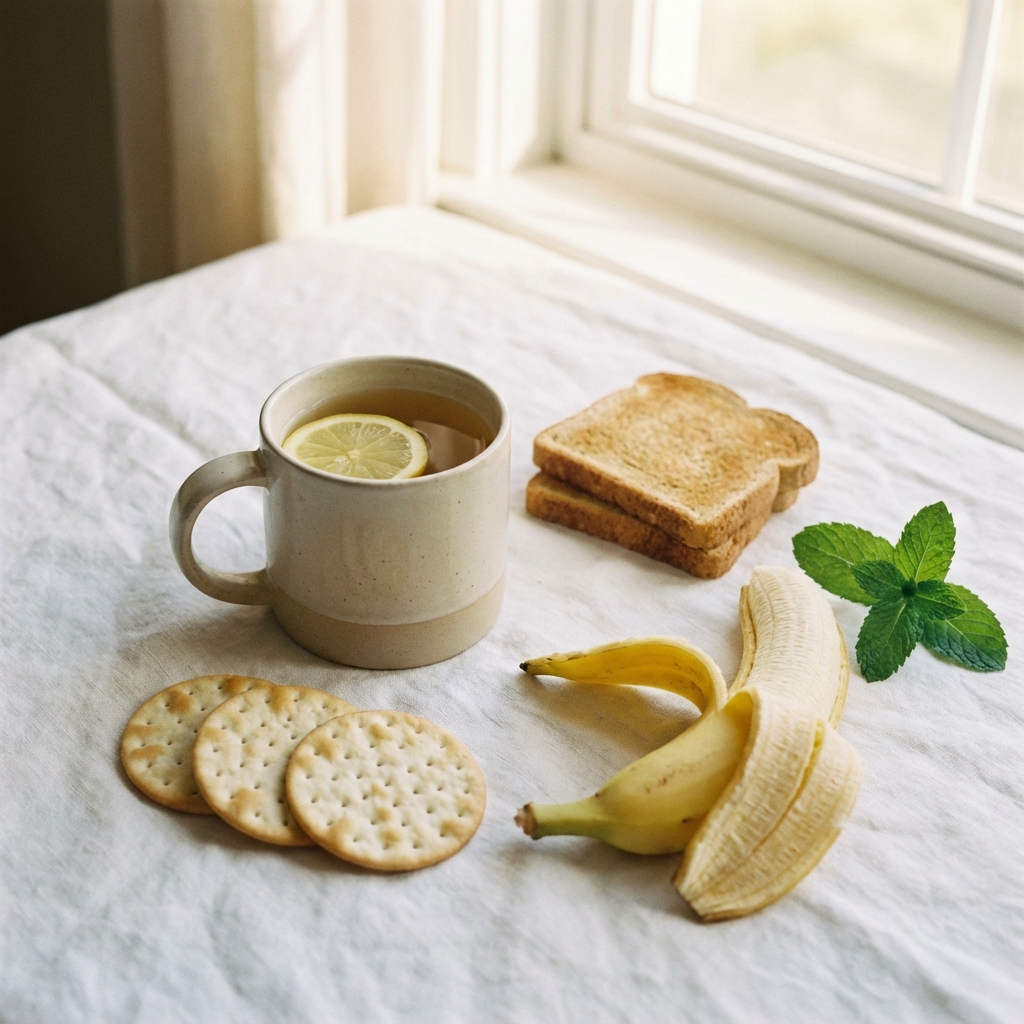
- Plain crackers or rice cakes
- Dry toast (white bread is easier to digest)
- Plain pasta or rice
- Pretzels
- Plain bagels or English muffins
The strategy: Eat a few crackers before you even get out of bed in the morning. Keep a stash on your nightstand.
Cold Foods
Cold foods often work better than hot foods during pregnancy nausea. Why? They produce less smell, and it's often the smell that triggers queasiness.
- Yoghurt
- Cold fruit (watermelon is particularly good)
- Cheese cubes
- Pre-made sandwiches from the fridge
- Smoothies
- Cold pasta salads
Citrus and Sour Foods
Many pregnant women find that sour or citrus flavours actually reduce nausea rather than making it worse.
- Lemon water (just a squeeze in cold water)
- Lemonade or lemon ice lollies
- Sour sweets or lemon drops
- Pickles (yes, the stereotype exists for a reason!)
- Green apples
Protein-Rich Snacks
Protein takes longer to digest, which means it keeps your blood sugar stable for longer. Stable blood sugar = less nausea.
- A handful of nuts
- Cheese sticks or cubes
- Hard-boiled eggs (make them in advance!)
- Peanut butter on toast or crackers
- Greek yoghurt
Peppermint
Like ginger, peppermint has natural anti-nausea properties.
- Peppermint tea (warm or iced)
- Peppermint sweets
- Sniffing peppermint essential oil
- Peppermint chewing gum
Watermelon and Water-Rich Fruits
Dehydration makes nausea worse, but drinking large amounts of water can also trigger queasiness. Water-rich fruits solve both problems.
- Watermelon (the absolute MVP)
- Cantaloupe
- Grapes
- Strawberries
- Oranges
Eating Strategies That Actually Help
✓ Key Strategies
- Eat Small, Eat Often: 6-8 mini meals instead of 3 large ones
- Keep Something Everywhere: Stash snacks in your bag, desk, car, coat pockets
- Separate Liquids and Solids: Drink between meals, not during
- Don't Force It: If vegetables make you gag, skip them for now
- Use What Works: If all you can stomach is plain pasta for three weeks, that's fine
Foods to Avoid When Nauseated
- Fatty or greasy foods - take longer to digest
- Spicy foods - can irritate an already sensitive stomach
- Strong-smelling foods - garlic, onions, fish, curries
- Very hot foods - steam carries more aroma
- Iron supplements on an empty stomach
When Nausea Becomes Something More
For most women, nausea improves significantly by weeks 12-16. If vomiting is severe, you might have hyperemesis gravidarum.
⚠️ Contact Your Doctor If:
- You can't keep any fluids down for 24+ hours
- Signs of dehydration (dark urine, dizziness)
- You've lost more than 5% of your pre-pregnancy weight
- Blood in your vomit
- You have a fever
Your First Trimester Nausea Toolkit
Keep these on hand:
- ✓ Crackers or oatcakes by your bed
- ✓ Ginger (tea, biscuits, or crystallised)
- ✓ Lemon drops or sour sweets
- ✓ Cold water with lemon
- ✓ Easy protein snacks (nuts, cheese)
- ✓ Watermelon or grapes
- ✓ Peppermint tea or mints
The Bottom Line
First trimester nausea is miserable, but it's temporary. Be gentle with yourself during this phase - whatever you can manage to eat is a win. And remember: this too shall pass.
Related Reading
See also: First Trimester Meal Plan, Iron in Pregnancy, and Folate vs Folic Acid.
Download PregnancyPlate to track what works for you and identify patterns in your symptoms.
Why These Foods Work: The Blood Sugar Explanation
Worth understanding, because it turns a list of foods into a strategy you can apply to whatever happens to be in your kitchen.
First trimester nausea is worst on an empty stomach, and worse again when blood sugar drops. That is precisely why the classic advice is crackers before you sit up: you have gone eight hours without food and your blood sugar is at its lowest point of the day.
So the underlying rule is never fully empty, never overly full. Something small every two to three hours beats three proper meals, and each of those small things works better with a little protein or fat attached, because that slows the glucose curve and prevents the crash that brings the nausea back. Crackers alone help for twenty minutes. Crackers with cheese help for two hours.
The Practical Kit to Keep in the House
Nausea planning works best when it requires no cooking and no decisions, because both are beyond you on the bad days.
- By the bed: plain crackers or oatcakes and a bottle of water, eaten before you sit up.
- In your bag: nuts, dried fruit, a cereal bar, boiled sweets or ginger chews.
- In the fridge: hard cheese, yogurt, hummus, cold cooked potatoes, watermelon.
- In the freezer: frozen grapes and ice lollies, often the only tolerable thing on the worst days and a way to get fluids in when drinking is hard.
- In the cupboard: ginger tea, plain crisps for the salt, instant mash or noodles for a bland hot meal with almost no smell.
When Nausea Is More Than Morning Sickness
Most first trimester nausea, however grim, is manageable at home. But there is a threshold worth knowing about.
Hyperemesis gravidarum is not simply bad morning sickness. It involves persistent vomiting, an inability to keep fluids down, weight loss of more than roughly 5% of your body weight, and signs of dehydration such as very dark urine or dizziness. It affects a small percentage of pregnancies and it needs medical treatment, often including anti-sickness medication that is both safe in pregnancy and genuinely effective.
If you cannot keep fluids down for a full day, contact your midwife or GP. Too many women endure this for weeks believing it is normal and that nothing can be done, and both of those beliefs are wrong.
Foods That Commonly Make It Worse
Just as useful as the list of what helps, and more individual, so treat these as suspects rather than rules.
Strong smells are the biggest single trigger, and often more than taste. Anything cooking, particularly frying onions, garlic, fish or coffee brewing, hits harder than the same food eaten cold. This is why cold meals frequently succeed where hot ones fail, and why asking someone else to cook and then eating in another room is a legitimate strategy rather than being precious.
Very fatty or fried food sits in the stomach longer, which prolongs the queasiness. Very sweet things on an empty stomach spike and crash blood sugar, so a biscuit alone often makes the next hour worse. And large volumes of liquid at once can trigger vomiting where the same amount sipped across an hour stays down comfortably.
Prenatal vitamins deserve a mention too, since the iron in them makes a lot of women nauseous. Taking yours at night, with food, rather than first thing on an empty stomach solves it for most people, and is worth trying before switching brands.
Clinical Sources & Research
Meet the Editorial Team
The researchers and experts behind PregnancyPlate.

Fiza Izra
Founder & Tech Researcher
A UK-based mother of 3 with a background in tech and data synthesis, Fiza brings real-world experience navigating hyperemesis gravidarum and postnatal depression. She engineers complex clinical guidelines (NHS, ACOG) into accessible tools, ensuring rigorous fact-checking with deep empathy.

Emma Davies
Senior Nutrition Editor
A mum and writer, Emma runs our food safety desk. She is the one who rings the restaurant to ask how long the lettuce sits out, checks every claim against CDC, FDA and NHS guidance, and rewrites the answer until it is usable at 9pm in a drive-thru queue.