Can I Eat Ice Cream from McDonald’s While Pregnant? (Machine Safety Explained)
Is the McDonald's soft-serve machine safe? We audit corporate heat-treatment cleaning cycles, listeria biofilm risks, and the safety difference between a cone and a McFlurry.
In this article
Editorial note: This article is researched from official public health and pregnancy food safety guidance, then edited by the PregnancyPlate team for clarity. It is not medical advice. If you are worried about symptoms or a specific exposure, contact your midwife, GP or healthcare provider.
The McDonald's Ice Cream Audit: For decades, the safety of soft-serve has been a top-tier pregnancy concern. In 2026, we deep-dive into the corporate sanitation protocols and the molecular listeria risks of the Golden Arches.
Scan Any Menu Item on PregnancyPlateYour next meal, a little less guesswork.
Scan your plate for pregnancy food-safety guidance and a nutrition breakdown. Keep your meals and nutrient progress in one place.
 Scan with your iPhone
to get the app
Few treats are as globally recognizable - or as debated during pregnancy - as the McDonald’s soft-serve cone. For an expectant mother in 2026, the craving for a cold, creamy vanilla swirl often comes with a side of "Listeria Anxiety." You’ve likely heard the warnings: "Avoid soft-serve machines because they aren't cleaned properly." While this advice is a cornerstone of traditional prenatal nutrition, a clinical audit of modern corporate standards reveals a more nuanced reality. This authoritative guide breaks down the sanitation science of McDonald’s ice cream machines, the risks of bacterial biofilms, and the glycemic impact of your favorite McFlurry. We examine the molecular pathways of listeria, the technical hardware of the Taylor HT machines, the historical context of soft-serve bans, and the global regulatory landscape of fast-food dairy.
The Machine Hygiene Audit: How McDonald’s Cleans
The primary concern with soft-serve ice cream isn't the dairy itself (which is pasteurized), but the machine that dispenses it. Soft-serve machines have complex internal parts - pipes, hoppers, and nozzles - where dairy residue can accumulate and form a Biofilm. A biofilm is a microscopic layer of bacteria that protects itself from standard cleaning agents. In 2026, McDonald’s utilizes two primary types of machines: manual-clean and heat-treatment (HT) units. Most modern McDonald’s locations use Taylor HT machines (like the C602 and C707 models). These units are programmed to undergo an automated "Heat-Kill" cycle every 24 hours. During this cycle, the internal temperature of the dairy mix is raised to approximately 151°F (66°C) and held there for at least 30 minutes. This process effectively pasteurizes the mix within the machine, killing pathogens like Listeria monocytogenes and Salmonella without requiring the machine to be disassembled. This automated process removes the variable of "human error" in daily cleaning. Furthermore, every 14 days, even the HT machines are fully disassembled, hand-cleaned, and sanitized by certified technicians. This dual-layer approach - daily heat treatment and bi-weekly deep cleaning - is designed to prevent the formation of the bacterial biofilms that can harbor pathogens over long periods.
Biofilm Resilience and Quorum Sensing: The Microbial Combat
In 2026, we understand that bacteria don't just "sit" in a machine; they actively communicate. Through a process called Quorum Sensing, bacteria like Listeria can detect the density of their population and trigger the production of a protective extracellular matrix. This matrix is what makes a biofilm so difficult to remove with standard rinsing. The Heat-Treatment cycle in McDonald's machines is specifically designed to disrupt these communication pathways by using thermal energy to destabilize the biofilm's physical structure. Without the 151°F heat cycle, a machine could harbor Listeria even if it looks visually "clean." This is why corporate fast-food machines are technically safer than those in smaller establishments that rely solely on manual brushing and cold-water sanitizers.
Molecular Listeria Pathways: Why the Risk Matters
To understand the safety of McDonald's ice cream, we must look at the bacteria itself. Listeria monocytogenes is a unique pathogen because it is an intracellular bacterium. It produces specialized proteins called Internalin A and B, which allow it to bind to the receptors on human cells, including those in the placenta. Once it crosses the placental barrier, it can multiply in the fetal environment, which has a less developed immune system. This is why the "zero-tolerance" policy for Listeria in dairy products is so strictly enforced by global health agencies in 2026. McDonald's HT technology specifically targets these molecular pathways by using thermal energy to denature the proteins the bacteria needs to survive. The heat doesn't just "kill" the bacteria; it renders its "keys" (the internalins) useless, preventing them from unlocking your cells.
Historical Data vs. 2026 Reality: Why the Ban Existed
The "Soft-Serve Ban" for pregnant women originated in the 1980s following several high-profile outbreaks linked to unpasteurized dairy and poorly maintained equipment. During that era, soft-serve machines required daily manual disassembly - a process that was often skipped or performed incorrectly by overworked staff. This led to a genuine clinical risk. However, in 2026, the technology has fundamentally shifted. The introduction of the automated Heat-Treatment cycle in corporate environments has reduced the incidence of machine-related Listeria in fast food to near-zero. When you see a "soft-serve warning" today, it is often a legacy piece of advice that hasn't been updated to reflect the pharmacological and technical reality of modern corporate sanitation.
The McFlurry vs. Vanilla Cone: A Safety Breakdown
Is there a difference in safety between the basic cone and a complex McFlurry? From a microbiological standpoint, the answer lies in the Cross-Contamination of the add-ins and the environment of the prep area.
- The Vanilla Cone: The safest option. The ice cream goes directly from the pasteurized internal chamber of the machine to the wafer cone. There is minimal human contact, and no external tools are introduced into the product. The cone itself is baked and carries virtually zero bacterial risk.
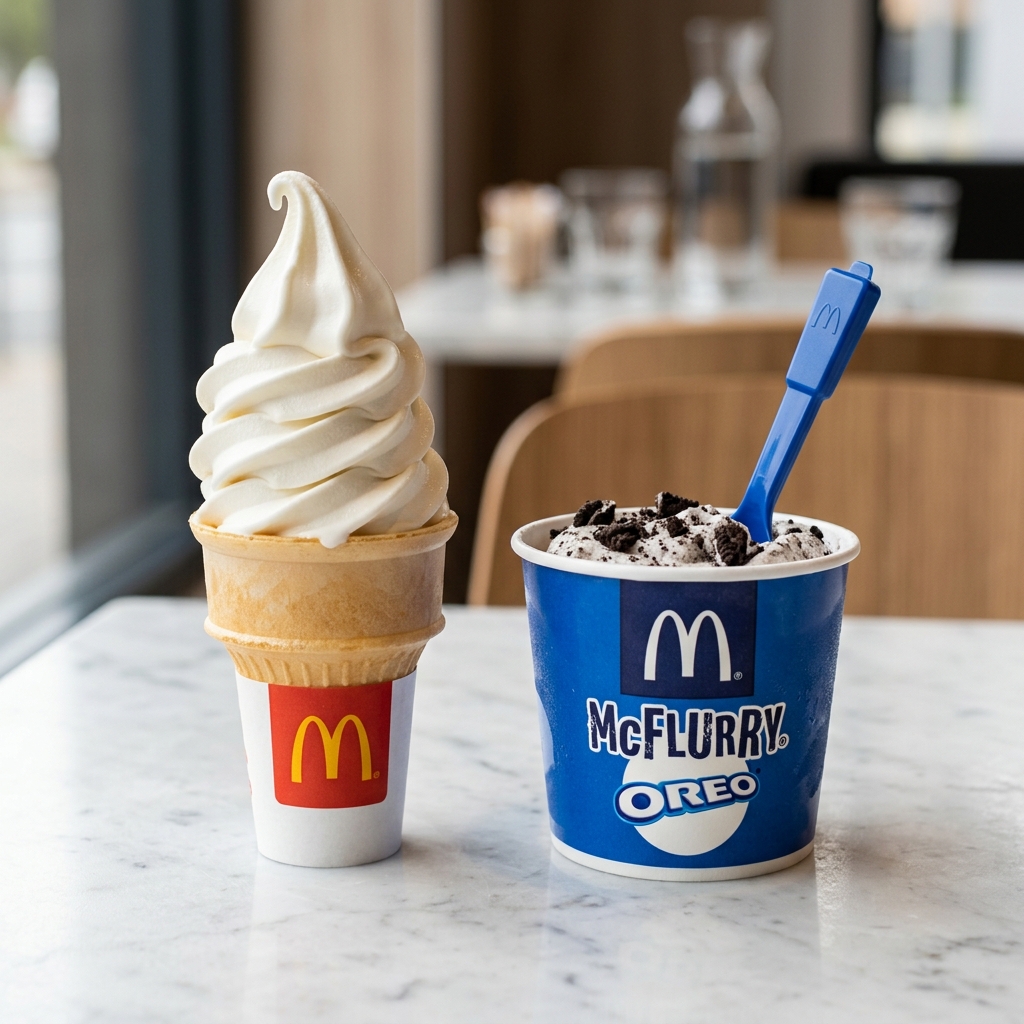
- The McFlurry: Slightly higher risk. The risk doesn't come from the ice cream, but from the toppings (Oreos, M&Ms) and the mixing process. If the McFlurry mixing station isn't cleaned between uses, or if the topping bins are exposed to environmental contaminants (like a nearby sink splash), the risk of pathogen exposure increases marginally. However, McDonald's uses a "single-use" hollow spoon design for mixing in most regions to mitigate this exact risk. The spoon acts as the mixing blade and is then given to the customer, ensuring no reuse of mixing equipment across different orders.
The Gut-Placenta Axis: Impact of Stabilizers
In 2026, we examine more than just pathogens; we look at the Maternal Microbiome. McDonald's soft-serve contains stabilizers like Carrageenan and Polysorbate 80. Recent clinical studies suggest that high consumption of these emulsifiers can impact the gut-placenta axis by altering the composition of maternal gut bacteria. While occasional treats are perfectly safe, a daily soft-serve habit could potentially contribute to low-grade systemic inflammation, which is a risk factor for gestational hypertension. Clinical Tip: View your McDonald's treat as a weekly celebratory event, not a daily hydration source.
Global Regulatory Landscape: US vs. UK vs. Australia
In 2026, fast-food dairy safety is governed by different standards depending on your location.
- In the USA (FDA): The FDA mandates strict "Hazard Analysis and Critical Control Point" (HACCP) plans for all soft-serve machines. McDonald's USA maintains digital logs of every HT cycle, which are auditable by health inspectors at any time.
- In the UK (FSA): The Food Standards Agency requires a "5-Star" hygiene rating system. Most McDonald's locations in the UK consistently achieve a 5-star rating, partly due to the automated nature of their dairy equipment.
- In Australia (FSANZ): Australian standards for soft-serve are among the strictest in the world, requiring frequent microbiological testing of the "draw" (the ice cream as it comes out of the machine).
Gestational Diabetes and the McFlurry Surge
Managing your blood sugar is a core clinical priority during the second and third trimesters. A standard Oreo McFlurry contains over 80g of sugar - more than the total daily recommended intake for a pregnant woman. This causes a massive Post-Prandial Spike in blood glucose. Chronic spikes are linked to fetal macrosomia (excessive birth weight) and an increased risk of the baby developing metabolic issues later in life. Recommendation: If you are craving a McFlurry, opt for the "Mini" size and pair it with a protein anchor, like a handful of almonds, to flatten the glucose curve. The protein and fat in the almonds help slow gastric emptying, leading to a more controlled insulin response.
Sanitization Chemistry: The 14-Day Teardown
During the bi-weekly deep clean, McDonald's technicians use specialized quaternary ammonium compounds (Quats) to sanitize the machine parts. In 2026, there is some maternal concern regarding "chemical residue." However, the protocols involve a multi-stage rinse with potable water after the sanitization step. The levels of Quats remaining in the machine are significantly below the safety threshold for human consumption and do not pose a risk to the fetus. The benefit of a sterile, pathogen-free machine far outweighs any infinitesimal trace of cleaning agents.
Summary: The McDonald's Ice Cream Safety Checklist
- Is it safe? Yes, the Heat-Treatment (HT) machines provide a high-end clinical safety barrier against Listeria.
- Safest Order: A small Vanilla Cone (minimal cross-contamination risk).
- The "Magic" Cycle: Machines are heat-sanitized to 151°F every 24 hours automatically.
- Corporate Advantage: Corporate-mandated HT technology is significantly safer than manual cleaning in small shops.
- The "High Volume" Rule: Choose busy locations; high turnover means fresher mix and more frequent machine cycles.
- Glycemic Tip: Stick to the cone or a mini McFlurry to avoid excessive sugar spikes.
- Visual Audit: If the restaurant area appears poorly maintained, trust your gut and skip the dairy.
In 2026, the "soft-serve ban" is largely a thing of the past for informed mothers. By understanding the technology behind the machines and choosing high-volume, well-maintained locations, you can satisfy your cold cravings with clinical confidence. Your pregnancy journey should include moments of joy, and a McDonald’s cone is a perfectly safe way to celebrate a hot afternoon. Stay informed, stay safe, and enjoy your treat with total peace of mind.
Don't Guess Your Safety Targets
Is that McFlurry topping safe? Are you hitting your calcium goals without spiking your sugar? Use the PregnancyPlate App to log your treats. Our AI safety engine audits thousands of restaurant items in real-time, providing you with a clinical "Green Light" so you can eat with total peace of mind. Stay safe, stay happy.
Meet the Editorial Team
The researchers and experts behind PregnancyPlate.

Fiza Izra
Founder & Tech Researcher
A UK-based mother of 3 with a background in tech and data synthesis, Fiza brings real-world experience navigating hyperemesis gravidarum and postnatal depression. She engineers complex clinical guidelines (NHS, ACOG) into accessible tools, ensuring rigorous fact-checking with deep empathy.

Emma Davies
Senior Nutrition Editor
A mum and writer, Emma runs our food safety desk. She is the one who rings the restaurant to ask how long the lettuce sits out, checks every claim against CDC, FDA and NHS guidance, and rewrites the answer until it is usable at 9pm in a drive-thru queue.
Make sense of every plate.
Scan your plate for pregnancy food-safety guidance and a nutrition breakdown. Keep your meals and nutrient progress in one place.
Scan with your iPhoneto get the app