Pregnancy Weight Gain Calculator: How Much Should You Gain, Week by Week?
Work out how much weight to gain in pregnancy from your pre-pregnancy BMI, see the typical range for your week, and check the ranges for twins, with guidelines from the IOM, CDC and ACOG.
In this article

Editorial note: This article is researched from official public health and pregnancy food safety guidance, then edited by the PregnancyPlate team for clarity. It is not medical advice. If you are worried about symptoms or a specific exposure, contact your midwife, GP or healthcare provider.
Your weight gain range, week by week
- Starting BMI24.1, healthy weight
- Typical range at week 207.5–12.5 lb
- Gained so far10 lb
You're within the typical range for week 20.
Ranges follow the Institute of Medicine 2009 guidelines used by the CDC and ACOG. An estimate, not medical advice.
How It Works: How much weight to gain in pregnancy depends on your BMI before you got pregnant. With a pre-pregnancy BMI in the healthy range, the recommended total is 25 to 35 pounds, most of it after the first trimester. Enter your height and weights in the calculator above to see your total range and where you should roughly be this week.
Your next meal, a little less guesswork.
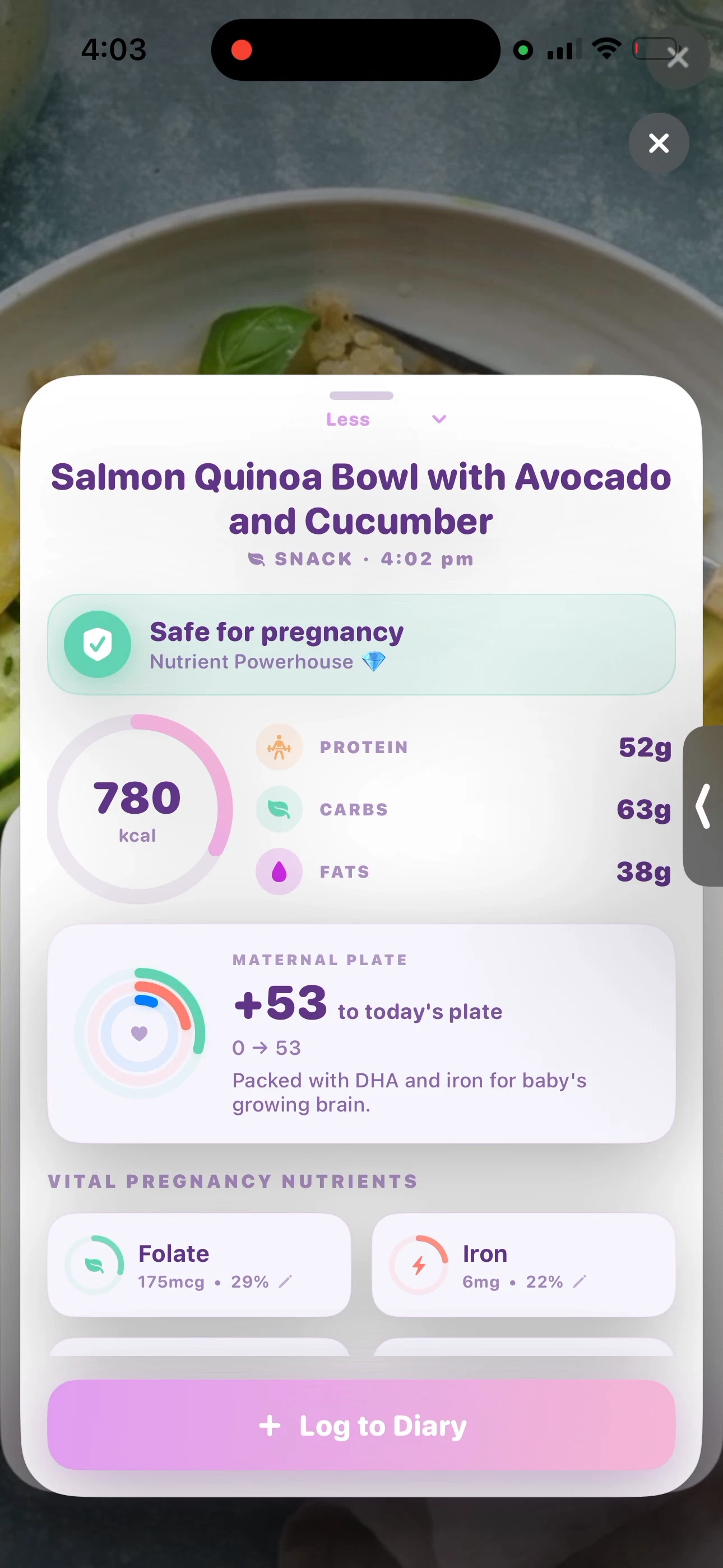
Scan your plate for pregnancy food-safety guidance and a nutrition breakdown. Keep your meals and nutrient progress in one place.
 Scan with your iPhone
to get the app
Weight gain is one of the most-checked numbers in pregnancy, and one of the most worried about. The guidelines used in the US come from the Institute of Medicine (now the National Academy of Medicine), published in 2009, and the CDC and ACOG both follow them. They're ranges, not targets, and they're based on one thing: your body mass index (BMI) before pregnancy.
The Recommended Ranges
| Pre-pregnancy BMI | Total gain | Per week, 2nd and 3rd trimesters |
|---|---|---|
| Under 18.5 (underweight) | 28 to 40 lb | About 1 to 1.3 lb |
| 18.5 to 24.9 (healthy weight) | 25 to 35 lb | About 0.8 to 1 lb |
| 25 to 29.9 (overweight) | 15 to 25 lb | About 0.5 to 0.7 lb |
| 30 or more (obesity) | 11 to 20 lb | About 0.4 to 0.6 lb |
In the first trimester, ACOG says you may gain only 1 to 5 pounds, or nothing at all, and some people lose a little because of nausea. Most of the gain happens from week 14 onward, which is why the calculator's range climbs slowly at first and faster later.
If You're Expecting Twins
The ranges for twins are higher. These are the figures the CDC lists:
- Underweight: 50 to 62 pounds
- Healthy weight: 37 to 54 pounds
- Overweight: 31 to 50 pounds
- Obesity: 25 to 42 pounds
The underweight twin range is the CDC's own figure, because the Institute of Medicine didn't set one. For triplets or more, there's no standard range, so your provider will set a goal with you. Tick the twins box in the calculator to see the twin range for your BMI.
Why the Range Matters
The CDC calls pregnancy weight gain important both for your pregnancy and for the long-term health of you and your baby. In the research behind the guidelines, gaining well above the range was linked to a larger baby, a higher chance of a cesarean birth and keeping extra weight after birth, while gaining well below it was linked to a baby born small or early. It's also very common to be outside the range: the CDC cites a study in which only about 1 in 3 women gained the recommended amount, 1 in 5 gained less and 1 in 2 gained more.
Those are risks across large groups of people, not predictions for you. A week or two outside the range is common and usually means nothing. What your provider looks at is the overall pattern across your appointments.
How to Read Your Result
- Within the range: keep doing what you're doing.
- A little under: very common in the first trimester and with nausea. If it continues into the second trimester, your provider may suggest adding a snack or two with protein.
- A little over: also common, and fluid retention can add several pounds quickly, especially late in pregnancy. Sudden swelling of the face or hands, or a rapid jump in weight, is worth a call to your provider, because it can be a sign of preeclampsia.
Whatever the number says, pregnancy is not the time to diet. If you're gaining faster than expected, the usual advice is to look at what you're eating rather than how much, swapping sugary drinks and snacks for foods with protein and fiber, and keeping active in ways your provider has okayed.
How Many Calories Is That?
Gaining within the range doesn't take much extra food. The extra energy pregnancy needs is roughly nothing in the first trimester, about 340 calories a day in the second and about 450 in the third. Our pregnancy calorie calculator works out your daily number, and our pregnancy macro calculator splits it into protein, carbs and fat.
If you'd like to see how your meals add up day to day, our guide to pregnancy nutrition apps explains what to look for in one built for pregnancy, rather than for weight loss.
A Note on BMI
BMI is a rough measure. It doesn't know how much of your weight is muscle, and it can sit awkwardly for very tall or very short people, or for different body types. The guidelines use it because it's simple and was the basis for the research, but your provider can take your whole history into account. If your result doesn't feel right for you, that's a good conversation to have at your next appointment.
Sources
This calculator gives general ranges from published guidelines. It isn't medical advice, and your provider may recommend a different target based on your health and history.
Meet the Editorial Team
The researchers and experts behind PregnancyPlate.

Fiza Izra
Founder & Tech Researcher
A UK-based mother of 3 with a background in tech and data synthesis, Fiza brings real-world experience navigating hyperemesis gravidarum and postnatal depression. She engineers complex clinical guidelines (NHS, ACOG) into accessible tools, ensuring rigorous fact-checking with deep empathy.

Emma Davies
Senior Nutrition Editor
A mum and writer, Emma runs our food safety desk. She is the one who rings the restaurant to ask how long the lettuce sits out, checks every claim against CDC, FDA and NHS guidance, and rewrites the answer until it is usable at 9pm in a drive-thru queue.
Make sense of every plate.
Scan your plate for pregnancy food-safety guidance and a nutrition breakdown. Keep your meals and nutrient progress in one place.
Scan with your iPhoneto get the app