Vitamin D and Pregnancy: How Much Do You Really Need in Winter?
The sunshine vitamin becomes even more critical when you're expecting - especially during the darker months. Your complete guide to vitamin D during pregnancy.
In this article
Editorial note: This article is researched from official public health and pregnancy food safety guidance, then edited by the PregnancyPlate team for clarity. It is not medical advice. If you are worried about symptoms or a specific exposure, contact your midwife, GP or healthcare provider.
Winter pregnancy brings unique nutritional challenges. As daylight hours shrink and you spend more time indoors, your body's ability to produce vitamin D plummets - right when your growing baby needs it most.
Vitamin D deficiency during pregnancy is alarmingly common, affecting up to 40-80% of pregnant women in some populations. Yet adequate vitamin D is essential for your baby's bone development, immune system, and possibly even their long-term health.
This guide covers everything you need to know: why vitamin D matters during pregnancy, how much you really need, the best sources, and whether you should supplement (spoiler: you probably should in winter).
What Is Vitamin D and Why Does It Matter?
Vitamin D is a fat-soluble vitamin that behaves more like a hormone in your body. Unlike most vitamins, you can actually produce vitamin D yourself - when ultraviolet B (UVB) rays from sunlight hit your skin.
What Does Vitamin D Do?
- Calcium absorption: Vitamin D helps your body absorb calcium from food - without it, calcium just passes through
- Bone health: Works with calcium to build and maintain strong bones
- Immune function: Regulates immune response and helps fight infections
- Cell growth: Influences how cells grow and differentiate
- Mood regulation: Low levels are linked to depression and seasonal affective disorder (SAD)
During pregnancy, these functions become especially important - you're building an entire skeleton and immune system from scratch.
Why Vitamin D Is Critical During Pregnancy
For Your Baby
Bone and Tooth Development: Your baby's skeleton begins forming in the first trimester and continues developing throughout pregnancy. Vitamin D ensures calcium is properly deposited into growing bones. Severe deficiency can lead to:
- Rickets (soft, weak bones) in infancy
- Delayed fontanelle closure
- Poor tooth enamel formation
- Reduced childhood bone density
Brain Development: Emerging research suggests vitamin D plays a role in brain development. Studies link low maternal vitamin D to lower childhood cognitive scores and increased risk of ADHD symptoms.
Immune System Programming: Vitamin D helps programme your baby's immune system while still in the womb. Adequate levels may reduce your child's risk of allergies and eczema, asthma, autoimmune conditions, and type 1 diabetes.
For You (Mum)
Preeclampsia Risk: Multiple studies link low vitamin D to increased preeclampsia risk - a serious pregnancy complication involving high blood pressure. Some research suggests adequate vitamin D may reduce this risk.
Gestational Diabetes: Vitamin D deficiency is associated with higher gestational diabetes risk. While supplementation hasn't been proven to prevent GD, maintaining adequate levels may help.
Mood and Mental Health: Vitamin D deficiency contributes to depression. Given the hormonal changes of pregnancy, maintaining adequate levels may support mental health during an already vulnerable time.
How Much Vitamin D Do You Need?
Official Recommendations
- UK NHS: 10 micrograms (400 IU) daily for all pregnant women
- US (IOM): 15 micrograms (600 IU) daily
- Endocrine Society: 37.5-50 micrograms (1,500-2,000 IU) for those at high risk
Are These Recommendations Enough?
Many researchers argue current recommendations are too conservative. Several pregnancy studies have used 4,000 IU (100mcg) daily without adverse effects, and some found benefits at higher levels.
The UK's recommendation of 400 IU is considered a minimum safe dose - enough to prevent severe deficiency but possibly not enough for optimal levels, especially in winter.
The Winter Problem: Why Deficiency Is So Common
How Your Body Makes Vitamin D
When UVB rays hit your bare skin, a cholesterol compound converts to vitamin D3. This is then processed by your liver and kidneys into the active form.
The problem? This only works when the sun is high enough in the sky (April-September in the UK), your skin is exposed without sunscreen, you're outside during peak sun hours (10am-3pm), and you don't have dark skin (melanin reduces vitamin D production).
Why Winter Is Challenging
In the UK and northern regions (above 37°N latitude), UVB rays are too weak from October to March to produce meaningful vitamin D. Even standing outside all day in winter won't boost your levels.
This means for roughly half the year, you must rely entirely on dietary sources and supplements.
Who's at Highest Risk of Deficiency?
- Those with darker skin - melanin blocks UVB rays
- Those who cover most of their skin - for religious or cultural reasons
- Those who spend little time outdoors - office workers, homeworkers
- Those living at high latitudes - UK, Northern Europe, Canada, northern US
- Those with obesity - vitamin D gets trapped in fat tissue
- Those with digestive conditions - affects absorption (Crohn's, coeliac)
Best Food Sources of Vitamin D
Let's be honest: it's very difficult to get enough vitamin D from food alone. Few foods naturally contain significant amounts, and those that do aren't eaten in large quantities.
Natural Sources
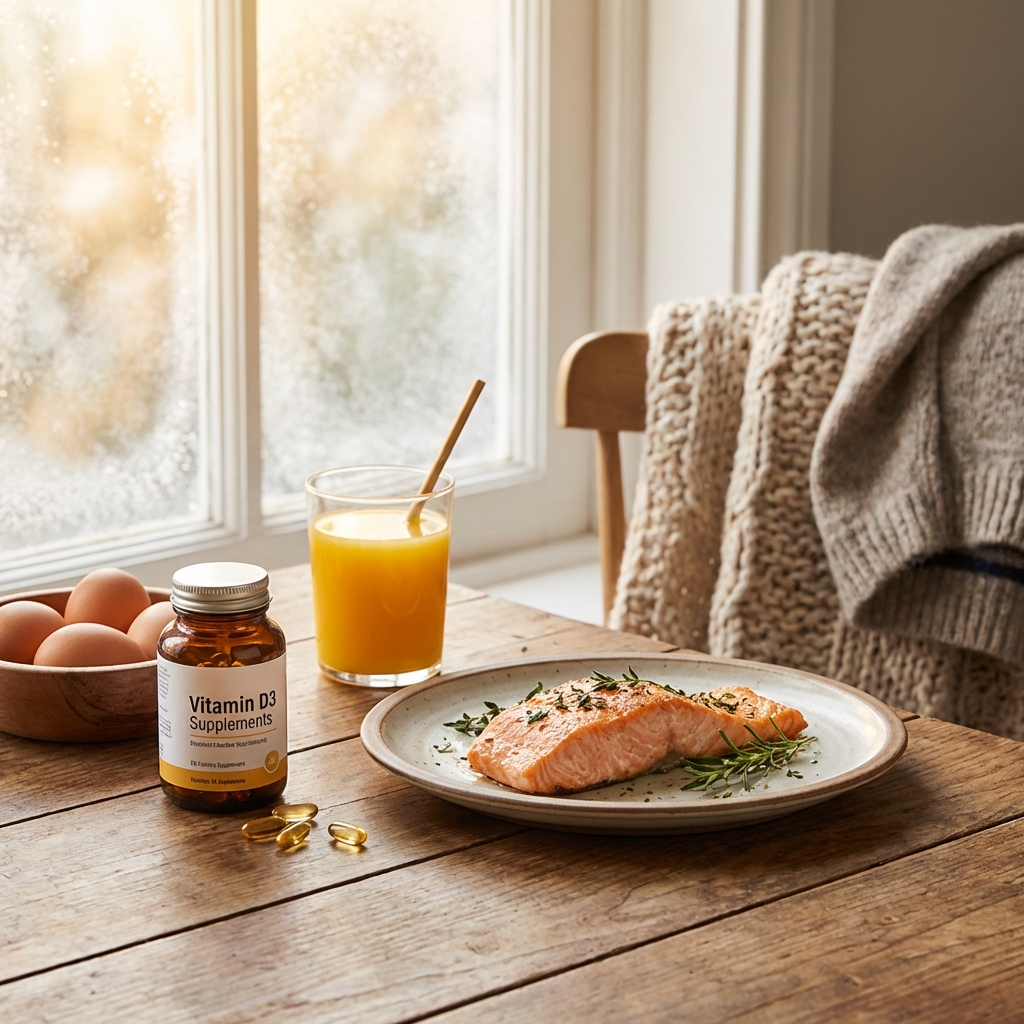
- Wild salmon (3.5 oz): 600-1000 IU
- Farmed salmon (3.5 oz): 100-250 IU
- Mackerel (3.5 oz): 350 IU
- Sardines (canned, 3.5 oz): 175 IU
- Herring (3.5 oz): 300 IU
- Egg yolk (1 large): 40 IU
- Cod liver oil (1 tsp): 450 IU
Note: Wild-caught fish contains significantly more vitamin D than farmed fish. Egg vitamin D content varies based on what the chickens were fed.
Fortified Foods
- Fortified milk: ~100 IU per cup
- Fortified plant milks: ~100 IU per cup (check label - varies)
- Fortified orange juice: ~100 IU per cup
- Fortified breakfast cereals: ~40-100 IU per serving
Should You Take a Vitamin D Supplement?
The Short Answer: Yes, Probably
The NHS recommends all pregnant and breastfeeding women take a daily supplement containing 10 micrograms (400 IU) of vitamin D - regardless of season.
Many healthcare providers now suggest higher doses, especially for those at risk of deficiency.
What to Look For in a Supplement
Form: Vitamin D3 (cholecalciferol) is more effective than D2 (ergocalciferol). Most supplements use D3.
Dose:
- Minimum: 400 IU (10mcg) - NHS recommendation
- Common pregnancy dose: 1,000-2,000 IU (25-50mcg)
- Higher therapeutic doses: 4,000 IU - only with medical guidance
Safe Sun Exposure During Pregnancy
While supplements are important, safe sun exposure can help boost vitamin D levels during warmer months.
Summer Strategy (April-September in UK)
- Aim for 15-20 minutes of sun exposure on face, arms, and legs
- Best time: 10am-3pm when UVB rays are strongest
- Don't burn - just get brief daily exposure
- Skip sunscreen for this short window (then apply if staying out longer)
Signs of Vitamin D Deficiency
Deficiency often causes no obvious symptoms, which is why it's called a "silent" deficiency. However, possible signs include:
- Fatigue and tiredness (though this overlaps with pregnancy generally)
- Bone pain or achiness
- Muscle weakness or cramps
- Low mood or depression
- Frequent infections
Frequently Asked Questions
Can you take too much vitamin D?
Yes. Vitamin D toxicity is rare but can occur with very high doses over time. Symptoms include nausea, vomiting, weakness, and kidney problems. Toxicity typically requires consuming over 10,000 IU daily for extended periods. Stay within recommended upper limits (4,000 IU/day) unless monitored by a doctor.
What if I'm already taking a prenatal vitamin with vitamin D?
Check the amount. If your prenatal contains 400-600 IU, you may want to add a separate supplement of 400-1,000 IU during winter, for a total of 1,000-2,000 IU daily. Avoid exceeding 4,000 IU total unless advised by your doctor.
Can I get vitamin D through a window?
No. Glass blocks UVB rays. You need direct skin exposure to sunlight - sitting by a sunny window doesn't count.
Should I take vitamin D with calcium?
You don't have to take them at the same moment, but you need adequate calcium alongside vitamin D. Vitamin D helps you absorb calcium - without sufficient calcium intake, the vitamin D can't do its job. Most prenatal vitamins contain both.
The Bottom Line
Vitamin D is essential for your baby's bone development, immune system, and brain function. During winter months, when sunlight can't trigger natural vitamin D production, supplements become non-negotiable.
Key takeaways:
- All pregnant women should take a vitamin D supplement - at least 400 IU (10mcg) daily per NHS guidelines
- Many experts recommend 1,000-2,000 IU daily, especially in winter and for those at higher risk
- Food alone is insufficient - even eating oily fish regularly won't meet your needs
- Get tested if you have risk factors or symptoms of deficiency
- Safe sun exposure (without burning) can help during April-September
- Vitamin D3 is more effective than D2
Don't let the winter vitamin D gap affect your pregnancy. A simple daily supplement can make all the difference.
Meet the Editorial Team
The researchers and experts behind PregnancyPlate.

Fiza Izra
Founder & Tech Researcher
A UK-based mother of 3 with a background in tech and data synthesis, Fiza brings real-world experience navigating hyperemesis gravidarum and postnatal depression. She engineers complex clinical guidelines (NHS, ACOG) into accessible tools, ensuring rigorous fact-checking with deep empathy.

Emma Davies
Senior Nutrition Editor
A mum and writer, Emma runs our food safety desk. She is the one who rings the restaurant to ask how long the lettuce sits out, checks every claim against CDC, FDA and NHS guidance, and rewrites the answer until it is usable at 9pm in a drive-thru queue.