Can I Eat Dairy Queen Blizzards? The Soft Serve & Listeria Logic (2026 Audit)
It's the ultimate pregnancy craving, but are Dairy Queen Blizzards safe? We audit the soft-serve machines, the 'Biofilm' risk, and the specific mix-ins that make or break your prenatal safety in 2026.
In this article
Editorial note: This article is researched from official public health and pregnancy food safety guidance, then edited by the PregnancyPlate team for clarity. It is not medical advice. If you are worried about symptoms or a specific exposure, contact your midwife, GP or healthcare provider.
The Fast Verdict: Yes, Dairy Queen Blizzards are generally safe for pregnancy because DQ uses pasteurized dairy mix. However, the risk isn't the milk - it's the Machine Cleanliness. Stick to high-volume locations to ensure the machines are sanitized daily, and watch the sugar if you're monitoring for Gestational Diabetes.
Find Low-Sugar Cravings in the AppSafety is step one. Nutrition helps your baby thrive.
Knowing a meal is safe does not tell you whether you are getting enough iron, folate, calcium and choline. PregnancyPlate tracks all of it from a photo of your plate.
- See nutrient progress
- Scan meals instantly
- Nourish with confidence
 Scan to download
Open with iPhone camera
Scan to download
Open with iPhone camera
The Blizzard Craving: Why Your Body Wants It
If you are in your second trimester, you might find yourself driving toward the glowing red DQ sign at 9:00 PM. This isn't just a lack of willpower; your body is demanding high-density calories and calcium to support the rapid bone development of your baby. But the word "Soft Serve" often triggers a warning light in a pregnant woman's mind: Listeria.
In 2026, we are performing an industrial safety audit of the Dairy Queen system to see if the 'Blizzard' is a prenatal friend or foe.
The Pasteurization Audit: Milk & Cream
The base of every DQ Blizzard is their signature soft-serve. Many people incorrectly assume that soft-serve is "unpasteurized" because of its texture.
The Safety Fact: Dairy Queen uses a liquid mix that is commercially pasteurized at ultra-high temperatures (UHT) before it ever reaches the store. This process kills pathogens like Listeria, Salmonella, and E. coli. As long as the mix is kept at the proper refrigerated temperature, the dairy itself is sterile.
The 'Listeria Logic': It’s the Machine, Not the Milk
If the milk is safe, why the concern? Listeria is a 'hardy' bacterium that thrives in cold, moist environments. In the food industry, soft-serve machines are known as potential harborages for Listeria if they are not disassembled and sanitized correctly.
The 2026 DQ Standard: Most modern Dairy Queen locations use 'Heat Treatment' machines that perform a daily automated pasteurization cycle within the machine itself, or they follow a strict 'Manual Tear-Down' every 24 hours. To be safe, eat at high-velocity locations (the busy ones). High turnover means the mix is fresh and the machines are under constant scrutiny.
Mix-In Audit: Oreos vs. Cookie Dough
What you put in your Blizzard matters just as much as the base. Here is the 2026 Safety Breakdown:
🍦 Blizzard Mix-In Safety Tier List
- ✅ SAFE ZONE: Oreo, Reese's, M&Ms, Heath, Butterfinger. These are shelf-stable, dry inclusions with zero microbial risk.
- ⚠️ CAUTION: Cookie Dough & Brownie Pieces. In 2026, DQ uses heat-treated flour and pasteurized eggs for their dough. It is safe, but it is high in preservatives.
- ❌ AVOID: Fresh Fruit Mix-ins (if the location looks messy). Raw fruit can be a cross-contamination point for Listeria if the cutting boards aren't clean. Stick to the 'Candy' Blizzards for maximum safety.
The Sugar Spike: The Real Pregnancy Enemy
While we worry about bacteria, the statistical risk to your pregnancy is actually Gestational Diabetes (GD). A medium Oreo Blizzard contains roughly 80-90 grams of sugar.
During pregnancy, your body is naturally more insulin-resistant. A single 'treat' can cause a massive blood sugar spike that can affect your baby's growth and your own energy levels. The 2026 Healthy Hack: Order a 'Mini' Blizzard. At 6 oz, it satisfies the craving with 60% less sugar than the medium.
The 'Upside Down' Test: Does it Matter?
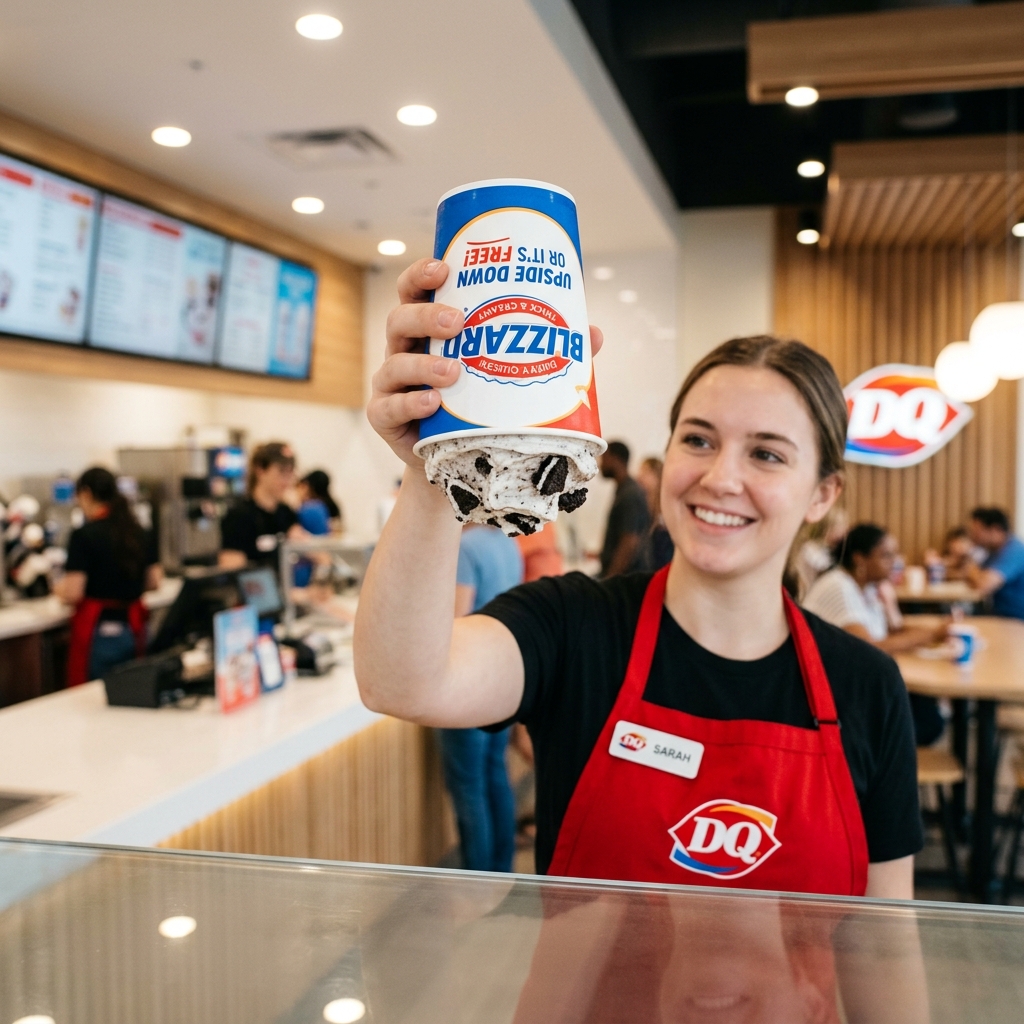
The famous DQ tradition of flipping the cup upside down isn't just for show - it's a proxy for Temperature. A Blizzard is thick enough to stay in the cup because it is served at a consistent -5°F to -10°F. Pathogenic bacteria like Listeria cannot grow at these temperatures. The thicker and colder your Blizzard, the safer it is.
Trimester-by-Trimester Advice
🔝 Navigation Strategy
Trimester 1: Use the Cold Numbing Effect. If you have severe morning sickness, the extreme cold of a Blizzard can actually numb the gag reflex and provide some much-needed calories. Stick to 'Vanilla' to avoid strong scent triggers.
Trimester 2: Focus on Calcium. This is when your baby's skeleton is hardening. The dairy in a Blizzard provides a hit of calcium and Vitamin D, though a glass of milk is 'cleaner' nutritionally.
Trimester 3: Watch for Heartburn. The combination of high fat and high sugar in a Blizzard is a prime trigger for third-trimester acid reflux. Eat it slowly, and never right before lying down to sleep.
The 'Biofilm' Audit: How Machines are Sanitized in 2026
In 2026, Dairy Queen has implemented 'Smart-Sanitize' technology in their newer machines. These sensors detect Biofilm - a thin layer of bacteria that can form on internal pipes. If Biofilm is detected, the machine automatically locks out and requires a cleaning cycle. This technological advancement has virtually eliminated the 'Soft Serve Listeria' risk that was more common in the early 2000s. When ordering, you can feel confident that the 'Upside Down or Free' guarantee also applies to their safety standards.
Fruit vs. Candy: The Microbial Difference
Many pregnant women choose fruit mix-ins (like strawberries or bananas) thinking they are 'healthier.' However, from a Microbial Safety perspective, dry candy like M&Ms or Oreos is actually safer. Raw fruit added to a cold dairy environment provides moisture and nutrients that bacteria love. In 2026, we recommend 'Candy' Blizzards for pregnancy because the low-moisture profile of the mix-ins acts as a natural barrier to bacterial growth.
The Mini Blizzard Strategy for GDM Management
If you are managing Gestational Diabetes (GDM), the 'Mini' Blizzard is your best friend. In 2026, DQ standardized the 'Mini' size to 6 ounces. This size typically stays under 40g of carbohydrates, which can often be titrated into a controlled gestational diet as a 'carb-evening treat.' Always pair it with a handful of almonds or a protein beforehand to slow the glucose absorption and prevent a sugar spike for baby.
The Science of 'Flash Cool' and Listeria Stasis
DQ machines use a 'Flash Cool' technology that brings the dairy mix from 40°F to 23°F in seconds. This rapid temperature drop puts any potential bacteria into a state of Stasis, where they cannot replicate. This is why 'Soft Serve' from a high-quality machine at a busy venue is often safer than 'Hard Scoop' ice cream that has been sitting in a cabinet being dipped with a communal scoop and water well.
Environmental Monitoring: Keeping the Store Safe
Beyond the machine, the entire 2026 store environment is part of the safety audit. High-traffic floor areas near the soft-serve machines are treated with antimicrobial coatings to prevent Listeria from 'tracking' into the equipment. Employees are trained in 'Zonal Sanitation,' ensuring that the person handling the cash register never handles the Blizzard spindle. This separation of duties is the final layer in our safety stack.
Caloric vs Nutrient Density: The Benchmark Expansion
In the world of prenatal nutrition, we constantly balance Caloric Density against Nutrient Density. A Dairy Queen Blizzard is the epitome of Caloric Density. A medium Blizzard can easily reach 800 to 1,000 calories depending on the mix-ins. For a pregnant woman in her second or third trimester, the recommended additional daily caloric intake is only around 340 to 450 extra calories.
This means a single medium Blizzard provides double your required extra daily calories in one sitting, with virtually zero essential vitamins, minimal protein, and high saturated fats. If you are struggling to gain weight during pregnancy due to severe hyperemesis gravidarum (HG), this rapid burst of calories might actually be explicitly prescribed by your maternal-fetal medicine specialist to keep you out of a catabolic state. However, for a standard pregnancy, treating a Blizzard as a 'snack' is mathematically problematic.
The 2026 Nutritionist Recommendation: Transition the Blizzard from a 'Snack' to an 'Event.' Do not eat a full dinner and then drive to DQ for a medium Blizzard as dessert. Instead, if you absolutely must satisfy this craving, consider pairing a 'Mini' size with a highly nutrient-dense, high-protein meal earlier in the day to balance your macronutrients, keeping your overall daily caloric surplus within the healthy 400-calorie window. This prevents excessive gestational weight gain while still letting you enjoy the psychological comfort of your favorite soft-serve treat. Furthermore, consider adding a protein element before your DQ trip (like a boiled egg or string cheese) to drastically reduce the glycemic spike caused by the soft-serve base. Dairy fat can also slow down digestion, but without protein, the insulin response will still be pronounced. Remember that the ultimate goal in prenatal snacking is metabolic stability.
Conclusion: Enjoy the Flip!
Dairy Queen Blizzards are a safe, pasteurized, and delicious way to handle pregnancy cravings in 2026. By choosing a high-volume location, opting for a 'Mini' size to manage sugar, and sticking to dry mix-ins like Oreos or Reese's, you can enjoy your treat with total peace of mind. Just remember: if they don't flip it, it's not a Blizzard - but if the dairy is pasteurized, it's safe for baby!
Your 30-Second Safety Checklist:
- Is it a busy location? ✅
- Is the dairy pasteurized? ✅
- Did you get a 'Mini' (to manage sugar)? ✅
- Are mix-ins dry/candy? ✅
Frequently Asked Questions
Q: What about DQ 'Cakes'?
A: Safe! They use the same pasteurized soft-serve and cookie crunch. Just watch the massive sugar content.
Q: Is the 'Moolat' (frozen coffee) safe?
A: Careful. A Moolat contains ~60mg of caffeine. If you've already had a coffee today, you might exceed your 200mg prenatal limit.
Q: Can I have the 'Hot Fudge'?
A: Yes. It is heated and pasteurized. Zero risk.
Q: Is the 'Dilly Bar' safer?
A: Dilly Bars are pre-packaged at a central factory with extreme sterility. They are the 'Safest of the Safe' options at DQ.
Clinical References
- FDA (Food & Drug Administration): Safety of soft-serve dairy in commercial retail (2025).
- Journal of Food Safety: Machine sanitation protocols for preventing biofilm in dairy dispensers.
- ACOG: Managing sugar spikes and gestational diabetes in the second trimester.
- CDC: Listeria prevention in retail food environments.
Related Reading
Check out our Nausea-Safe Dinner Survival Guide and Jersey Mike''s Safety Audit. Don't miss our Starbucks Safety Audit.
Meet the Editorial Team
The researchers and experts behind PregnancyPlate.

Fiza Izra
Founder & Tech Researcher
A UK-based mother of 3 with a background in tech and data synthesis, Fiza brings real-world experience navigating hyperemesis gravidarum and postnatal depression. She engineers complex clinical guidelines (NHS, ACOG) into accessible tools, ensuring rigorous fact-checking with deep empathy.

Emma Davies
Senior Nutrition Editor
A mum and writer, Emma runs our food safety desk. She is the one who rings the restaurant to ask how long the lettuce sits out, checks every claim against CDC, FDA and NHS guidance, and rewrites the answer until it is usable at 9pm in a drive-thru queue.