Can You Eat Runny Eggs While Pregnant? (Soft Yolks, Poached and Dippy Eggs)
Craving a dippy egg or eggs benedict? We break down exactly when runny yolks are safe during pregnancy, the massive difference between UK and US egg safety rules, and what to look for on the carton.
In this article

Editorial note: This article is researched from official public health and pregnancy food safety guidance, then edited by the PregnancyPlate team for clarity. It is not medical advice. If you are worried about symptoms or a specific exposure, contact your midwife, GP or healthcare provider.
Quick Answer: It totally depend on where you live. In the UK, if the eggs have the British Lion mark on the shell, they are 100% safe to eat runny or even raw while pregnant. In the US, runny eggs are only safe if you specifically buy pasteurised eggs. If your eggs don't meet these criteria, you gotta cook them until both the white and the yolk are completely solid.
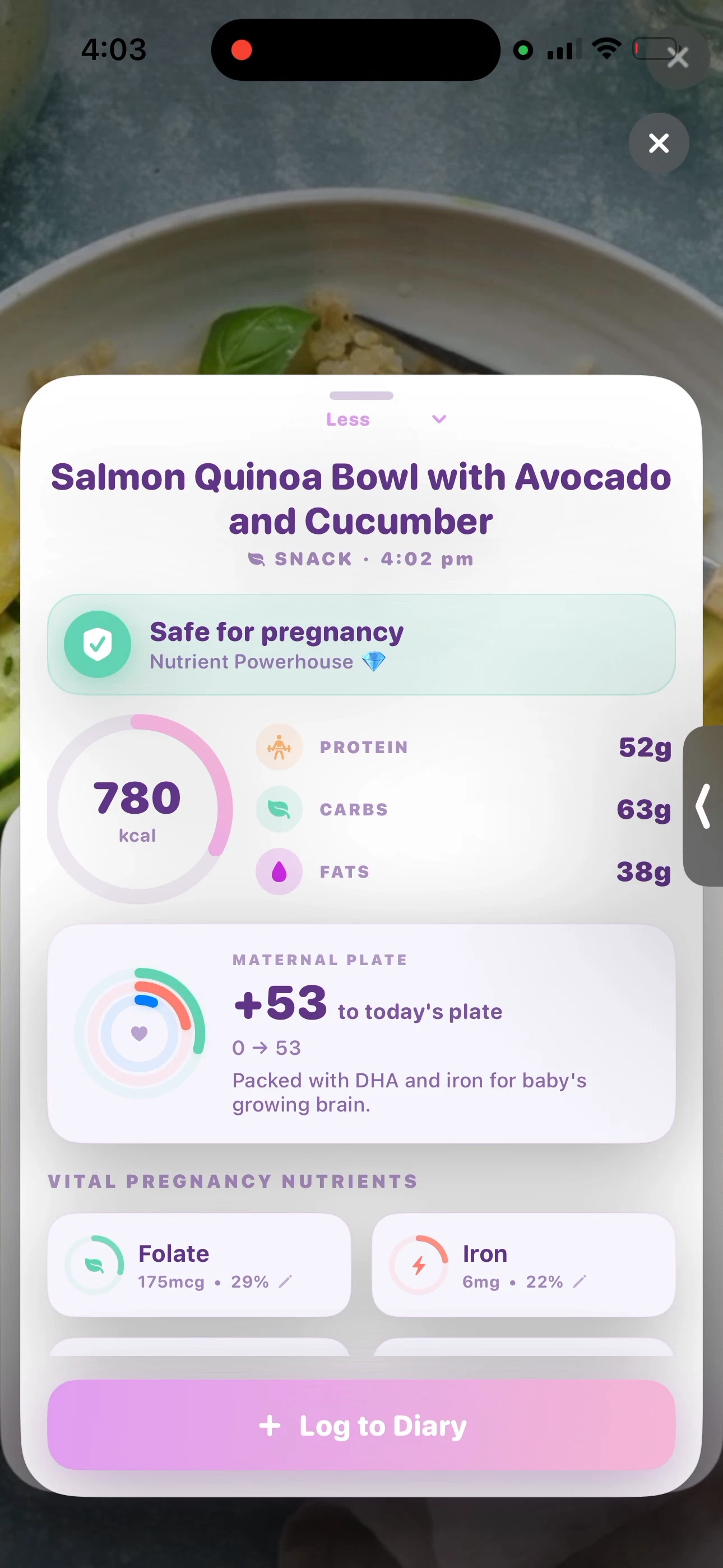
Check Your Breakfast Safety in the AppYour next meal, a little less guesswork.
Scan your plate for pregnancy food-safety guidance and a nutrition breakdown. Keep your meals and nutrient progress in one place.
 Scan with your iPhone
to get the app
I still remember sitting in a brunch cafe during my first tri. Nauseous as anything. The waiter comes over and I'm staring at a plate of poached eggs at the next table like it's the holy grail. I frantically googled "can you eat runny eggs when pregnant" under the table while he awkwardly waited for my order. I ended up panic-ordering dry toast.
For the longest time, the advice given to pregnant women about eggs was super strict. We were basically told to cook every single egg until it bounced. No poached eggs on toast. No soft boiled dippy eggs. Def no hollandaise sauce. It was a bleak time for brunch lovers.
But the rules have changed massively in recent years, especially if you're in the UK. The problem is there's so much outdated advice still floating around online. Plus the safety rules are literally completely different depending on which country you're in right now. So lets clear up the confusion properly.
The Real Risk With Runny Eggs
Lets start with why doctors have historically been so cautious. It basically comes down to one thing: Salmonella. It's a bacteria that causes nasty food poisoning. It can be found on the outside shell of the egg or sometimes inside if the hen was infected.
Getting Salmonella food poisoning while you're pregnant is a big deal. Pregnancy naturally suppresses your immune system so your body doesn't reject the baby. Which means you are way more susceptible to bugs than normal. If you get Salmonella, it can cause severe vomiting and diarrhoea. This leads to dehydration, which can potentially trigger premature labour or distress the baby. In super rare cases, it can cross the placenta.
Cooking an egg until both the white and the yolk are solid kills any Salmonella bacteria. That's why hard boiled or fully scrambled eggs are always universally safe, anywhere in the world. But what if you want a runny yolk? That's where things get interesting.
The UK Rules: The British Lion Mark
If you live in the UK, you have some of the best egg safety standards globally. Back in the late 90s, the UK introduced a massive vaccination programme for hens to eliminate Salmonella. It was incredibly successful.
Because of this, the NHS updated their official guidance a few years back. You can now safely eat raw or partially cooked eggs during pregnancy, as long as they carry the British Lion mark. It's a little red stamp printed directly onto the eggshell itself, not just the box.
So if you have British Lion eggs in the fridge, you can safely eat:
- Soft boiled "dippy" eggs with toast soldiers
- Poached eggs with runny yolks
- Fried eggs sunny side up
- Homemade mayo made with raw egg
- Traditional hollandaise sauce
Like 90 percent of eggs sold in UK supermarkets carry this mark. If you buy eggs from a local farm, or they just don't have the Lion mark, you gotta cook them until the yolk is completely solid.
The US Rules: Pasteurisation is Key
If you live in the United States, the situation is totally different. The US doesn't have the same hen vaccination programme as the UK. Because of this, the FDA states that pregnant women must avoid all raw or undercooked eggs.
In the US, the only way you can safely eat a runny egg during pregnancy is if you specifically buy pasteurised eggs. Pasteurisation is this process where the eggs are gently heated in their shells to a temp high enough to kill bacteria, but low enough that the egg doesn't actually cook.
Pasteurised eggs are safe to eat runny or even raw. But they can sometimes be tricky to find in standard grocery stores and they cost more. You have to look very carefully at the carton. It must explicitly state that the eggs inside are pasteurised. If it just says "organic" or "farm fresh", that is not the same thing. Those eggs must be cooked solid.
Eating Eggs Out at Restaurants and Cafes
Cooking at home is easy cuz you control the ingredients. Eating breakfast out requires a bit more navigation.
In the UK
Most large chain restaurants and cafes use British Lion eggs cuz its the industry standard. But you can't always guarantee this, especially at small indie cafes that might source fancy eggs from local farms. When ordering, just ask: "Are your eggs British Lion stamped?" If they aren't sure, ask for your eggs to be scrambled or fried well-done instead. Better safe than sorry.
In the US
You basically have to assume that restaurants are using standard, unpasteurised eggs unless stated otherwise. This means steering clear of poached eggs, sunny side up eggs, and over-easy eggs when dining out. Scrambled, over-hard, or baked eggs are your safe bets. For more on navigating fast food breakfasts, check out our guide to McDonald's breakfast safety.
What About Hollandaise Sauce and Mayonnaise?
This is where loads of pregnant women get caught out. Traditional hollandaise sauce (the stuff on eggs benedict) and traditional mayonnaise are both made using raw egg yolks.
If your making these at home in the UK using British Lion eggs, totally fine. If you're in the US making them with pasteurised eggs, also fine. But what about at restaurants or from a jar?
Store-bought mayonnaise in jars or squeezy bottles (like Hellmann's) is completely safe globally. It's made using commercially pasteurised eggs and has preservatives that stop bacterial growth. Same goes for most bottled salad dressings.
Restaurant hollandaise is way riskier. High-end spots often make their hollandaise fresh from scratch using raw yolks. Unless they can confirm they use pasteurised eggs (in the US) or Lion mark eggs (in the UK), you should definitely avoid it. Some chain restaurants use a pre-made commercial hollandaise mix which is usually safe, but always ask.
The Nutritional Power of Eggs
Despite the safety rules you have to navigate, eggs are genuinely one of the most incredible foods you can eat while growing a human. They are basically a prenatal multivitamin packaged in a shell.
Eggs are an amazing source of high-quality protein, which your body desperately needs to build fetal tissue and expand your blood volume. Our pregnancy protein guide explains just how much your requirements jump in the second and third tri. Eggs make hitting those targets so much easier.
But the real magic is the yolk. The yolk is where almost all the vital nutrients are stored. It's one of the best dietary sources of choline available. Choline is incredibly important for your baby's brain development. A single egg contains roughly 150mg of choline, which gets you a good way towards your daily pregnancy target of 450mg.
Egg yolks also provide vitamin D, iron, and iodine. So whatever you do, don't skip the yolks just to be safe. Eat the whole egg, just prep it according to the safety rules for your country.
Trimester by Trimester Advice
- First Trimester: Eggs can be a lifesaver or a total nightmare rn. Some women find the smell of cooking eggs completely repulsive. If that's you, don't force it. If you can stomach them, cold hard-boiled eggs are often easier to manage cuz they smell less. Great high-protein snack to keep blood sugar stable.
- Second Trimester: As your appetite comes back, this is a great time to lean heavily on eggs for protein. Breakfasts like a spinach omelette or scrambled eggs on wholemeal toast are perfect. If you have safe access to runny eggs, a dippy egg with sourdough soldiers is elite comfort food.
- Third Trimester: Your stomach space is super limited cuz the baby is taking up all the room. Eggs are nutrient-dense, meaning they give you a lot of nutrition without taking up a huge amount of physical space. They digest relatively easily too. Check out our pregnancy snack guide for more ideas.
FAQs About Eggs During Pregnancy
Can I eat soft boiled eggs while pregnant?
In the UK, yes absolutely, as long as they carry the British Lion mark on the shell. In the US, no, unless you specifically bought eggs labelled as pasteurised.
Are runny fried eggs safe?
The exact same rules apply. Lion mark or pasteurised are safe to eat runny. Any other eggs must be fried until the yolk is cooked solid.
Is store-bought mayonnaise safe?
Yes. Commercial mayonnaise sold on supermarket shelves is made using pasteurised eggs. Completely safe during pregnancy. It's only fresh homemade or restaurant mayo you need to watch out for.
Can I eat raw cookie dough?
This is actually a double risk. It's not just the raw eggs you have to worry about, it's also the raw flour, which can carry E. coli. Even if you use safe eggs, you shouldn't eat raw cookie dough unless the flour has been heat-treated first. Commercial "edible cookie dough" is usually safe as they use pasteurised eggs and heat-treated flour.
What if I accidentally ate a runny egg that wasn't safe?
Try not to panic. The actual statistical risk of getting Salmonella from a single egg is still really low. Just monitor how you feel. Symptoms usually start within 12 to 72 hours and include stomach cramps, diarrhoea, fever, and vomiting. If you get any of these, call your doctor or midwife immediately.
The Bottom Line
You absolutely don't have to give up eggs during pregnancy. Depending on where you live, you might not even have to give up runny yolks. They are a nutritional powerhouse for your baby.
The Golden Rules:
✓ UK residents: Look for the British Lion mark. If it's there, eat them however you want.
✓ US residents: Look for the word "pasteurised". If it's there, eat them however you want.
✓ If you don't have either of those, just cook the egg until the yolk is totally solid.
✓ Always ask at restaurants how their hollandaise is made.
✓ Keep enjoying store-bought mayo.
Breakfast doesn't have to be boring. Just shop smart and keep the yolk rules in mind.
Scan Menus and Grocery Labels Instantly
Can't remember the rules while staring at a brunch menu? The PregnancyPlate App lets you scan any restaurant menu or food label to instantly check if it's safe for your current trimester based on global health guidelines. Takes the guesswork completely out of eating.
Sources
- National Health Service (NHS), Foods to Avoid in Pregnancy: Eggs (2024).
- You.S. Food and Drug Administration (FDA), Food Safety for Pregnant Women: Eggs (2023).
- Centers for Disease Control and Prevention (CDC), Salmonella and Eggs (2023).
- American College of Obstetricians and Gynecologists (ACOG), Nutrition During Pregnancy (2024).
Meet the Editorial Team
The researchers and experts behind PregnancyPlate.

Fiza Izra
Founder & Tech Researcher
A UK-based mother of 3 with a background in tech and data synthesis, Fiza brings real-world experience navigating hyperemesis gravidarum and postnatal depression. She engineers complex clinical guidelines (NHS, ACOG) into accessible tools, ensuring rigorous fact-checking with deep empathy.

Emma Davies
Senior Nutrition Editor
A mum and writer, Emma runs our food safety desk. She is the one who rings the restaurant to ask how long the lettuce sits out, checks every claim against CDC, FDA and NHS guidance, and rewrites the answer until it is usable at 9pm in a drive-thru queue.
Make sense of every plate.
Scan your plate for pregnancy food-safety guidance and a nutrition breakdown. Keep your meals and nutrient progress in one place.
Scan with your iPhoneto get the app