Pregnancy Macro Ratios: Exactly How Many Carbs, Fats, and Proteins You Need per Trimester
Tracking total calories is a flawed strategy during pregnancy. Discover the exact, shifting macronutrient ratios clinical dietitians use to optimize fetal growth and prevent gestational diabetes from the first through the third trimester.
In this article

Editorial note: This article is researched from official public health and pregnancy food safety guidance, then edited by the PregnancyPlate team for clarity. It is not medical advice. If you are worried about symptoms or a specific exposure, contact your midwife, GP or healthcare provider.
The Fast Answer: Most generic pregnancy advice focuses entirely on calories, but tracking total calories is arguably the least important metric for fetal development. A 2,000-calorie diet composed mostly of simple carbohydrates will trigger violent nausea and insulin resistance, while a 2,000-calorie diet properly balanced with amino acids and essential fatty acids will stabilize your hormones. But those ideal macro ratios actually completely shift between your first, second, and third trimesters as your baby develops. Scroll down to see the exact, clinical macro percentages you need to hit for each specific phase of your pregnancy.
Track Your Trimester Macros with PregnancyPlate ProYour next meal, a little less guesswork.
Scan your plate for pregnancy food-safety guidance and a nutrition breakdown. Keep your meals and nutrient progress in one place.
 Scan with your iPhone
to get the app
When you find out you are pregnant, everyone suddenly has dietary advice for you. The most common refrain is that you are now "eating for two." When you turn to the internet for clarification, you are bombarded with conflicting advice about caloric surpluses, weight gain trackers, and restrictive diets.
Here is the clinical truth: obsessing over total calories is a fundamentally flawed strategy during pregnancy. Calories are just a measurement of energy. They tell you absolutely nothing about the actual nourishment your baby is receiving.
If you eat 2,000 calories of saltines and pasta, you will hit your energy requirement, but you will completely deprive your baby of the amino acids required to build muscle tissue and the DHA required to build their brain. Furthermore, that heavy carbohydrate load will send your blood sugar on a violent rollercoaster, exacerbating your morning sickness and increasing your risk of Gestational Diabetes.
The secret to an optimal pregnancy diet is not calorie counting. It is Macronutrient Balancing. You must track the exact ratio of Carbohydrates, Proteins, and Fats you are consuming. But there is a massive catch that traditional fitness apps completely miss: your ideal macro ratio fundamentally shifts depending on which trimester you are in.
We are going to break down the exact, clinical macronutrient percentages you need to hit for the first, second, and third trimesters, heavily sourced from the Institute of Medicine (IOM) and functional prenatal dietitians.
The Great Macro Shift: Why Your Ratios Change
Before we dive into the numbers, you need to understand why a static diet plan fails during pregnancy. Your baby is not just growing larger; they are going through distinct phases of physiological development.
During the first trimester, the primary goal is cellular division and the formation of the neural tube. Your body is working so hard to build the placenta that you experience crushing fatigue and nausea. During this phase, you need quick, easily digestible energy.
By the third trimester, the placenta is fully formed, and the focus shifts entirely to rapid weight gain, bone calcification, and massive neurological development. The brain is made of nearly 60% fat. Therefore, a diet that worked perfectly in the first trimester will leave you completely depleted in the third.
First Trimester Macros: The Survival Phase
Clinical Ratio Target: 55% Carbohydrates | 25% Fat | 20% Protein
The first trimester is notoriously difficult. Surging levels of hCG (human chorionic gonadotropin) and progesterone completely hijack your digestive system. Your stomach emptying slows down, your sense of smell heightens, and severe food aversions set in.
During this phase, you do not need extra calories (the clinical recommendation is a 0-calorie surplus for the first 12 weeks), but you do need to completely alter your macro ratios.
Because protein (meat) and heavy fats are difficult to digest and highly odorous, they are the primary triggers for nausea. Your body instinctively craves carbohydrates because they are bland, odorless, and provide instant energy to combat first-trimester fatigue.
However, you cannot just eat simple carbs like white bread and crackers. Simple carbs digest instantly, spike your blood sugar, and lead to a massive crash two hours later. That crash triggers an intense wave of nausea. To survive the first trimester, you must focus on Complex Carbohydrates (like oats, sweet potatoes, and whole grains) paired with whatever mild proteins you can tolerate (like Greek yogurt or collagen peptides).
The Execution: Do not panic if you cannot hit massive protein goals right now. Focus on keeping your blood sugar stable by eating small, complex-carb-heavy meals every two hours. A perfect first-trimester meal is a bowl of oatmeal (complex carb) mixed with a scoop of unflavored protein powder and a handful of chia seeds (fat).
Second Trimester Macros: The Growth Phase
Clinical Ratio Target: 45% Carbohydrates | 30% Fat | 25% Protein
Welcome to the "honeymoon phase" of pregnancy. The placenta has taken over hormone production, your nausea has likely subsided, and your energy is returning. But under the surface, a critical metabolic shift is occurring: you are becoming naturally insulin resistant.
Your body deliberately induces a state of mild insulin resistance to ensure that glucose stays in your bloodstream longer, allowing it to cross the placenta and feed your growing baby. Because of this, you can no longer tolerate the high-carbohydrate diet of the first trimester.
If you continue to eat a 55% carbohydrate diet during the second trimester, your blood sugar will spike dangerously high, placing severe stress on your pancreas and drastically increasing your risk of developing Gestational Diabetes (GD).
This is the trimester where you must aggressively pull down your carbohydrate intake and replace those calories with high-quality proteins and healthy fats. As we discussed in our 100-Gram Protein Challenge, clinical functional dietitians recommend aiming for 80g to 100g+ of protein per day during this phase to support massive tissue expansion.
The Execution: Every single time you eat a carbohydrate, it must be "clothed" in a fat or a protein. Never eat an apple alone; eat it with two tablespoons of almond butter. Never eat a bowl of pasta alone; switch to chickpea pasta and add a heavy serving of meat sauce or cottage cheese. This is the trimester where macro tracking becomes absolutely essential for blood sugar management.
Third Trimester Macros: The Brain & Bone Phase
Clinical Ratio Target: 40% Carbohydrates | 35% Fat | 25% Protein
In the final stretch of pregnancy, your baby is gaining roughly half a pound per week. Their skeletal structure is rapidly calcifying, and their brain is expanding at an astonishing rate. To support this, your macro ratios must shift into their final, most fat-heavy configuration.
There is also a physical constraint to consider: your uterus has grown so large that it is completely crushing your stomach and intestines. You can no longer eat large, voluminous meals without suffering from severe acid reflux and heartburn.
Because you cannot eat large volumes of food, you must focus on extreme caloric density. Fat contains 9 calories per gram (compared to 4 calories per gram for carbs and protein). By shifting your macros to a 35% fat ratio, you can consume the energy your baby needs in much smaller, highly concentrated portions.
Furthermore, the specific type of fat you consume is critical. Your baby's developing brain requires massive amounts of DHA (an Omega-3 fatty acid). If you do not consume enough dietary DHA, your baby will literally pull it directly from your own brain tissue, which is clinically linked to "pregnancy brain" (brain fog) and postpartum depression.
The Execution: Aggressively incorporate healthy, high-density fats into every meal. Drizzle olive oil over your salads. Eat half an avocado with your breakfast. Incorporate low-mercury, high-DHA seafood (like wild-caught salmon or sardines) into your weekly rotation. Carbohydrates should be minimized to make room for these essential fats and to continue managing your insulin resistance.
The Calorie App Trap: Why Generic Trackers Fail in Pregnancy
If you are serious about managing your pregnancy health, you realize that trying to calculate these shifting percentages on a notepad is impossible. You need a digital tracker.
This is where millions of women make a critical mistake: they download a generic calorie-counting app. Those apps are engineered for weight loss and bodybuilding. They do not know what trimester you are in, and they certainly do not dynamically adjust your macro targets based on fetal development milestones. If you use a generic app, you will be following a static, inappropriate diet plan that triggers anxiety and completely ignores your baby's shifting needs.
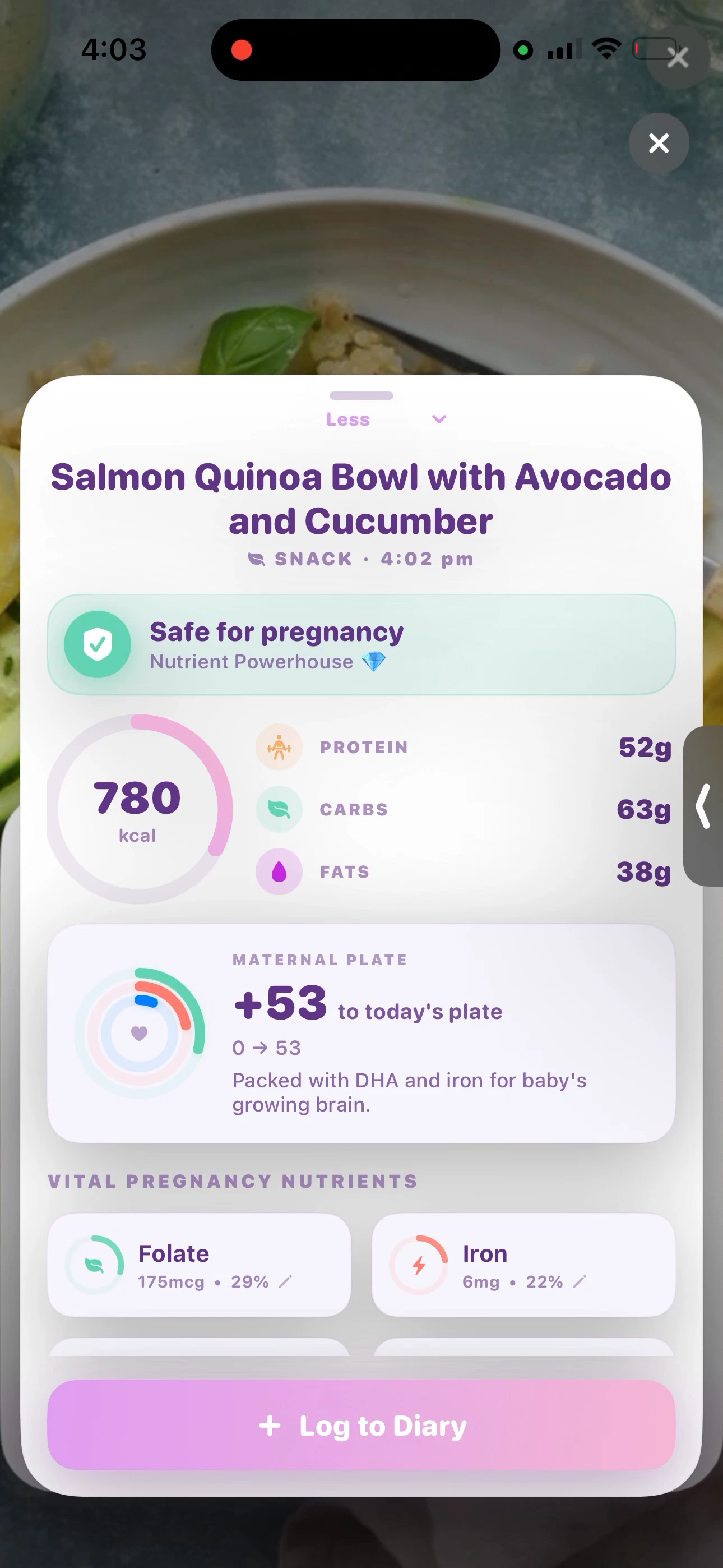
This is exactly why the PregnancyPlate Pro App is the ultimate tool for expecting mothers. It is the only macro tracker built from the ground up for prenatal clinical nutrition.
When you log into PregnancyPlate, you input your exact week of pregnancy. The AI automatically shifts your daily carbohydrate, protein, and fat targets to match the specific trimester phase you are in. It warns you if your breakfast is too high-glycemic for your second trimester, and it reminds you to increase your healthy fats in your third trimester.
Stop guessing with your nutrition. Ditch the calorie-obsessed fitness trackers, and start tracking the macros that actually build a healthy baby.
Ratios are only half the picture without a total to apply them to, and our pregnancy calorie calculator covers that side. For tracking any of it without doing sums by hand, see our guide to choosing a pregnancy nutrition app.
Clinical Sources & Research
- Institute of Medicine (IOM), Dietary Reference Intakes for Macronutrients.
- American College of Obstetricians and Gynecologists (ACOG), Nutrition During Pregnancy: Macronutrient Guidelines.
- National Institutes of Health (NIH), Macronutrient Intake and Pregnancy Outcomes.
Meet the Editorial Team
The researchers and experts behind PregnancyPlate.

Fiza Izra
Founder & Tech Researcher
A UK-based mother of 3 with a background in tech and data synthesis, Fiza brings real-world experience navigating hyperemesis gravidarum and postnatal depression. She engineers complex clinical guidelines (NHS, ACOG) into accessible tools, ensuring rigorous fact-checking with deep empathy.

Emma Davies
Senior Nutrition Editor
A mum and writer, Emma runs our food safety desk. She is the one who rings the restaurant to ask how long the lettuce sits out, checks every claim against CDC, FDA and NHS guidance, and rewrites the answer until it is usable at 9pm in a drive-thru queue.
Make sense of every plate.
Scan your plate for pregnancy food-safety guidance and a nutrition breakdown. Keep your meals and nutrient progress in one place.
Scan with your iPhoneto get the app