Should You Track Calories During Pregnancy? A Guide to Healthy Weight Gain Apps
Is calorie counting safe while pregnant? Discover the clinical shift from 'restriction' to 'nourishment', the target gain ranges for your BMI, and why generic fitness apps are dangerous for moms-to-be.
In this article
Editorial note: This article is researched from official public health and pregnancy food safety guidance, then edited by the PregnancyPlate team for clarity. It is not medical advice. If you are worried about symptoms or a specific exposure, contact your midwife, GP or healthcare provider.
The Nutritional Shift: In standard health apps, "success" is often defined by a calorie deficit. In pregnancy, success is defined by Nutrient Adequacy and Controlled Growth. Tracking should never be about eating less; it should be about knowing you've given your baby enough.
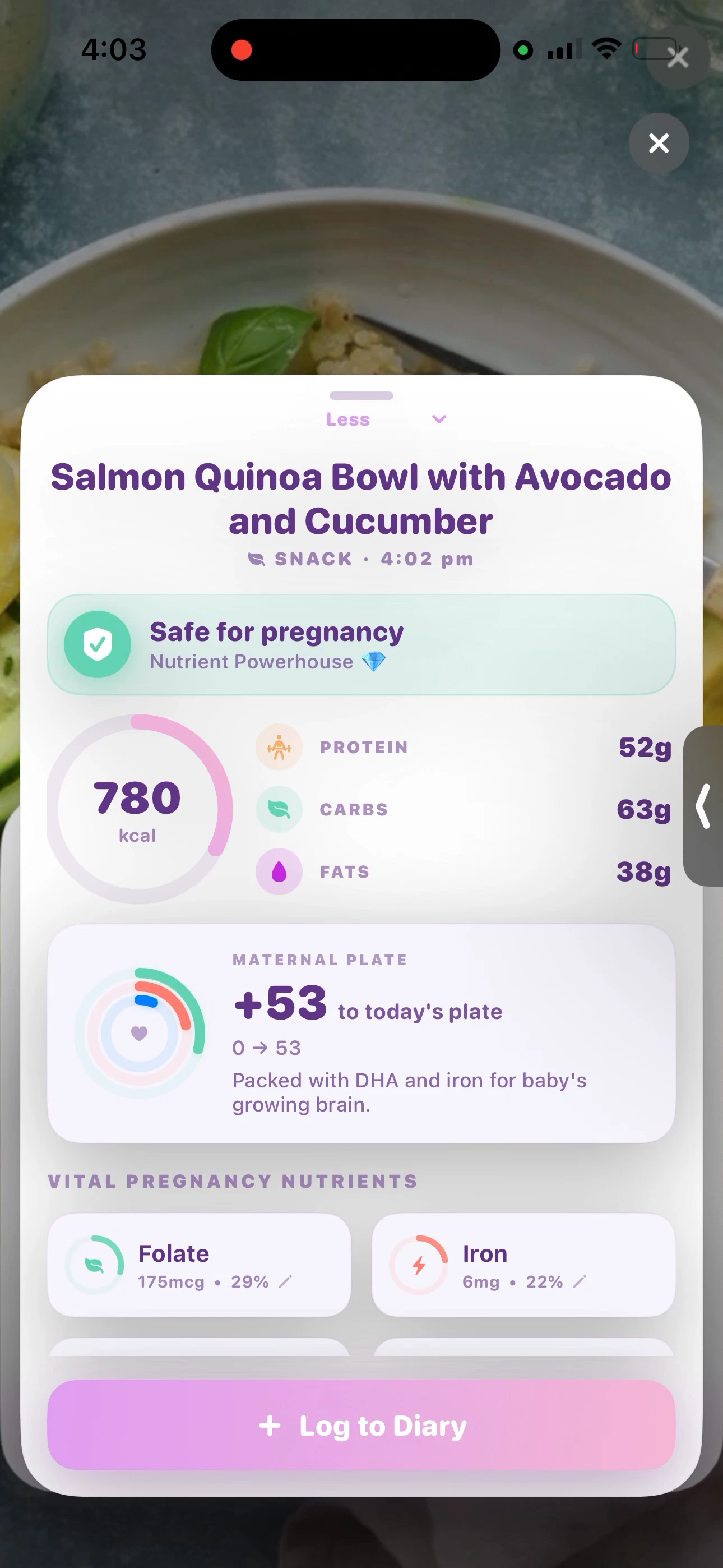
Track Your Pregnancy Growth on PregnancyPlateYour next meal, a little less guesswork.
Scan your plate for pregnancy food-safety guidance and a nutrition breakdown. Keep your meals and nutrient progress in one place.
 Scan with your iPhone
to get the app
Pregnancy is one of the only times in a woman's biological life when gaining significant weight is not just expected, but medically mandatory. However, for many mothers who have spent years navigating a culture of calorie restriction and "snap-back" fitness goals, the clinical instruction to "just gain weight" can be incredibly anxiety-inducing. Simultaneously, the counter-advice - the old adage to "eat for two" - is equally dangerous, often leading to excessive weight gain that increases the risk of maternal gestational diabetes, preeclampsia, and high-birth-weight complications that can lead to surgical intervention.
This leads to a central, often controversial question in 2026: Should you actually track your calories while pregnant? For some, tracking provides a sense of safety and ensures their baby is getting enough Choline, Iron, and DHA. For others, it can trigger obsessive behaviors and a preoccupation with numbers that detracts from the emotional joy of pregnancy. In this authoritative audit, we explore the biology of pregnancy weight gain, why standard fitness apps are mathematically dangerous for expectant mothers, and how to use data-driven nourishment to support a healthy birth without the psychological baggage.
The Trimester-Specific Reality: Metabolic Staging
In 2026, clinical guidelines define weight gain as a non-linear process. Your body’s metabolic demands change drastically across the 40 weeks, and "tracking" should reflect these specific stages rather than a static daily limit.
- First Trimester (0–13 Weeks): Metabolic Preparation. You actually need zero extra calories during these weeks. Your baby is the size of a bean; their energy requirements are minimal. However, you need a massive surge in micronutrients like Folate and B12 for DNA synthesis. Tracking during this phase is best used for symptom management (identifying nausea triggers) rather than calorie counting.
- Second Trimester (14–27 Weeks): Anabolic Growth. Your caloric demand increases by roughly 340 calories per day. This is the period of rapid length-wise skeletal growth for the baby and massive blood volume expansion for the mother. Most of your gain here is fluid, placental tissue, and maternal fat stores intended for breastfeeding.
- Third Trimester (28–40 Weeks): Energy Peak. Metabolism reaches its absolute height. You need approximately 450 extra calories per day to support the baby's rapid body fat accumulation (called brown fat) and brain-weight tripling.
Why Standard Calorie Apps Are Dangerous in Pregnancy
Most popular tracking apps were designed for the "Deficit Industry." Their underlying code and user interfaces are built to keep you under a strict ceiling. When a pregnant woman logs into these apps, she is met with UI elements that are architecturally hostile to her pregnant biology:
- Red Warnings for "Over-Eating": Standard apps flag any intake over a daily limit in bright red, triggering a dopamine-level guilt response that is completely inappropriate for a growing pregnancy.
- Calorie Deficit Targets: These apps often prioritize a constant deficit of 500 calories to drive weight loss. In pregnancy, a persistent calorie deficit can lead to Intrauterine Growth Restriction (IUGR).
The Hormone Shift: Leptin and Ghrelin in Pregnancy
Pregnancy alters your body’s baseline signals for hunger and fullness. The hormone Leptin (which signals satiety) often rises, but your brain becomes temporarily "Leptin Resistant" to ensure you consume enough energy to build a placenta. Simultaneously, Ghrelin (the hunger hormone) surges, making you feel "bottomless."
Tracking calories without understanding this hormonal shift leads to frustration. Instead, in 2026, we suggest tracking "Satiety Anchors" - protein and fiber. High-protein meals help reset your Ghrelin levels, preventing the late-night sugar binges that lead to excessive, non-functional weight gain. When you log on PregnancyPlate, you aren't fighting your hormones; you're working with them.
BMI and The "Healthy Gain" Curve
The "ideal" weight gain is mathematically tied to your pre-pregnancy BMI. In 2026, clinical practitioners use the following ranges to monitor progress:
- Normal Weight (BMI 18.5–24.9): Recommended gain of 25–35 lbs.
- Overweight (BMI 25.0–29.9): Recommended gain of 15–25 lbs.
- Obese (BMI > 30.0): Recommended gain of 11–20 lbs.
Gestational Diabetes (GD) and Tracking: The Preventive Power
Gestational Diabetes concerns millions of mothers. Life in 2026 allows us to use tracking as a "preventive radar." One of the most effective ways to manage GD risk is through the tracking of Fiber and Protein Ratios. By tracking your food, you can ensure that every time you eat a carbohydrate, you are "anchoring" it with enough protein and fiber to slow glucose absorption. This data allows for gentle dietary course-corrections rather than drastic, stressful changes later in the pregnancy.
Metabolic Adaptation: The Efficiency Paradox
Your body actually becomes "better" at extracting nutrients from food as the pregnancy progresses. This is called Metabolic Efficiency. Your intestines expand their surface area, and your insulin sensitivity shifts to prioritize sending glucose directly to the placenta. Because of this adaptation, even a slight over-consumption of processed sugars can have a much larger impact on your weight and blood sugar than it would pre-pregnancy. This is why tracking quality is more important than tracking volume.
Hidden Minerals: Zinc, Selenium, and Thyroid Function
Weight gain and energy levels are heavily dictated by your thyroid. During pregnancy, your thyroid must work 50% harder to support both you and the baby. This requires a specific surge in Zinc and Selenium. If you are tracking, ensure you are hitting these micro-targets (found in Brazil nuts, shellfish, and chickpeas). If your thyroid slows down due to mineral deficiency, you may experience rapid, non-functional weight gain and crushing fatigue. Tracking these "Hidden Minerals" is the definitive 2026 strategy for metabolic health.
Summary Checklist: How to Track Healthily
- The "Brain-First" Metric: Make your 'success metric' the completion of your DHA and Choline bars, not the calorie limit.
- Log Your Symptoms: Pair your food intake with your mood and heartburn logs to find your unique triggers.
- The 80/20 Rule: Aim for 80% nutrient density, and leave 20% for the "emotional calories" - the cravings that make you happy.
- Review with Your OBGYN: Bring your progress reports to appointments to have factual, non-judgmental conversations about your growth.
Tracking your calories during pregnancy should never be a tool for control; it should be a tool for confidence. When done correctly, with the right 2026 technology, it provides the ultimate peace of mind that you are building your baby's future with the highest quality materials. Focus on the nutrients, track what you are actually getting, and let the data support your path to a healthy birth.
Ready to Nourish Without the Guilt?
Your pregnancy is unique. Your tracking should be, too. Download the PregnancyPlate App today. Our AI weight tracker calculates your unique growth curve and focuses on the minerals that actually matter for your baby. No red warnings. No calorie shaming. Just pure clinical support for your healthy weight gain journey.
If you do decide tracking is right for you, two things help: knowing your actual target, which our pregnancy calorie calculator sets out by trimester, and picking a tool built for pregnancy rather than weight loss, which our pregnancy nutrition app guide covers.
Meet the Editorial Team
The researchers and experts behind PregnancyPlate.

Fiza Izra
Founder & Tech Researcher
A UK-based mother of 3 with a background in tech and data synthesis, Fiza brings real-world experience navigating hyperemesis gravidarum and postnatal depression. She engineers complex clinical guidelines (NHS, ACOG) into accessible tools, ensuring rigorous fact-checking with deep empathy.

Emma Davies
Senior Nutrition Editor
A mum and writer, Emma runs our food safety desk. She is the one who rings the restaurant to ask how long the lettuce sits out, checks every claim against CDC, FDA and NHS guidance, and rewrites the answer until it is usable at 9pm in a drive-thru queue.
Make sense of every plate.
Scan your plate for pregnancy food-safety guidance and a nutrition breakdown. Keep your meals and nutrient progress in one place.
Scan with your iPhoneto get the app