Eating at Other People's Houses While Pregnant
Being fed by family while pregnant is a social problem as much as a safety one. What is genuinely risky, what isn't, and how to decline without a row.
In this article
Editorial note: This article is researched from official public health and pregnancy food safety guidance, then edited by the PregnancyPlate team for clarity. It is not medical advice. If you are worried about symptoms or a specific exposure, contact your midwife, GP or healthcare provider.
The Fast Answer: In someone else's kitchen the risks narrow to four things: undercooked meat, soft cheese, food left out too long, and cross-contamination you cannot see. Everything else is fine. The harder half is social, and the most useful line is not a health lecture. It is "I'm being careful with a few things at the moment", which almost nobody argues with.
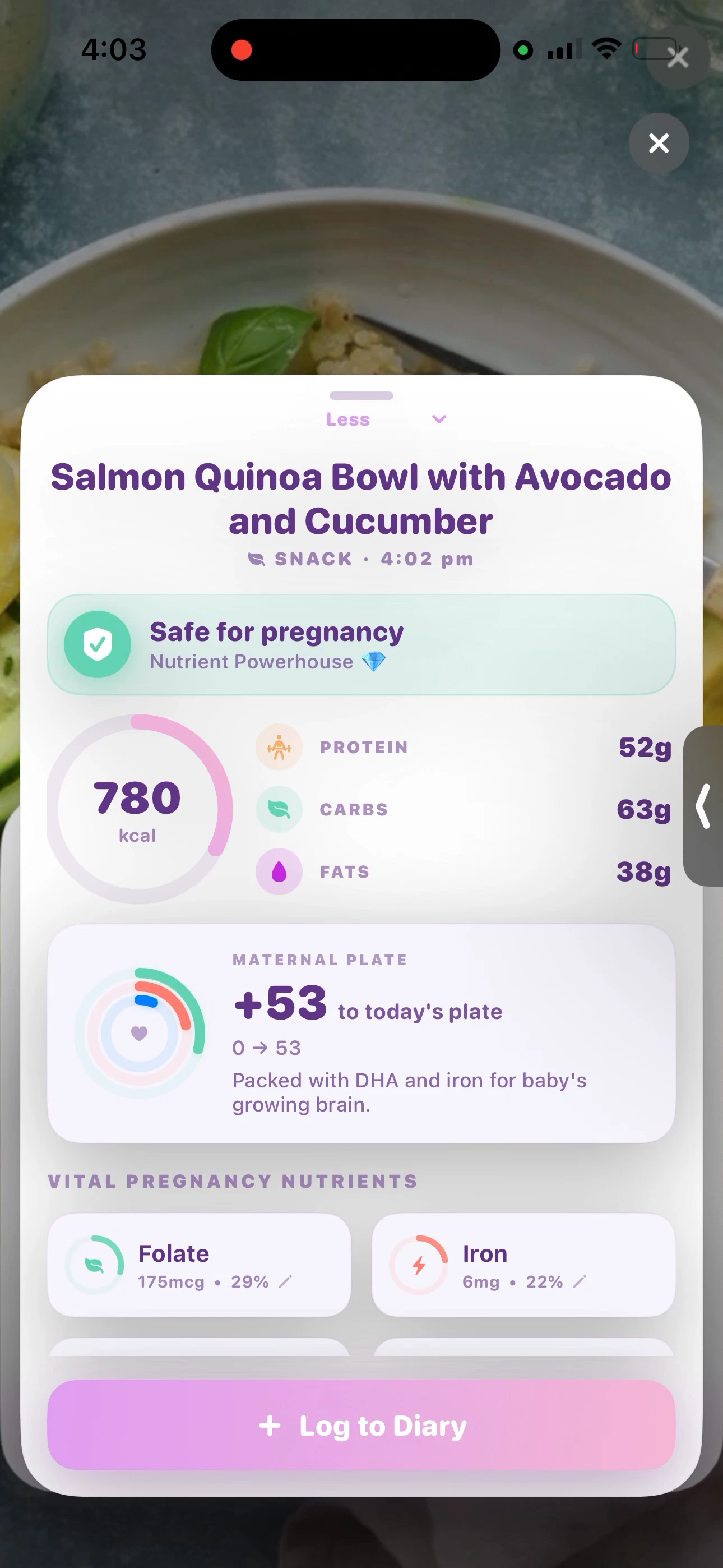
Check any dish for pregnancy safety in the PregnancyPlate AppYour next meal, a little less guesswork.
Scan your plate for pregnancy food-safety guidance and a nutrition breakdown. Keep your meals and nutrient progress in one place.
 Scan with your iPhone
to get the app
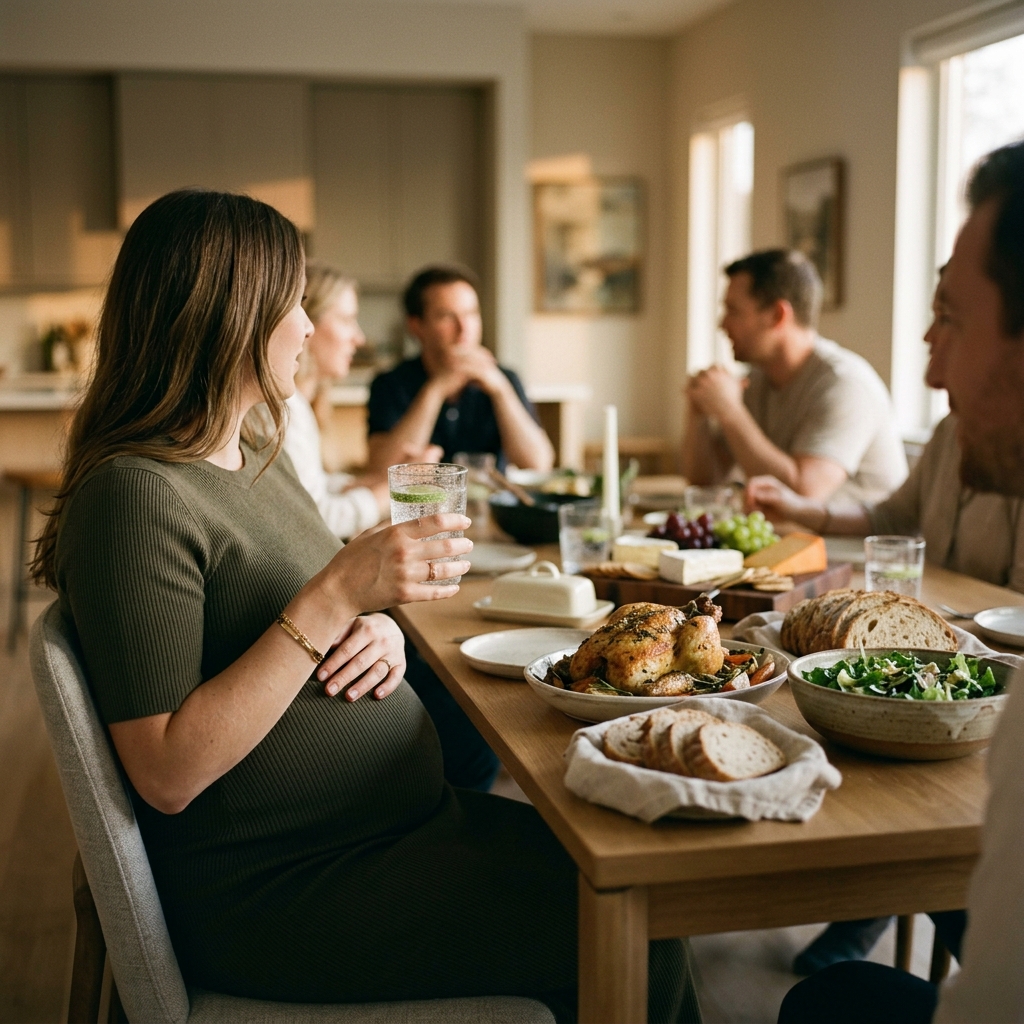
Food safety advice assumes you are the one cooking. Most of the difficult moments in pregnancy happen when you are not: at your mother-in-law's table, at a friend's dinner party, at a family lunch where someone has been baking since Thursday.
The safety part is genuinely straightforward. The social part is what people actually struggle with, so this covers both.
The Four Things That Matter
Narrowing it down helps, because trying to police an entire meal is impossible and exhausting.
Undercooked meat. Burgers, sausages, chicken and pork need to be cooked through with no pink. Whole cuts of beef and lamb can be pink in the middle, since bacteria live on the surface. If a roast is served rare and you would rather not, take from the outside.
Soft cheese. Mould-ripened cheeses like brie and camembert, and blue cheeses, are the ones to skip unless cooked until steaming. Hard cheeses are always fine. A baked camembert is fine. A cheeseboard is where to be careful, and our cheese guide covers which is which.
Food left out too long. The buffet problem. Two hours out of the fridge, one hour if the room is warm. Dips, quiches, cold meats and anything mayonnaise-based that has been on the table since people arrived.
Cross-contamination you cannot see. The one you have least control over. Someone else's chopping board, the tongs that did raw chicken, the salad rinsed in a colander that held mince. There is no polite way to audit this, so it is one to accept rather than manage.
Notice what is not on that list. Reheated leftovers served piping hot are fine. Home-cooked eggs are fine if they are British Lion stamped and cooked. Most of a normal dinner is not a problem.
The Dishes That Come Up Most
A few specific ones that cause real hesitation at other people's tables.
Homemade tiramisu, mousse and cheesecake. These often contain raw egg. Commercial versions use pasteurised egg and are fine; homemade may not be. This is the single most common one, and it is worth asking rather than assuming.
Homemade mayonnaise, aioli and hollandaise. Same issue. Shop-bought is pasteurised and fine.
A charcuterie board. Parma ham, salami and chorizo are cured rather than cooked, so they carry a toxoplasmosis risk. Cooked on a pizza they are fine.
The trifle nobody can date. Cream-based desserts made well in advance sit in the food-left-out category.
A rare roast. Fine from the outside, and nobody notices which slice you take.
Homemade chutney or preserves. Generally fine, though anything home-fermented or preserved without a clear method is reasonable to skip.
What to Ask, and How
Some questions are worth asking and some are not worth the friction. The distinction is whether the answer changes what you do.
Worth asking: whether a dessert contains raw egg, whether a cheese is pasteurised, and whether a mayonnaise or dressing is homemade. All three change your decision and all three are easy to ask casually while someone is serving.
Not worth asking: anything about chopping boards, fridge temperatures or how long something has been defrosting. You will not get a reliable answer, and the question lands as an accusation about their kitchen.
The phrasing matters more than the question. "Is there raw egg in this? I have to check at the moment" is fine. "Did you use pasteurised egg?" sounds like an inspection.
And it is usually easier to ask the person who cooked than to announce it to the table. A quiet word in the kitchen while offering to help carry things gets you the same information without an audience.
How to Decline Without a Row
This is the part that gets left out of every food safety article, and it is where people actually get stuck.
The mistake is explaining the science. Telling someone their homemade pâté carries a listeria risk sounds, to them, like being told their cooking is dangerous. It rarely lands well, particularly with older relatives who had four children on a diet of pâté and rare steak and will tell you so.
What works better:
"I'm being careful with a few things at the moment." Vague, unarguable, and does not invite debate.
"The midwife has me on a list." Deflects to an authority nobody wants to argue with.
"I'll have some of that instead, it looks great." Redirection beats refusal, and complimenting something else does most of the social work.
Offer to bring a dish. The single most effective move. It guarantees one thing you can eat and reads as generous rather than fussy.
Say it early, not at the table. A quiet message beforehand saying you are avoiding a few things saves everyone the public negotiation, and gives a host time to adjust without feeling caught out.
And if someone pushes, "I know, the rules have changed a lot" is a complete answer. You are not obliged to win the argument.
Someone Else's Kitchen in One Box
- Four risks only: undercooked meat, soft cheese, food left out, cross-contamination.
- Ask about homemade desserts. Raw egg is the usual culprit.
- Bring a dish. Guarantees one safe option and reads as generous.
- Message ahead rather than negotiating at the table.
- Don't explain the science. "I'm being careful" ends it faster.
Staying Over, and the Longer Visit
A dinner is one meal. A weekend is nine, and that changes the calculation.
The practical move is to take charge of one meal rather than negotiating all of them. Offering to cook dinner one night, or to do breakfast, gives you a guaranteed safe meal and reads as helpfulness rather than suspicion.
Bring your own supplies for the gaps. Snacks you know are fine, your prenatal vitamins, and something for breakfast if you are unsure what will be there. It removes the moment where you are hungry, there is nothing you can eat, and you make a worse decision than you would have at home.
On the fridge itself: it is entirely reasonable to check a date or a label discreetly rather than asking. And if something has been out on the side all afternoon in a warm kitchen, quietly having something else is easier than raising it.
One genuinely useful thing for a longer stay is to mention it in advance, framed around what you would love rather than what you cannot have. Hosts generally want to get it right and would far rather know beforehand than discover it at the table.
When It Is Family, Not Friends
Worth separating, because the dynamics differ.
Friends generally accept a preference without comment. Family, particularly the generation above, often experience food refusal as a rejection of them, and guidance has genuinely changed a great deal since they were pregnant. Being told the rules are different now can feel like being told they got it wrong.
Two things help. Frame it as current advice rather than as a correction. And give them something to say yes to: asking them to make a dish you can eat converts the conversation from what you are avoiding into what you want.
If it becomes a recurring source of friction, it is a reasonable thing to hand to your partner. Their family, their conversation.
If You Have Eaten Something You Are Unsure About
Most likely nothing happens, and there is no benefit in retrospective panic.
Listeria is the one worth knowing about because it can take weeks to appear and often looks like flu rather than food poisoning. So if you develop an unexplained fever, aches or feel generally unwell in the weeks after, mention what you ate to your midwife or GP rather than assuming it is a cold.
Seek advice the same day for a temperature, severe stomach cramps, an inability to keep fluids down, or any change in your baby's movements. Our food poisoning guide covers the symptoms, and our foods to avoid guide has the full list.
For the overwhelming majority of meals at other people's houses, the honest position is that the food is fine and the awkwardness is the harder part. Our barbecue guide covers the outdoor version of the same problem.
Clinical Sources & Research
Meet the Editorial Team
The researchers and experts behind PregnancyPlate.

Fiza Izra
Founder & Tech Researcher
A UK-based mother of 3 with a background in tech and data synthesis, Fiza brings real-world experience navigating hyperemesis gravidarum and postnatal depression. She engineers complex clinical guidelines (NHS, ACOG) into accessible tools, ensuring rigorous fact-checking with deep empathy.

Emma Davies
Senior Nutrition Editor
A mum and writer, Emma runs our food safety desk. She is the one who rings the restaurant to ask how long the lettuce sits out, checks every claim against CDC, FDA and NHS guidance, and rewrites the answer until it is usable at 9pm in a drive-thru queue.
Make sense of every plate.
Scan your plate for pregnancy food-safety guidance and a nutrition breakdown. Keep your meals and nutrient progress in one place.
Scan with your iPhoneto get the app