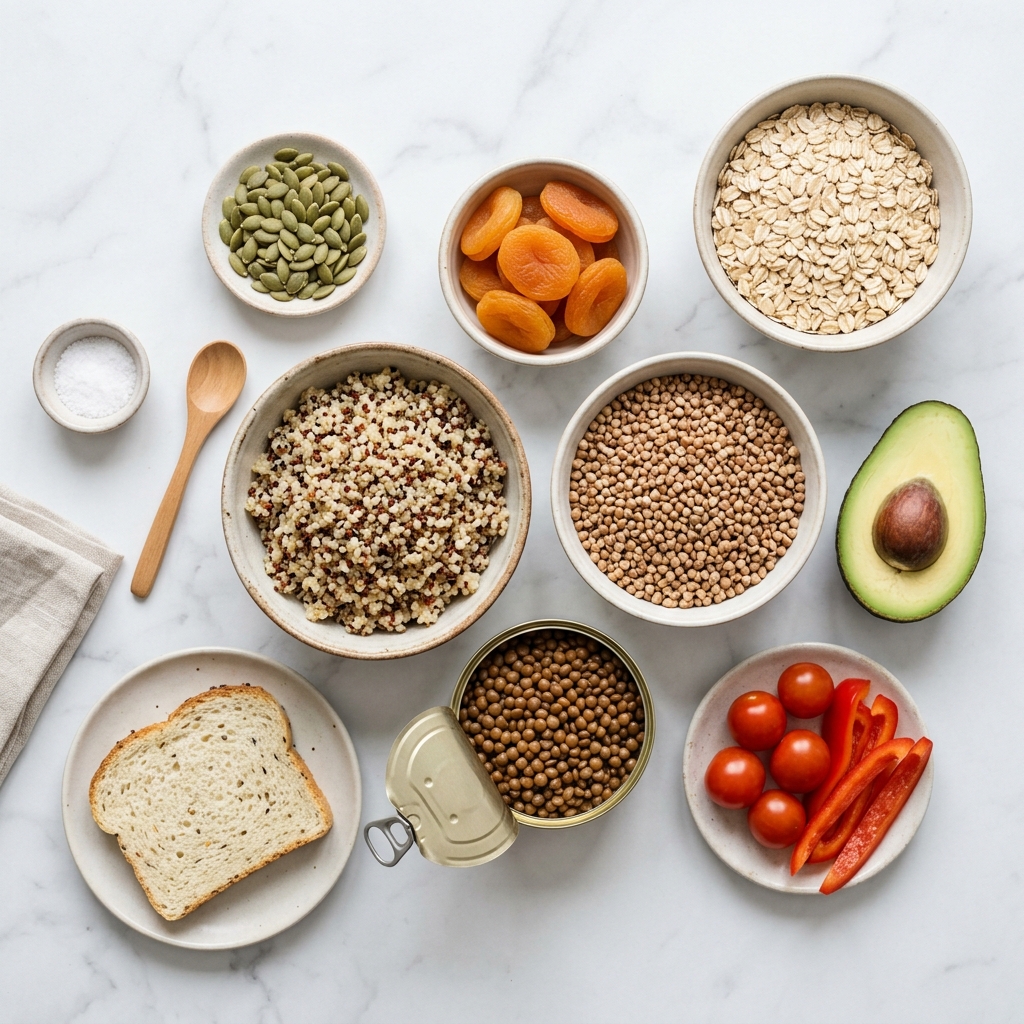
Gestational Diabetes Meal Plan: 7 Days of Low-GI Meals That Steady Blood Sugar
A 7 day gestational diabetes meal plan with carb counts for every meal, the pairing rule that flattens spikes, and why breakfast needs its own lower number.
In this article
Editorial note: This article is researched from official public health and pregnancy food safety guidance, then edited by the PregnancyPlate team for clarity. It is not medical advice. If you are worried about symptoms or a specific exposure, contact your midwife, GP or healthcare provider.
The Fast Answer: A gestational diabetes meal plan is not a low-carb plan. It is a plan that spreads carbohydrate evenly across the day and never serves it alone. Most women do well starting around 30 to 45g of carbohydrate per meal and 15 to 30g per snack, with breakfast deliberately the lowest because morning insulin resistance is at its worst. Seven days below. Your diabetes team's targets always override anything on this page.
Track carbs per meal in the PregnancyPlate AppSafety is step one. Nutrition helps your baby thrive.
Knowing a meal is safe does not tell you whether you are getting enough iron, folate, calcium and choline. PregnancyPlate tracks all of it from a photo of your plate.
- See nutrient progress
- Scan meals instantly
- Nourish with confidence
 Scan to download
Open with iPhone camera
Scan to download
Open with iPhone camera
A gestational diabetes diagnosis usually arrives somewhere around week 28, along with a glucose meter, a testing schedule and a leaflet. What most women want at that point is not a lecture on glycaemic index. It is a week of actual meals that will not send their readings over target.
So that is what this is. Before the plan, though, four things determine whether any GD week works, and understanding them means you can build your own meals rather than following mine forever.
Why Carbohydrate Is the Lever
Gestational diabetes is not caused by eating sugar. It is caused by placental hormones making your cells resistant to insulin, which is a normal process in every pregnancy that in some women outpaces what the pancreas can compensate for. It affects roughly 1 in 20 pregnancies in the UK, it usually appears in the second half, and it usually resolves after birth.
Carbohydrate matters because it is the macronutrient that raises blood glucose most directly. Protein and fat barely move it. That is the entire mechanical basis of a GD diet, and it explains why the plan below reshuffles carbohydrate rather than removing it.
And it must not be removed. The recommended minimum carbohydrate intake in pregnancy is around 175g a day, because your baby's brain runs on glucose and cutting too low pushes you toward ketosis, which is not something you want in pregnancy. Very low carb diets are the most common mistake newly diagnosed women make, usually out of fear, and they are the wrong answer. The goal is well-distributed carbohydrate, not scarce carbohydrate.
The Four Rules That Run the Plan
Spread it evenly. Three meals and two to three snacks, so no single sitting delivers a load your insulin response cannot handle. Going long stretches without eating and then having a large meal is the classic spike pattern.
Never eat carbohydrate alone. Pair every carb with protein, fat or fibre, all of which slow gastric emptying and flatten the curve. An apple on its own may spike you. An apple with peanut butter usually will not. This single habit changes more readings than any food swap.
Choose slower carbohydrate. Wholegrain over white, oats over instant cereal, whole fruit over juice, and anything with intact fibre over anything refined. Juice and smoothies deserve specific mention because they behave almost like liquid sugar even when made of fruit.
Breakfast gets its own, lower number. Insulin resistance peaks in the early morning thanks to overnight hormone patterns, so the same bowl of porridge that is fine at 2pm can spike you at 8am. Many women tolerate only 15 to 30g of carbohydrate at breakfast. This surprises almost everyone, and it is the most common reason a first week of readings looks bad.
Know Your Own Targets
Your team will give you numbers and a testing schedule, typically fasting plus either one or two hours after each meal. As a reference point, NICE guidance in the UK suggests aiming for a fasting level below 5.3 mmol/L, below 7.8 mmol/L one hour after eating, and below 6.4 mmol/L at two hours. In the US, ACOG commonly cites below 95 mg/dL fasting, below 140 mg/dL at one hour and below 120 mg/dL at two hours.
Those are reference figures, not instructions. Targets are individualised, and if your team has given you different ones, theirs are the ones that count.
The 7 Day Gestational Diabetes Meal Plan
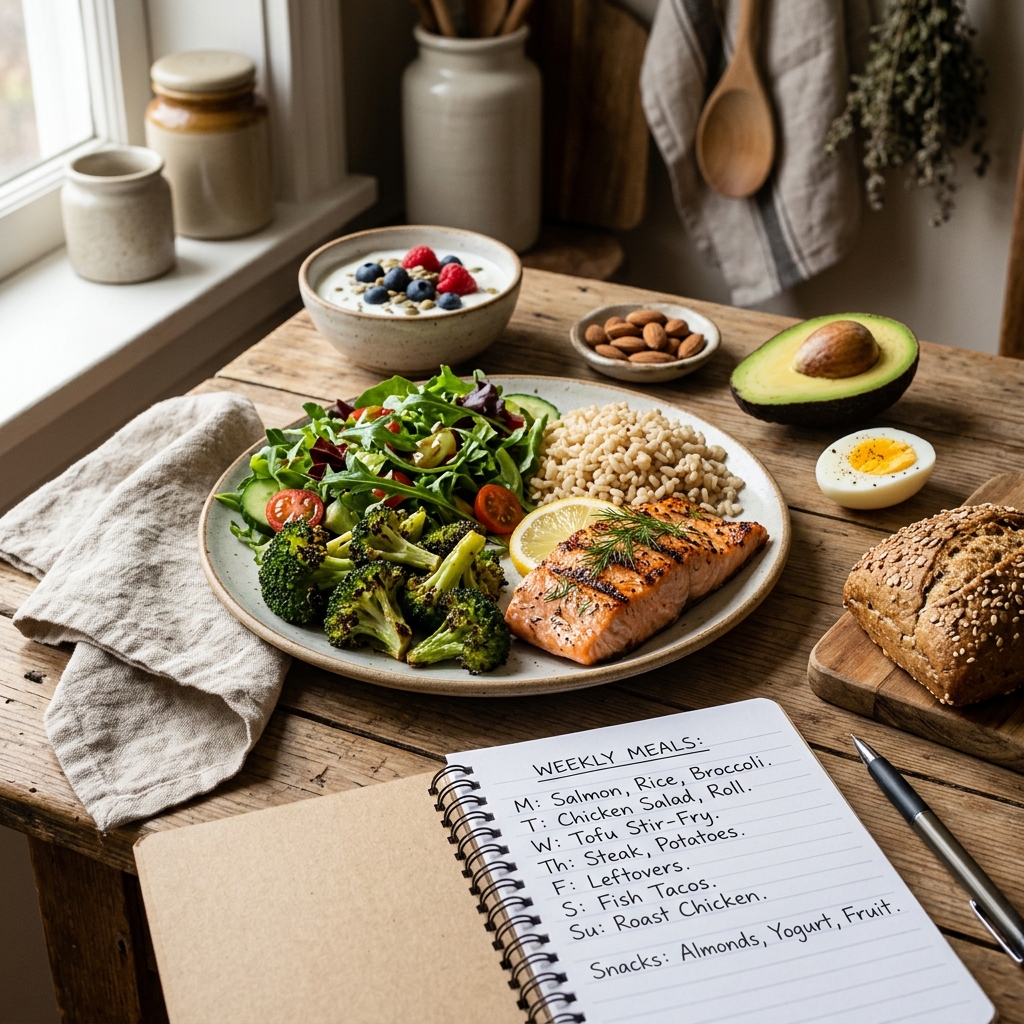
Carbohydrate estimates are approximate and depend on your portions, so weigh and check labels for the first fortnight until you can eyeball it. Snacks sit between meals: Greek yogurt with a few berries, cheese and two oatcakes, a boiled egg, a small apple with nut butter, or a handful of nuts. Each lands around 15 to 20g of carbohydrate or less.
Monday. Breakfast: two scrambled eggs with one slice of wholegrain toast and half an avocado (~20g). Lunch: chicken, mixed leaf and butter bean salad with olive oil dressing and one small wholegrain roll (~35g). Dinner: salmon fillet with a fist-sized portion of new potatoes and green beans (~35g).
Tuesday. Breakfast: Greek yogurt with a small handful of berries, chopped walnuts and a spoon of chia (~15g). Lunch: leftover salmon flaked through a quinoa and cucumber salad (~35g). Dinner: beef and black bean chilli over half a cup of brown rice with soured cream (~40g).
Wednesday. Breakfast: omelette with cheese, mushrooms and spinach, no toast (~5g). Lunch: lentil and vegetable soup with one slice of seeded bread and butter (~35g). Dinner: chicken thigh and chickpea curry with cauliflower rice and two tablespoons of brown rice (~30g).
Thursday. Breakfast: full-fat Greek yogurt with two tablespoons of low-sugar granola and flaked almonds (~20g). Lunch: jacket sweet potato, modest size, with tuna, mayonnaise and salad (~40g). Dinner: turkey meatballs in tomato sauce over courgette ribbons with a small portion of wholewheat pasta (~35g).
Friday. Breakfast: two boiled eggs with one slice of rye toast (~18g). Lunch: chicken and halloumi salad with olives, tomatoes and a small pitta (~30g). Dinner: takeaway night, made workable. Choose grilled meat or fish with salad and a small portion of rice, skip the naan, chips and sugary sauces (~40g).
Saturday. Breakfast: mushrooms, grilled tomatoes, bacon and one slice of sourdough (~20g). Lunch: roast chicken with roast vegetables and a small portion of potatoes (~35g). Dinner: leftover roast chicken and vegetable soup with a slice of wholegrain bread and cheese (~30g).
Sunday. Breakfast: shakshuka, eggs poached in tomato sauce, with one slice of wholegrain bread (~20g). Lunch: cheese, cold meats, oatcakes, olives, cucumber and a small apple, a picking plate (~30g). Dinner: baked white fish with lentils, roasted peppers and a green salad (~35g).
What to Do With a High Reading
You will get one. Everybody does, and a single high number is data rather than a verdict on your character.
Note what you ate, the portion and the timing, and look for the pattern rather than reacting to the individual result. If one meal spikes you repeatedly, the usual fixes in order are: shrink the carbohydrate portion by a third, add protein or fat alongside it, swap to a slower carbohydrate, or move a short walk to the twenty minutes after eating. Ten to fifteen minutes of gentle walking after a meal has a measurable effect on post-meal glucose and is the most underused tool available.
What does not help is skipping the next meal to compensate. That produces a longer fast, more hunger and a bigger spike later.
The Plan in One Box
- Do not cut carbs out. Around 175g a day is the pregnancy minimum. Distribute, do not eliminate.
- Roughly 30 to 45g per meal, 15 to 30g per snack, as a starting point to refine with your readings.
- Breakfast is the strict one, often 15 to 30g, because morning insulin resistance is highest.
- Never serve carbohydrate alone. Pair with protein, fat or fibre every time.
- Walk for 10 to 15 minutes after meals. One of the most effective non-food levers you have.
The Foods That Catch People Out
Several things marketed as healthy behave badly on a meter, and finding out by reading is easier than finding out by spiking.
Fruit juice and smoothies, because blending and juicing strip the fibre that would have slowed absorption. Whole fruit with a protein alongside is a completely different proposition.
Instant porridge and most breakfast cereals, which are processed to a texture that digests fast. Steel-cut or jumbo oats behave far better, though plenty of women still cannot tolerate any oats at breakfast specifically.
Low-fat flavoured yogurts, where the removed fat is usually replaced with sugar. Full-fat plain Greek yogurt with your own fruit is the better trade.
Dried fruit, which concentrates sugar into a very small volume. Fine in the small quantities that appear in the plan above, a problem by the handful.
Rice and pasta portions, which are the most commonly underestimated carbohydrate on the plate. Weigh them once, dry, and you will recalibrate permanently.
If Diet Is Not Enough
This part matters, and it gets left out of most GD articles. A substantial share of women with gestational diabetes will need medication, usually metformin or insulin, in addition to diet.
That is not a failure of willpower and it is not a sign you ate wrongly. It reflects how strongly your particular placenta is driving insulin resistance, which is not something a meal plan can out-argue. Women who reach that point often describe feeling like they let themselves down, and it is worth naming clearly: needing insulin is a normal clinical outcome, not a personal one. Keep eating well alongside it, because good distribution still reduces the dose you need and steadies your readings.
Where to Go From Here
Our beginner's guide to managing gestational diabetes with diet covers the diagnosis and the plate method in more depth if you have only just been told. For the wider picture, our complete pregnancy meal plan explains how nutrient needs shift by trimester, and the third trimester meal plan is worth reading alongside this one, since most women managing GD are doing it during exactly those weeks and dealing with reflux and reduced stomach capacity at the same time.
One last reassurance, because the diagnosis lands hard. Well-managed gestational diabetes is associated with outcomes close to those of pregnancies without it. The management is the thing that matters, and you have just read the practical half of it.
Clinical Sources & Research
This article is general information and does not replace the advice of your diabetes team, midwife or dietitian. Gestational diabetes is managed individually, and your own carbohydrate targets, blood glucose targets and medication decisions should always come from your care providers.
Meet the Editorial Team
The researchers and experts behind PregnancyPlate.

Fiza Izra
Founder & Tech Researcher
A UK-based mother of 3 with a background in tech and data synthesis, Fiza brings real-world experience navigating hyperemesis gravidarum and postnatal depression. She engineers complex clinical guidelines (NHS, ACOG) into accessible tools, ensuring rigorous fact-checking with deep empathy.

Emma Davies
Senior Nutrition Editor
A mum and writer, Emma runs our food safety desk. She is the one who rings the restaurant to ask how long the lettuce sits out, checks every claim against CDC, FDA and NHS guidance, and rewrites the answer until it is usable at 9pm in a drive-thru queue.