Gluten-Free and Pregnant: Covering Iron, Folate and Fibre
Going gluten-free removes the fortified foods pregnancy relies on. Why iron, folate and fibre get harder, and what to eat instead when you have coeliac disease.
In this article
Editorial note: This article is researched from official public health and pregnancy food safety guidance, then edited by the PregnancyPlate team for clarity. It is not medical advice. If you are worried about symptoms or a specific exposure, contact your midwife, GP or healthcare provider.
The Fast Answer: Gluten-free pregnancy has one specific problem, and it is not the gluten. In the UK, most wheat flour is fortified with iron and other nutrients by law, and gluten-free products are not. So going gluten-free quietly removes a daily iron and B-vitamin source at exactly the point demand doubles. Iron, folate and fibre are the three to plan for, and naturally gluten-free wholefoods do it far better than gluten-free bread.
Check your iron and folate in the PregnancyPlate AppYour next meal, a little less guesswork.
Scan your plate for pregnancy food-safety guidance and a nutrition breakdown. Keep your meals and nutrient progress in one place.
 Scan with your iPhone
to get the app
Most gluten-free advice in pregnancy stops at "avoid gluten", which is the part you already know how to do. The nutritional consequence is the bit that gets skipped.
And it is a genuine one, because of how the UK fortifies its flour.
The Fortification Problem
This is the thing worth understanding, because everything else follows from it.
In the UK, most wheat flour must by law have iron, calcium, thiamin and niacin added back, and folic acid is being added to non-wholemeal wheat flour too. That means ordinary bread, pasta and cereal quietly contribute a daily dose of exactly the nutrients pregnancy needs most.
Gluten-free products are not covered by that requirement. Gluten-free bread, pasta and flour blends are usually made from rice, maize, tapioca and potato starch, which are naturally low in iron and B vitamins and are not fortified in the same way.
So the swap is not neutral. Someone eating gluten-free bread and pasta is getting substantially less iron and folate than someone eating the wheat versions, without changing anything else about their diet.
Some gluten-free products are voluntarily fortified. Check the nutrition panel rather than assuming, because it varies enormously between brands.
Coeliac Disease Adds a Second Problem
If your gluten-free diet is because of coeliac disease rather than choice, there is an absorption issue on top of the intake one.
Untreated or poorly controlled coeliac damages the small intestine lining, which is precisely where iron, folate, calcium and B12 are absorbed. Many people are diagnosed only after unexplained anaemia, which tells you how central that is.
Two practical implications. First, a strictly gluten-free diet is the treatment, and being casual about cross-contamination in pregnancy costs you absorption at the worst time. Second, it is worth asking for your levels to be checked rather than assuming a good diet is enough, since a healed gut and a damaged one absorb very differently.
Coeliac UK and NICE both recommend regular monitoring, and pregnancy is a sensible point to ask for it.
Iron Without Fortified Bread
You need 27mg a day, roughly double the non-pregnant requirement, and you have just lost a daily background source.
Heme iron absorbs best, so red meat, dark poultry meat and oily fish do disproportionate work. A modest portion two or three times a week is worth more than a lot of leafy greens.
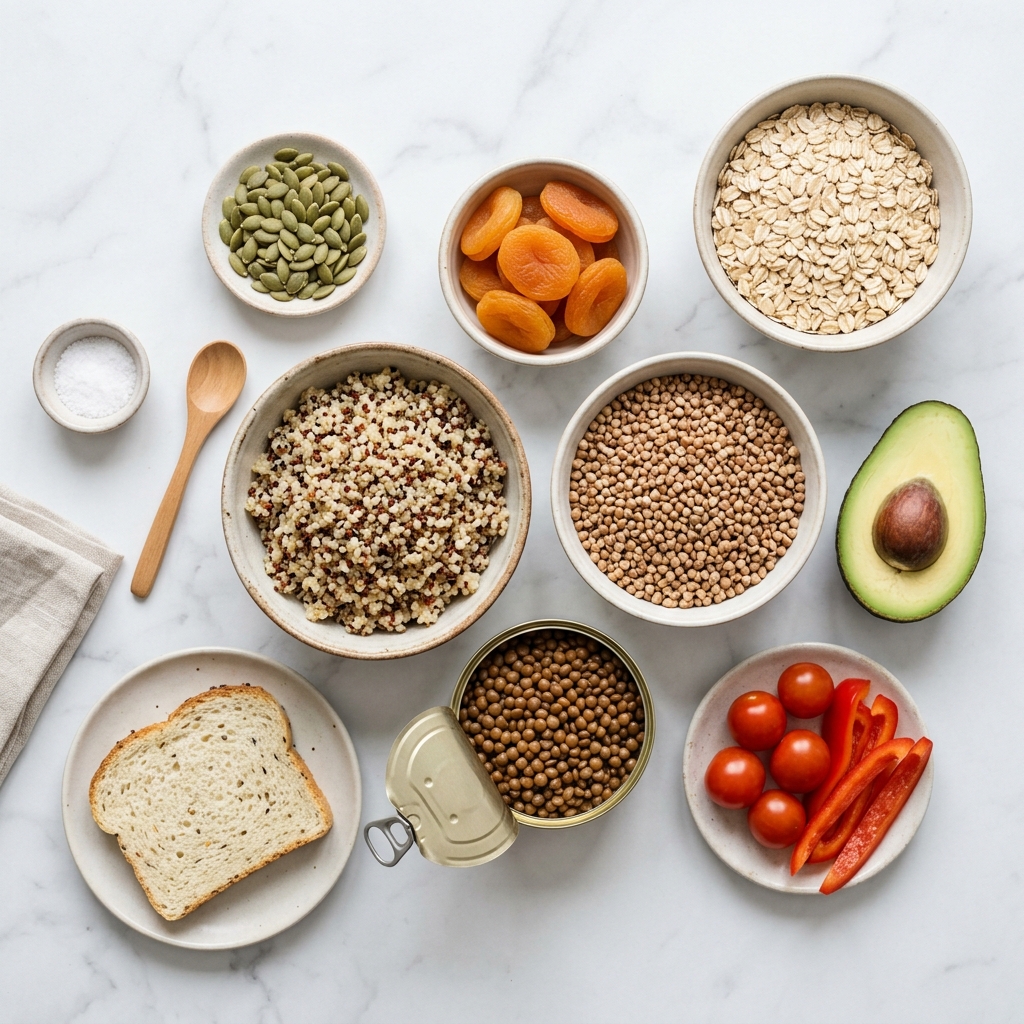
Naturally gluten-free plant sources: lentils, chickpeas, beans, tofu, quinoa, buckwheat, amaranth, teff, pumpkin seeds and dried apricots. Quinoa and buckwheat are notably better than rice-based gluten-free staples and worth defaulting to.
Pair with vitamin C at the same meal, which multiplies absorption from plant sources. Peppers, tomatoes, citrus.
Keep tea and coffee an hour clear of iron-rich meals.
Check gluten-free cereals specifically, since some are fortified and some are not, and the difference is large. Our iron guide covers the numbers.
Folate Without Fortified Flour
Your folic acid supplement covers the critical early requirement, and you should be taking 400mcg regardless.
Worth knowing that coeliac disease is one of the conditions where a higher 5mg dose is often recommended, because of the absorption issue. That is prescription only, so ask rather than assuming the standard supplement is right for you.
Food folate on top: leafy greens, broccoli, asparagus, beans, lentils, chickpeas, avocado, oranges. Naturally gluten-free and generally underused. Our folate versus folic acid guide explains the difference between the forms.
Gluten-Free Pregnancy in One Box
- UK wheat flour is fortified. Gluten-free products usually are not.
- Iron, folate and fibre are the three that get harder.
- Quinoa and buckwheat beat rice-based staples on all three.
- With coeliac, ask about the 5mg folic acid dose and get levels checked.
- Read the panel. Fortification of gluten-free products varies hugely by brand.
Fibre, and the Constipation Problem
The third gap, and the one you will feel first.
Gluten-free bread and pasta are usually much lower in fibre than wholemeal wheat versions. Pregnancy already slows the gut, and iron supplements make constipation worse. Those three together is a genuinely miserable combination.
Naturally gluten-free fibre: beans and lentils, quinoa, buckwheat, brown rice, oats labelled gluten-free, chia and flaxseed, fruit with skins on, vegetables, nuts. Aim for around 30g a day and increase it gradually with more water rather than all at once. Our fibre and constipation guide has the full list.
One label note: oats are naturally gluten-free but are usually contaminated in processing, so buy ones specifically labelled gluten-free. A minority of people with coeliac also react to oats themselves.
Building Meals Around Wholefoods
The simplest reframe: the problem is gluten-free replacement products, not gluten-free eating. A diet built on naturally gluten-free wholefoods outperforms one built on gluten-free bread without any effort.
Instead of gluten-free bread and pasta by default: quinoa, buckwheat, brown rice, potatoes, sweet potatoes, polenta, beans and lentils.
A day that works: gluten-free oats with seeds and berries. A quinoa salad with chickpeas, peppers and feta. A lentil dhal with brown rice, or salmon with potatoes and greens. Snacks of nuts, dried apricots, hummus with vegetables, yoghurt.
That covers iron, folate and fibre without relying on a single fortified product, and it happens to be exactly the pattern recommended in pregnancy anyway. Our pregnancy grocery list adapts easily.
Reading Labels When You Are Reading Two Sets
Pregnancy adds a second label check to one you already do, and the two are looking for different things.
Your gluten check is the allergen bolding, the crossed grain symbol, and "may contain" warnings.
Your pregnancy check is pasteurisation on anything dairy, and whether a product contains raw egg, pâté, liver or unpasteurised cheese.
Your new nutrition check is the panel itself: does this gluten-free cereal, bread or flour blend contain added iron and B vitamins, or none at all? This is the one nobody tells you to do, and it is where the difference between brands is largest.
Do it once per product you buy regularly and you are done. Photograph the panel of the ones you settle on, and you never have to stand in the aisle comparing again.
One trap worth naming: "gluten-free" on the front is a processing claim, not a health claim. Plenty of gluten-free products are lower in fibre and micronutrients and higher in sugar and fat than the versions they replace, precisely because starches need help to behave like wheat.
Eating Out and Cross-Contamination
Worth a note, because pregnancy adds a second set of rules to a situation you already navigate.
With coeliac, ask about shared fryers, shared toasters and shared pasta water, which are the usual culprits. Then layer the pregnancy questions on top: is the cheese pasteurised, is the meat cooked through. Our guide to eating at other people's houses covers the social half.
One thing that catches people: some gluten-free products contain unpasteurised cheese or raw egg in ways the wheat version would not, so the gluten-free label is not a pregnancy-safe label.
And if you suspect coeliac but have not been formally diagnosed, do not start a gluten-free diet before testing, since the test requires you to be eating gluten. That is a conversation for a GP rather than something to sort out yourself mid-pregnancy.
Prescriptions and What You May Be Entitled To
Worth checking, because provision varies and plenty of people never ask.
Some parts of the UK still provide certain gluten-free staple foods on prescription for people with a confirmed coeliac diagnosis, though what is available differs considerably by area and has been reduced in many places. Your GP or dietitian can tell you what applies where you live.
Separately, prescriptions are free throughout pregnancy and for twelve months after birth in England if you have a maternity exemption certificate, which your midwife can arrange. That is worth having regardless, and it covers any iron or higher-dose folic acid you are prescribed.
A referral to a dietitian is also reasonable to ask for. Coeliac plus pregnancy is exactly the combination where specialist input is useful rather than a luxury, and it is the fastest route to knowing whether your levels are actually where they should be.
Clinical Sources & Research
This article is general information and does not replace dietetic or medical advice. If you have coeliac disease, ask your GP or dietitian about folic acid dosing and nutrient monitoring in pregnancy.
Meet the Editorial Team
The researchers and experts behind PregnancyPlate.

Fiza Izra
Founder & Tech Researcher
A UK-based mother of 3 with a background in tech and data synthesis, Fiza brings real-world experience navigating hyperemesis gravidarum and postnatal depression. She engineers complex clinical guidelines (NHS, ACOG) into accessible tools, ensuring rigorous fact-checking with deep empathy.

Emma Davies
Senior Nutrition Editor
A mum and writer, Emma runs our food safety desk. She is the one who rings the restaurant to ask how long the lettuce sits out, checks every claim against CDC, FDA and NHS guidance, and rewrites the answer until it is usable at 9pm in a drive-thru queue.
Make sense of every plate.
Scan your plate for pregnancy food-safety guidance and a nutrition breakdown. Keep your meals and nutrient progress in one place.
Scan with your iPhoneto get the app