The Pregnancy Grocery List: What to Actually Put in Your Trolley
A pregnancy grocery list organised by aisle, with the reason each item earns its place, the ten essentials to buy first, and what to leave on the shelf.
In this article
Editorial note: This article is researched from official public health and pregnancy food safety guidance, then edited by the PregnancyPlate team for clarity. It is not medical advice. If you are worried about symptoms or a specific exposure, contact your midwife, GP or healthcare provider.
The Fast Answer: A pregnancy shop is not a different shop, it is a slightly reweighted one. Buy more iron, protein and calcium, buy things that survive a week of unpredictable appetite, and buy a short list of emergency items so that the evenings you cannot cook still end in a real meal. The full aisle-by-aisle list is below, along with the ten items that make everything else easy and the handful genuinely worth leaving on the shelf.
See what your shop adds up to in the PregnancyPlate AppSafety is step one. Nutrition helps your baby thrive.
Knowing a meal is safe does not tell you whether you are getting enough iron, folate, calcium and choline. PregnancyPlate tracks all of it from a photo of your plate.
- See nutrient progress
- Scan meals instantly
- Nourish with confidence
 Scan to download
Open with iPhone camera
Scan to download
Open with iPhone camera
Most pregnancy food advice tells you what to eat. Very little of it tells you what to buy, which is the step that actually decides what you eat. You cannot cook an iron-rich dinner on Thursday if Saturday's shop did not include anything containing iron, and no amount of good intention closes that gap at 7pm.
So this is the shopping list version. Organised by aisle, in the order you walk them, with the reason each item earns its place. Nothing here is exotic and nothing needs a health food shop.
The Ten That Do the Heavy Lifting
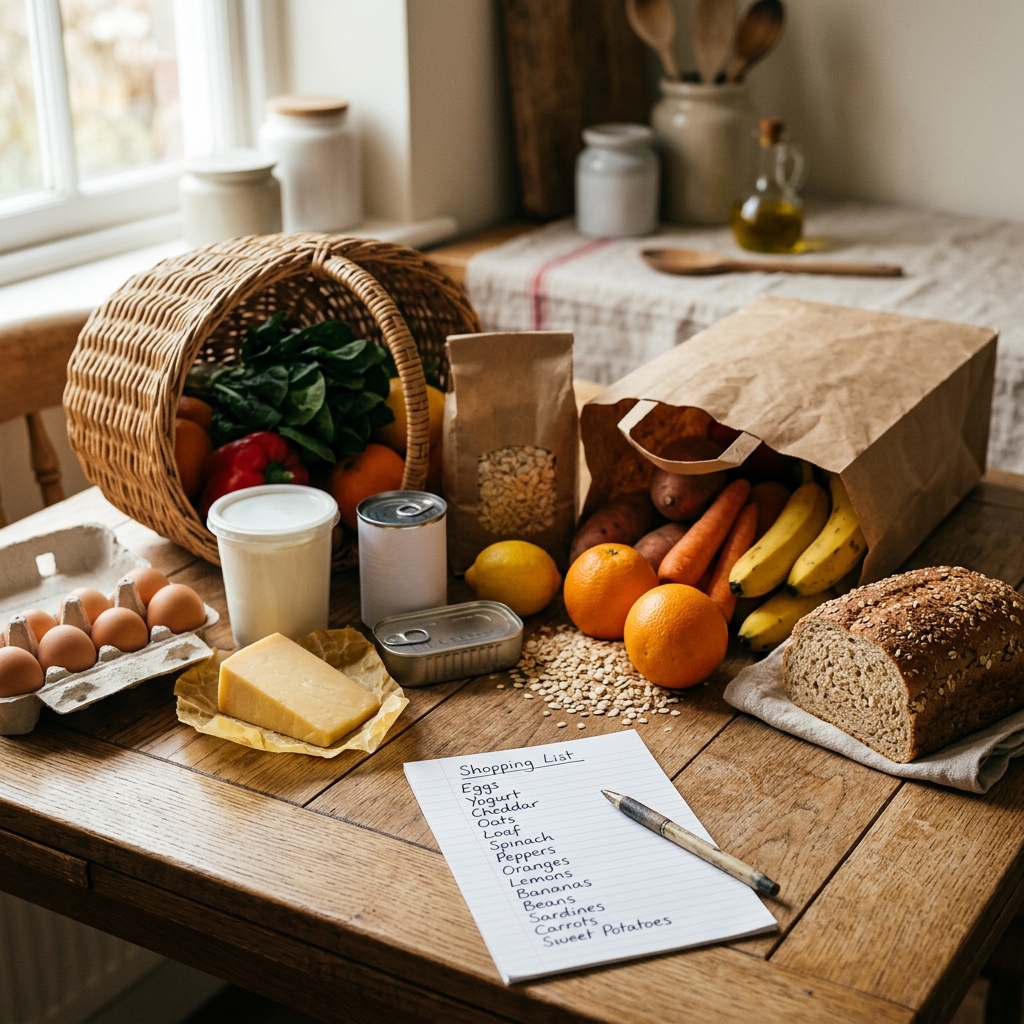
If you buy nothing else on this page, buy these. Between them they cover most of what pregnancy actually demands, and they combine into a dozen different meals rather than one.
- Eggs. Choline, protein, iodine, and the single most useful thing in the fridge when cooking feels impossible.
- Greek yogurt. Calcium and protein in one, and it goes down when hot food will not.
- Tinned beans or lentils. Iron, fibre and protein for pennies, no preparation.
- Frozen spinach. Iron and folate that will not rot in the drawer while you go off vegetables for a fortnight.
- Tinned tomatoes. The base of half the meals below, plus the vitamin C that helps plant iron absorb.
- Porridge oats. Fibre, slow carbohydrate, and often the only breakfast that stays down early on.
- Hard cheese. Calcium, no soft cheese worries, and it makes any beige dinner respectable.
- Wholegrain bread. Freeze half the loaf. Toast is a legitimate pregnancy meal.
- Tinned oily fish. Sardines or salmon deliver DHA and calcium with zero cooking.
- Frozen berries. Vitamin C, no waste, and they turn plain yogurt into something you want to eat.
Produce
Buy less fresh produce than feels virtuous. Pregnancy appetite is unreliable and there is nothing more demoralising than binning a wilted bag of salad on Friday because you went off green things on Tuesday.
The reliable ones: bananas, apples, oranges, lemons, carrots, onions, garlic, potatoes and sweet potatoes. All of them last, all of them tolerate being ignored for a week.
Worth buying weekly: spinach or kale, peppers, tomatoes, cucumber, avocado, broccoli. The peppers and the citrus are doing a specific job, which is supplying the vitamin C that multiplies iron absorption from beans and lentils. Buy them together with the beans deliberately, not by accident.
One practical note on washing. All fresh produce should be washed under running water before eating, including things with skins you discard, and bagged salad is worth extra thought given the recall history of the last few years. Our foods to avoid guide covers where the real risks sit.
Meat, Fish and Protein
Protein demand rises through pregnancy to roughly 75 to 100g a day, and this aisle is also where most of your iron comes from.
Red meat once or twice a week. Beef mince, braising steak or a small joint. Heme iron from meat absorbs several times better than plant iron, which is why a modest amount does disproportionate work.
Chicken thighs rather than breast where you do not mind, since the darker meat carries roughly twice the iron.
Two portions of fish a week, one of them oily. Salmon, mackerel or sardines for DHA. Keep to the two portion guidance on oily fish and skip shark, swordfish and marlin entirely.
Eggs, always. Buy more than you think. British Lion or equivalent stamped eggs are considered safe to eat runny in the UK, which widens what you can do with them considerably.
The plant column: tinned chickpeas, black beans, butter beans, red lentils, tofu. Cheap, iron-rich, and they keep indefinitely.
Dairy and Chilled
You are aiming at roughly 1,000mg of calcium a day, and this aisle is the straightforward route to it.
Milk, Greek yogurt, hard cheeses like cheddar and parmesan, and butter. Pasteurised is the operative word: check the label on anything soft, and treat mould-ripened soft cheeses like brie and blue cheeses as a no unless cooked until steaming. Hard cheese is fine regardless, which makes cheddar the pregnancy workhorse.
If dairy is off the menu, whether by aversion or intolerance, buy calcium-fortified plant milks and check the carton actually says fortified, because many organic versions are not.
Cupboard and Dry Goods
This is the aisle that quietly decides whether you eat well on a bad week, because everything in it survives being forgotten.
Grains and starch: porridge oats, rice, pasta, cous cous, a fortified breakfast cereal. Fortified cereals are an easy iron and folate win, so check the box for the iron figure per serving.
Tins: tomatoes, beans, chickpeas, lentils, tuna, sardines, sweetcorn. The backbone of every ten-minute dinner.
Flavour: stock cubes, curry paste, olive oil, herbs and spices. Worth naming because bland food is what makes a pregnancy diet collapse into toast, and a jar of curry paste rescues more dinners than any recipe.
Snacks that are not sugar: nuts, dried apricots, oatcakes, crackers, peanut butter. Dried apricots in particular are iron plus fibre, which addresses two problems at once. Our pregnancy snacks guide has more.
The Freezer
The freezer aisle is the most underrated part of a pregnancy shop. Frozen vegetables are picked and frozen fast, so nutritionally they hold up well against fresh, and they do not spoil while your appetite does whatever it wants.
Buy frozen spinach, peas, mixed berries, and a bag of something you can roast. Add frozen fish fillets, which go from freezer to oven with no planning at all. In the third trimester, this aisle plus a stocked freezer of your own cooking is most of the answer, which our freezer meals guide goes into properly.
What to Leave on the Shelf
Short list, because the avoid rules are narrower than the internet suggests.
Unpasteurised milk and juice, mould-ripened and blue soft cheeses, pâté of any kind including vegetable pâté, cold cured and deli meats unless you plan to cook them, shark, swordfish and marlin, and raw or undercooked shellfish. Liver and liver products too, because of vitamin A. Everything else is a question of handling rather than a ban.
The Shop in One Box
- Buy the ten essentials first, then fill in around them.
- Pair your iron with your vitamin C in the same basket, not the same vague intention.
- Buy less fresh produce than feels virtuous, and more frozen than feels necessary.
- Keep an emergency shelf of tins, pasta and sauce that needs no planning at all.
- Check labels for pasteurised on anything soft or dairy-based.
Doing This on a Budget
Almost nothing on the essentials list is expensive, and that is not an accident. Tinned beans, lentils, eggs, oats, frozen vegetables and tinned sardines are among the cheapest food in the shop and also among the most nutrient dense, which is a genuinely useful coincidence in pregnancy.
Where the money goes is fresh meat and fresh fish, so those are the two lines to flex. Tinned sardines instead of a salmon fillet costs a fraction and delivers more calcium. A whole chicken instead of breast fillets gives you two dinners and a pot of stock. Frozen fish is usually cheaper than the counter and no worse for you. Supermarket own-brand prenatal vitamins meeting the same 400mcg folic acid and 10mcg vitamin D guidance do the same job as the branded ones, and the price gap is considerable.
Buying the essentials well and treating everything else as optional is a better strategy than an expensive shop you only half use.
Shopping When Everything Smells Wrong
In the first trimester the supermarket itself can be the problem. The fish counter, the rotisserie chickens and the bakery are the usual culprits, and there is no nutritional case for putting yourself through them.
Shop online if you can, which also stops the impulse buying that food aversions drive. If you are shopping in person, go after eating rather than hungry, keep to the outer aisles where the smells are weaker, and buy cold and plain: yogurt, crackers, cheese, fruit, cereal. Beige and cold is a perfectly adequate fortnight. Our first trimester nausea guide covers what tends to stay down.
Turning the Trolley Into Meals
A list is only useful if it becomes dinner. The shortcut is to buy for four cooked dinners a week rather than seven, and let leftovers, a takeaway and an emergency-shelf meal cover the rest. That is the structure behind our complete pregnancy meal plan, and it is the reason the plan survives a real week rather than a theoretical one.
Buy the ten, add the aisles, and accept that some of it will go to waste because you changed your mind about food halfway through the week. That is not bad planning. That is pregnancy, and a slightly over-stocked cupboard is a much smaller problem than an empty one at 7pm.
Meet the Editorial Team
The researchers and experts behind PregnancyPlate.

Fiza Izra
Founder & Tech Researcher
A UK-based mother of 3 with a background in tech and data synthesis, Fiza brings real-world experience navigating hyperemesis gravidarum and postnatal depression. She engineers complex clinical guidelines (NHS, ACOG) into accessible tools, ensuring rigorous fact-checking with deep empathy.

Emma Davies
Senior Nutrition Editor
A mum and writer, Emma runs our food safety desk. She is the one who rings the restaurant to ask how long the lettuce sits out, checks every claim against CDC, FDA and NHS guidance, and rewrites the answer until it is usable at 9pm in a drive-thru queue.