Slow Cooker Pregnancy Meals: 10 Batch Dinners, Plus the Safety Rules Nobody Mentions
Ten iron-rich slow cooker meals that freeze well, the kidney bean rule that catches everyone out, and why a slow cooker can be miserable in the first trimester.
In this article
Editorial note: This article is researched from official public health and pregnancy food safety guidance, then edited by the PregnancyPlate team for clarity. It is not medical advice. If you are worried about symptoms or a specific exposure, contact your midwife, GP or healthcare provider.
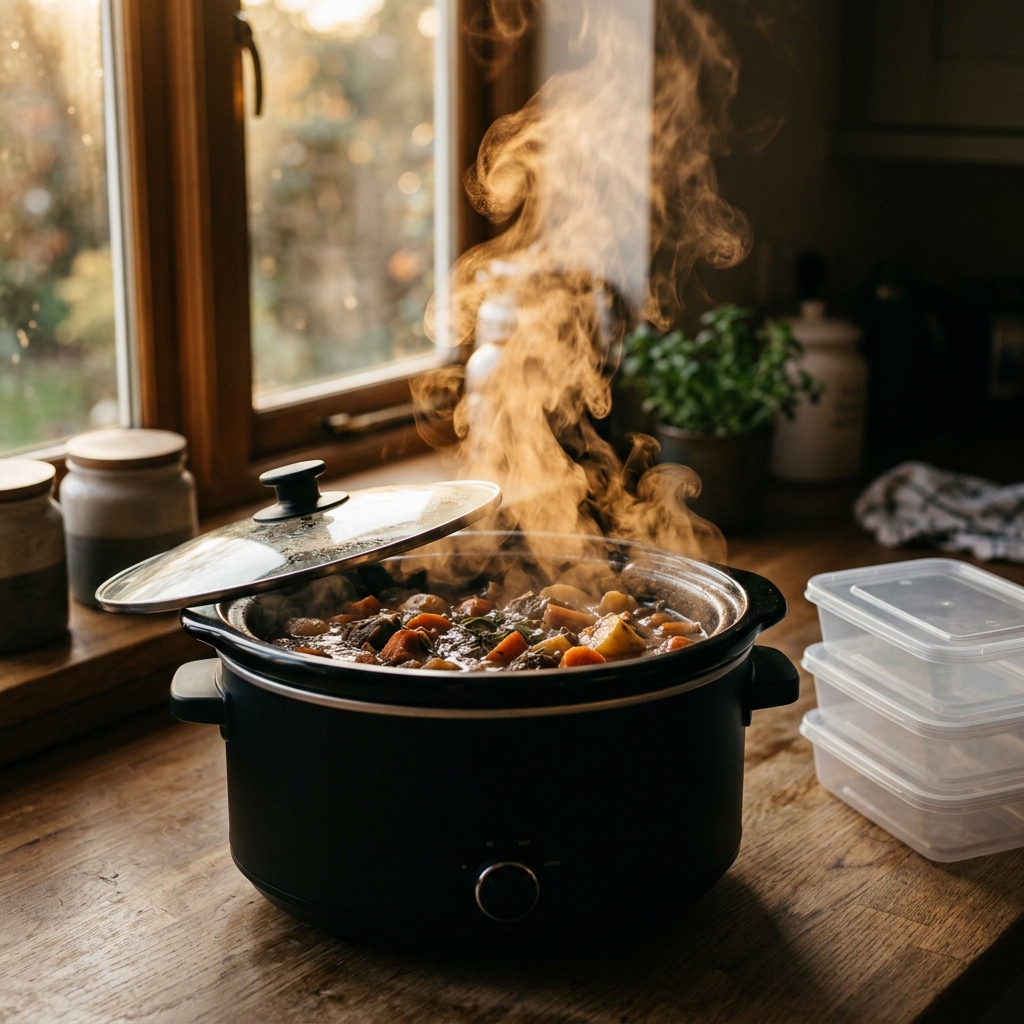
The Fast Answer: A slow cooker is one of the few kitchen gadgets that genuinely earns its place in pregnancy, because it turns cheap iron-rich ingredients into a week of dinners with ten minutes of standing up. Two caveats worth knowing: it scents the whole house for eight hours, which can be unbearable in the first trimester, and dried red kidney beans must be boiled for 10 minutes first, because slow cooking alone does not make them safe.
Track your nutrition in seconds in the PregnancyPlate AppSafety is step one. Nutrition helps your baby thrive.
Knowing a meal is safe does not tell you whether you are getting enough iron, folate, calcium and choline. PregnancyPlate tracks all of it from a photo of your plate.
- See nutrient progress
- Scan meals instantly
- Nourish with confidence
 Scan to download
Open with iPhone camera
Scan to download
Open with iPhone camera
Most pregnancy cooking advice assumes you have the energy to cook and the stomach to stand near it. The appeal of a slow cooker is that it needs about ten minutes of you, at whatever point in the day you can manage ten minutes.
It is also the cheapest way to eat well in pregnancy, because the ingredients it suits best, pulses and cheap cuts, are the iron-dense ones.
Why It Suits Pregnancy Specifically
Four reasons, and they line up neatly with the things that get hard.
The effort is front-loaded. Ten minutes in the morning buys you a dinner you do not have to face at seven in the evening, which is exactly when pregnancy fatigue peaks.
It suits iron-rich food. Lentils, beans, stewing beef, lamb shoulder and chicken thighs all improve with long slow cooking. Those are the same foods that carry the most iron, and your requirement in pregnancy is around 27mg a day.
It cooks things thoroughly by design. Long moist heat is a reliable way to get meat well past the temperatures that matter, which removes a whole category of worry.
It portions well. One batch becomes four dinners or eight freezer portions, which is what makes the third trimester and the first weeks after birth survivable.
The First Trimester Problem Nobody Mentions
Worth being honest about, because most articles sell the slow cooker as universally brilliant.
A slow cooker fills your home with cooking smells for eight hours. In the first trimester, when smell aversions are at their strongest, that is not a cosy detail. It is a day of low-level nausea, and by dinner time you may not be able to eat the thing you made.
If you are in that phase, there are workarounds. Run it overnight and refrigerate in the morning, so the smell happens while you are asleep and the food is cold when you portion it. Run it in a utility room, garage or outside on a covered step. Or accept that this is a second and third trimester tool and use the hob for quick, low-odour meals in the meantime, which our bland dinner ideas guide is built around.
By the middle trimester, when aversions usually settle, the same appliance becomes one of the most useful things in the kitchen.
Slow Cooker Food Safety, Properly
Slow cookers work in the temperature range bacteria like, then take them past it. That is fine when used as designed and less fine when improvised with.
Never put frozen meat straight in. Defrost fully in the fridge first. Frozen meat keeps the whole pot in the danger zone for too long while it thaws.
Fill it between half and three quarters full. Underfilled overheats and dries out, overfilled may not reach a safe temperature in the middle.
Keep the lid on. Every peek costs roughly twenty minutes of recovery. The recipe timings assume you leave it alone.
Low for six to eight hours, or high for three to four. Both work. Low suits tougher cuts and pulses better.
Check meat has reached at least 70°C for two minutes at the core, or about 75°C instantaneous. In practice anything that shreds with a fork is well past that, but poultry is worth checking with a probe if you have one.
Do not use the keep-warm setting to cook. It is designed to hold already-cooked food, and holding food warm for hours is how bacteria multiply.
Cool leftovers fast. Portion into shallow containers, get them into the fridge within two hours, and reheat once only, until steaming hot throughout.
The Kidney Bean Rule
This one gets its own heading because it is the genuine safety issue with slow cookers and almost nobody knows it.
Dried red kidney beans contain a natural lectin called phytohaemagglutinin, which causes sharp vomiting and stomach cramps. It is destroyed by a hard boil, and a slow cooker does not get hot enough to destroy it. Cooking dried kidney beans on low can actually leave them more toxic than raw.
So either soak dried kidney beans overnight and then boil them hard for at least 10 minutes before they go anywhere near the slow cooker, or simply use tinned kidney beans, which are already cooked. Tinned is the easy answer and there is no nutritional penalty worth caring about.
The same caution applies in a milder form to other dried beans. Tinned pulses sidestep the whole issue, and in pregnancy that is a reasonable trade.
Slow Cooker Rules in One Box
- Never frozen meat straight into the pot.
- Half to three quarters full, lid on, no peeking.
- Tinned kidney beans, or boil dried ones 10 minutes first.
- Keep-warm is for holding, never for cooking.
- First trimester: run it overnight so the smell happens while you sleep.
Ten Slow Cooker Meals That Work in Pregnancy
Chosen for iron, freezer behaviour and the fact that none of them needs you at the stove.
Lentil and vegetable dhal. The best of the lot. Very high iron, very cheap, freezes perfectly, and mild enough for most aversions.
Beef and root vegetable stew. Stewing beef is heme iron, which absorbs best of all, and a cheap cut becomes tender over six hours.
Chicken thigh and chickpea tagine with apricots. Iron from three directions at once, and the tomato base helps you absorb it.
Chilli with tinned kidney beans and beef mince. The freezer staple. Portion it and you have baked potato toppings and lunch fillings for a fortnight.
Minestrone with butter beans. Fibre-heavy, which matters when pregnancy slows digestion, and it takes any vegetable that needs using.
Pulled pork shoulder. Cooks itself, shreds into a week of different meals, and freezes in portions.
Butternut squash and red lentil soup. Smooth texture, gentle smell, and one of the few slow cooker meals that suits a bad nausea day.
Lamb and barley broth. Iron and slow carbohydrate together, and it reheats better than it cooks.
Chicken, leek and potato casserole. Genuinely bland in the useful sense, and a good one for the third trimester.
Mixed bean and vegetable stew with a tin of chopped tomatoes. Entirely plant based, costs very little, and doubles as a baby food base once you get there.
Does Slow Cooking Destroy the Nutrients?
A reasonable worry, and mostly an unfounded one.
Long heat does reduce some of the fragile vitamins, particularly vitamin C and a few of the B group. But the thing that usually causes nutrient loss is boiling food and pouring the water away, and a slow cooker does the opposite. Whatever leaches out stays in the sauce you eat, so the minerals go with it.
The nutrients that matter most here are barely affected. Iron, zinc, protein and fibre all survive long cooking comfortably. Long cooking of pulses also breaks down some of the phytates that block iron absorption, which means a lentil dhal may deliver more usable iron than the raw numbers suggest.
If you want the vitamin C back, add it at the end rather than the beginning. A squeeze of lemon, chopped fresh parsley or a handful of spinach wilted in at the last minute does it, and it helps you absorb the iron from the pot.
One mother described running the slow cooker every Sunday from about twenty weeks, mostly because it was the one form of cooking she could do sitting down at the kitchen table. By the time she reached forty weeks there were nineteen portions in the freezer, and she said those portions got her through the first three weeks after birth more than anything else she had planned for.
What Not to Put In
Slow cookers are forgiving about most things and ruinous about a few.
Dairy splits. Add cream, milk, yoghurt or soft cheese in the last twenty minutes rather than at the start.
Pasta and rice turn to paste. Cook them separately and combine at the end.
Delicate fish falls apart and overcooks in minutes. Add white fish for the final half hour at most.
Fresh herbs lose everything. Use dried herbs for the long cook and fresh ones stirred in at the end.
Too much liquid. Nothing evaporates in a sealed pot, so use roughly half what a hob recipe asks for or you will get soup.
Batching, Freezing and the Third Trimester
This is where the appliance pays for itself twice.
One full slow cooker generally yields six to eight adult portions. Cool it, portion it into flat containers or freezer bags, label with the date, and freeze flat so it stacks and defrosts faster. Most stews, dhals and chillis keep well for around three months.
In the third trimester, stomach capacity drops and small frequent meals work better than three big ones. Freezing in smaller portions rather than dinner-sized ones fits that pattern much better, and reheating a small tub is faster than reheating a plateful. Our third trimester dinner ideas work through the small-and-often approach in detail.
The other reason to build the freezer stock now is what comes after. Our freezer meals to make before baby arrives guide covers which of these reheat best one-handed, and the Sunday meal prep routine shows how to run a slow cooker batch alongside the rest of the week's food.
If you are choosing one thing to cook this week, make it the dhal. It is the cheapest, the highest in iron, the mildest in smell, and the most forgiving if you forget about it for an extra hour. Our iron in pregnancy guide explains why that combination matters more in the second half of pregnancy than almost anything else you could change.
Clinical Sources & Research
This article is general information and does not replace advice from your midwife, GP or dietitian. Always follow the manufacturer's instructions for your own slow cooker, since capacities and temperatures vary.
Meet the Editorial Team
The researchers and experts behind PregnancyPlate.

Fiza Izra
Founder & Tech Researcher
A UK-based mother of 3 with a background in tech and data synthesis, Fiza brings real-world experience navigating hyperemesis gravidarum and postnatal depression. She engineers complex clinical guidelines (NHS, ACOG) into accessible tools, ensuring rigorous fact-checking with deep empathy.

Emma Davies
Senior Nutrition Editor
A mum and writer, Emma runs our food safety desk. She is the one who rings the restaurant to ask how long the lettuce sits out, checks every claim against CDC, FDA and NHS guidance, and rewrites the answer until it is usable at 9pm in a drive-thru queue.