Instant Pot Pregnancy Meals: 10 Fast Dinners and the Pressure Cooker Safety Rules
Ten fast Instant Pot dinners for pregnancy, plus the safety rules that matter more than any recipe: delay start, frozen meat, kidney beans and the yogurt button.
In this article
Editorial note: This article is researched from official public health and pregnancy food safety guidance, then edited by the PregnancyPlate team for clarity. It is not medical advice. If you are worried about symptoms or a specific exposure, contact your midwife, GP or healthcare provider.
The Fast Answer: An Instant Pot, or any electric pressure cooker, is one of the most useful things you can own in pregnancy. It turns dried beans, lentils and cheap cuts of beef into iron-rich dinners in under an hour, with almost no standing at the stove. Three rules matter more than any recipe: never use the delay-start timer with raw meat, dairy or eggs, cook dried kidney beans at full high pressure, never on the slow cook setting, and only make yogurt from pasteurized milk.
Track your nutrition in seconds in the PregnancyPlate AppSafety is step one. Nutrition helps your baby thrive.
Knowing a meal is safe does not tell you whether you are getting enough iron, folate, calcium and choline. PregnancyPlate tracks all of it from a photo of your plate.
- See nutrient progress
- Scan meals instantly
- Nourish with confidence
 Scan to download
Open with iPhone camera
Scan to download
Open with iPhone camera
Pregnancy fatigue tends to peak at exactly the moment dinner needs making. The appeal of a pressure cooker is that it asks for ten minutes of chopping and then leaves you alone, and it finishes in the time a slow cooker would still be warming up.
It also happens to be very good at the foods pregnancy asks for most. Beans, lentils and stewing beef are some of the richest sources of iron you can buy, and they are exactly the ingredients a pressure cooker transforms fastest.
Why It Suits Pregnancy Specifically
It is fast where it counts. A beef stew that needs three hours in the oven is tender in about 35 minutes at pressure. Dried black beans go from bag to bowl in under an hour without soaking. That turns iron-rich cooking into a weeknight option rather than a Sunday project.
It suits the iron foods. Your iron requirement in pregnancy is 27mg a day. Half a cup of lentils provides about 3mg, and a cup of white beans about 8mg, according to the NIH. Those are the foods a pressure cooker makes easiest.
It keeps the smell in. The pot is sealed while it cooks, so you avoid the hours of cooking smell that makes a slow cooker hard going in the first trimester. There is one burst of steam at the end, which is easy to manage.
It cooks things thoroughly. Pressure cooking runs hotter than boiling, at around 240°F (115°C) on high pressure, which takes stews and pulled meats far past the temperatures that matter for safety.
Instant Pot or Slow Cooker?
Both are good in pregnancy. They solve different problems.
| Instant Pot (pressure) | Slow cooker | |
|---|---|---|
| Dinner from start | 30 to 60 minutes | 6 to 8 hours |
| Cooking smell | One burst when you release the steam | All day |
| Meat from frozen | Possible, with extra time | No, thaw it first |
| Dried kidney beans | Fine at full high pressure | Boil hard for 10 minutes first |
| First trimester | Usually easier | Often hard going |
| Best for | Weeknights, beans, fast stews | Hands-off weekend batches |
If you already own a slow cooker, our slow cooker pregnancy meals guide covers that side, including the kidney bean rule that catches most people out.
The Delay-Start Timer Is the Real Risk
Most pressure cooker safety worries are about the lid. Modern electric models will not open under pressure, so that one is largely solved. The setting that deserves more caution in pregnancy is the delay-start timer.
Delay start lets you load the pot in the morning and have it begin cooking hours later. With raw chicken, beef, dairy or eggs inside, that means hours at room temperature before any heat arrives. The USDA's rule is that perishable food should never sit out of refrigeration for more than 2 hours, or 1 hour above 90°F (32°C). An eight-hour delay is four times that limit.
Delay start is fine for dried beans, rice, steel-cut oats made with water, and vegetables. For anything that would normally live in your fridge, start the cook when you load the pot.
Cooking Meat From Frozen
This is one place the pressure cooker genuinely beats the slow cooker. A slow cooker heats so gently that frozen meat sits in the danger zone for too long while it thaws. A pressure cooker gets up to temperature quickly enough that cooking from frozen is fine, and the manufacturers design for it.
Two cautions. Add time, roughly half as much again for most cuts. And separate pieces before freezing where you can, because a solid frozen block of chicken thighs or ground beef cooks unevenly, and the outside can be done while the middle is not.
A food thermometer settles it. The USDA's safe minimum temperatures are 165°F (74°C) for poultry, 160°F (71°C) for ground meat, and 145°F (63°C) with a 3 minute rest for whole cuts of beef and pork. Stews and pulled meats go far past these numbers. The thermometer earns its place with quick cooks like chicken breasts and frozen meatballs.
The Kidney Bean Question
Dried red kidney beans contain a natural lectin called phytohaemagglutinin, which causes sharp vomiting and cramps. The FDA's food safety reference notes that undercooked kidney beans can be more toxic than raw ones, which is why slow cookers are a problem: they heat beans enough to make things worse, not enough to make them safe.
A pressure cooker is different. At full high pressure it runs well above boiling, and properly pressure-cooked kidney beans are safe. The risk is in the shortcuts:
- The Slow Cook setting. Most multicookers have one, and it behaves like a slow cooker. Never use it for dried kidney beans.
- Not reaching pressure. If the sealing valve was left on venting or the float valve never popped up, the beans were simmered, not pressure cooked.
- Undercooking. Soak the beans, cook for the full time in your recipe, and check that they are soft and creamy all the way through. A firm bean is not finished.
Or skip the question entirely and use canned kidney beans, which are already cooked. There is no nutritional penalty worth worrying about.
The Yogurt Button and Pregnancy
Homemade yogurt is one of the best things an Instant Pot does, and it needs one rule followed carefully. The yogurt setting holds milk warm for eight hours or more. That is perfect for the cultures you add, and it would be just as perfect for anything unwanted already in the milk.
- Use pasteurized milk only. The CDC lists pregnant women among the groups at higher risk of serious illness from raw milk, and an eight-hour warm incubation is the last place you want it.
- Heat the milk first. The standard method brings it to about 180°F (82°C) before cooling it to incubation temperature. Ultra-pasteurized milk is the one exception people use for "cold start" yogurt.
- Use a fresh starter from a pot of plain yogurt with live cultures, and a clean inner pot and sealing ring.
- Chill it as soon as it is set and eat it within about a week.
A practical note for the first trimester: the silicone sealing ring holds onto smells. If last night's curry is still in it, your yogurt will know. Many people keep a second ring just for yogurt and anything sweet.
Ten Instant Pot Meals That Work in Pregnancy
Chosen for iron, protein and how well they freeze. Times are typical at high pressure for a 6-quart model, and your recipe and model may differ.
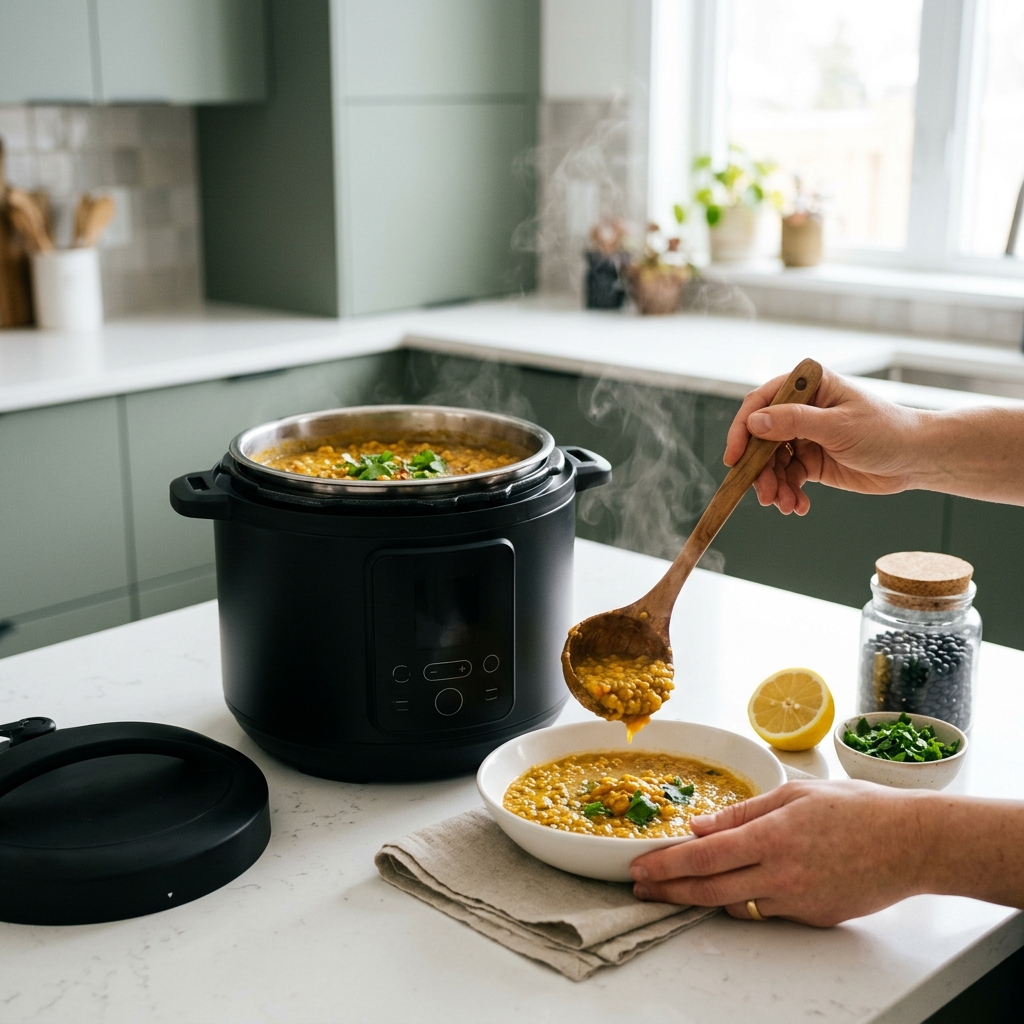
Red lentil dal, about 6 minutes. The best place to start. High in iron, very cheap, freezes perfectly, and mild enough for most aversions. Finish with a squeeze of lemon to help absorption.
Beef and vegetable stew, about 35 minutes plus natural release. Heme iron, the form your body absorbs best, from a cut that would take hours any other way.
Chicken, chickpea and spinach curry, about 8 minutes. Boneless thighs stay tender at pressure, and you get iron from three directions at once. Stir the spinach in at the end.
Black beans from dry, about 30 to 35 minutes, no soaking. The cheapest protein in the grocery store, and a freezer bag of cooked beans covers two weeks of burrito bowls and quick lunches.
Turkey chili with canned kidney beans, about 10 minutes. The freezer staple, with the kidney bean question already answered by the can.
Pressure cooker eggs, 5 minutes at pressure, 5 minutes natural release, 5 minutes in ice water. Firm yolks every time, which is the version US guidance prefers in pregnancy. Each large egg carries about 147mg of choline, a nutrient most pregnant women fall short on. Our choline guide explains why it matters.
Chicken and brown rice, about 22 to 25 minutes. A one-pot dinner, with one caution: portion the rice and refrigerate it promptly rather than leaving it on keep-warm all evening. Our guide to rice and pasta leftovers explains why.
Salmon with baby potatoes and green beans, about 4 to 5 minutes. Halved potatoes underneath, salmon on the steamer rack. Salmon is on the FDA's "Best Choices" list for pregnancy and one of the richest sources of DHA. Check that it flakes easily and has reached 145°F (63°C).
Steel-cut oats, about 10 to 12 minutes. A week of breakfasts in one go. Make them with water if you are using delay start, and add milk when you serve them.
Pulled pork shoulder, about 60 to 90 minutes. One cook becomes tacos, sandwiches, rice bowls and freezer portions for the weeks after birth.
Instant Pot Rules in One Box
- No delay start with raw meat, dairy or eggs.
- Frozen meat is fine, with extra time and a thermometer check.
- Kidney beans at full high pressure, never on Slow Cook. Or use canned.
- Yogurt from pasteurized milk only, heated first.
- Rice off keep-warm and into the fridge promptly.
Using It in the First Trimester
A pressure cooker is one of the better cooking tools for a nausea-heavy first trimester, because the smell stays sealed inside while it cooks. The moment to manage is the release.
Use natural release where the recipe allows it. It lets the pressure drop slowly over ten to twenty minutes instead of sending a jet of fragrant steam across the kitchen.
If you do need a quick release, put the cooker under the range hood or near an open window, and step out of the room for a minute.
Cook ahead and eat cold. Cooked beans, lentils and shredded chicken are all good cold the next day, and cold food smells far less than hot. Our low-odor dinner guide builds meals around exactly that.
Batching, Freezing and the Third Trimester
A full pot generally yields six to eight portions. Divide it into shallow containers so it cools quickly, get it into the fridge within 2 hours, and freeze what you will not eat in 3 to 4 days. The USDA says frozen leftovers are at their best for 3 to 4 months.
In the third trimester, when stomach space shrinks and small frequent meals work better, freezing in smaller portions pays off. Our third trimester dinner ideas work through that small-and-often approach, and freezer meals to make before baby arrives covers which of these reheat best one-handed.
Soups are the other thing a pressure cooker does brilliantly, and our pregnancy soup recipes include the cooling and reheating rules that matter most for big batches.
If you are choosing one thing to cook this week, make the dal. It takes six minutes at pressure, costs very little, and delivers more usable iron than almost anything else in this list. Our iron in pregnancy guide explains why that matters so much in the second half of pregnancy.
Clinical Sources & Research
- USDA FSIS: "Danger Zone" (40°F to 140°F).
- FoodSafety.gov: Safe Minimum Internal Temperatures.
- USDA FSIS: Leftovers and Food Safety.
- FDA: Bad Bug Book (Second Edition), Phytohaemagglutinin.
- CDC: Raw Milk.
- NIH: Iron Fact Sheet for Health Professionals.
- NIH: Choline Fact Sheet for Health Professionals.
- FDA: Advice About Eating Fish.
This article is general information and does not replace advice from your doctor, midwife or dietitian. Always follow the manual for your own pressure cooker, since pressure levels, capacities and settings vary between models.
Meet the Editorial Team
The researchers and experts behind PregnancyPlate.

Fiza Izra
Founder & Tech Researcher
A UK-based mother of 3 with a background in tech and data synthesis, Fiza brings real-world experience navigating hyperemesis gravidarum and postnatal depression. She engineers complex clinical guidelines (NHS, ACOG) into accessible tools, ensuring rigorous fact-checking with deep empathy.

Emma Davies
Senior Nutrition Editor
A mum and writer, Emma runs our food safety desk. She is the one who rings the restaurant to ask how long the lettuce sits out, checks every claim against CDC, FDA and NHS guidance, and rewrites the answer until it is usable at 9pm in a drive-thru queue.