Baby Led Weaning vs Purees: An Honest Comparison
What the evidence really says about baby led weaning versus purees, where each approach wins, and why most families end up doing a bit of both anyway.
In this article
Editorial note: This article is researched from official public health and pregnancy food safety guidance, then edited by the PregnancyPlate team for clarity. It is not medical advice. If you are worried about symptoms or a specific exposure, contact your midwife, GP or healthcare provider.
The Fast Answer: Neither wins. The research doesn't show a meaningful long-term difference in growth, fussiness or weight between the two, and most families end up combining them regardless of what they intended. Purees give you control and get iron in easily. Baby led weaning builds self-feeding and is far less work. Pick by your baby's temperament and your own nerve, then stop reading about it.
Log first foods and textures in the PregnancyPlate AppSafety is step one. Nutrition helps your baby thrive.
Knowing a meal is safe does not tell you whether you are getting enough iron, folate, calcium and choline. PregnancyPlate tracks all of it from a photo of your plate.
- See nutrient progress
- Scan meals instantly
- Nourish with confidence
 Scan to download
Open with iPhone camera
Scan to download
Open with iPhone camera
Of all the decisions in the first year, this one attracts the most certainty from people who have no idea what your baby is like.
Baby led weaning has become something close to an identity in parenting groups. Purees get treated as the lazy, old-fashioned option. Neither framing survives contact with the actual evidence, which is thinner and more boring than either camp suggests.
Here's what each one is, what the research found, and the honest case for both.
What They Actually Mean
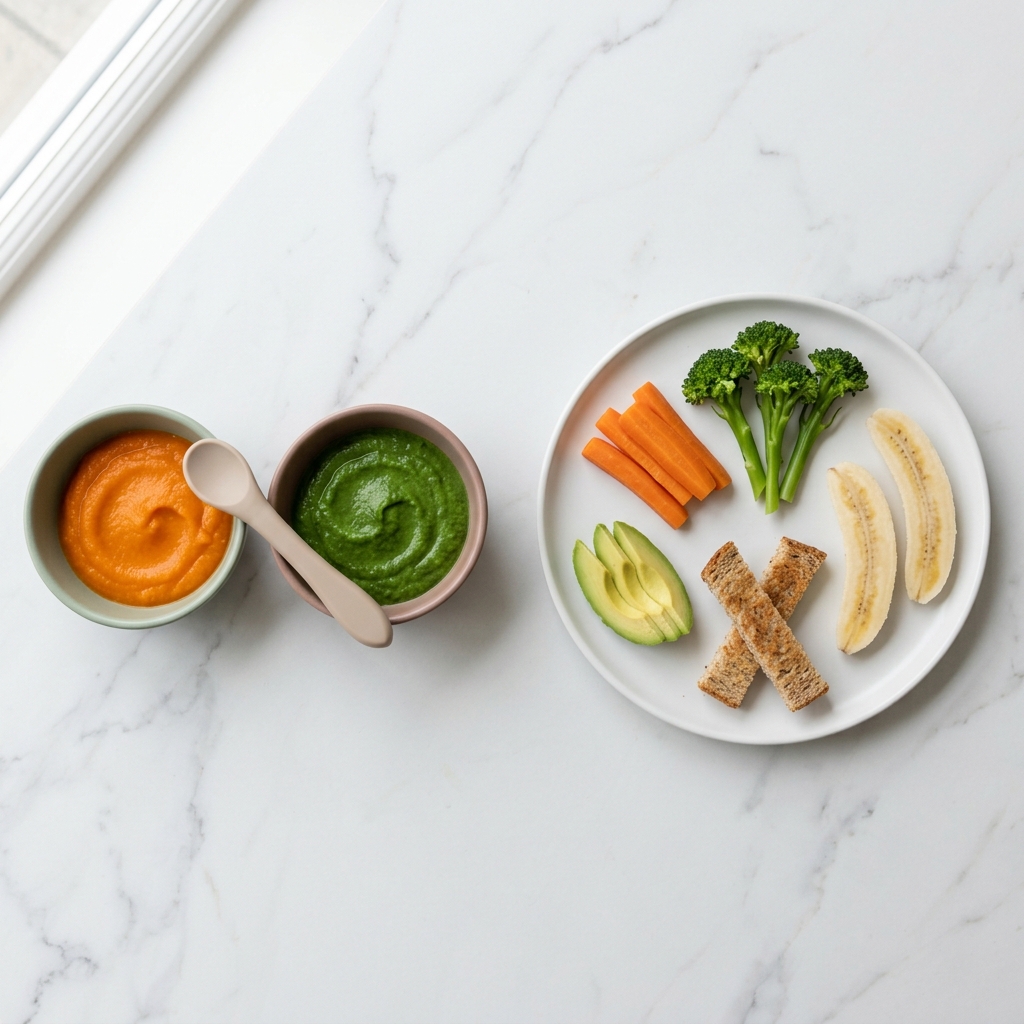
Purees means you spoon-feed smooth food, then gradually thicken it, then introduce lumps and finger foods somewhere around eight or nine months. Traditional, controlled, and what most of us were fed.
Baby led weaning skips the spoon. From the start you hand over soft food in graspable pieces and the baby feeds themselves. No purees, no spoon-feeding, and they decide how much goes in.
In practice, hardly anyone runs either one purely. Yogurt exists. So does porridge. You cannot hand a baby a fistful of yogurt and call it a philosophy.
What the Evidence Says
The most useful work here is the BLISS trial from New Zealand, which took baby led weaning seriously enough to test it properly rather than survey parents about it. Worth knowing what it found, because it gets misquoted in both directions.
On choking: the trial found no higher choking rate in the baby led group, but only after they modified the approach with specific safety rules. That caveat matters. Unmodified baby led weaning, where nobody's checked which shapes are risky, is a different proposition from the version that was studied.
On weight: no meaningful difference. The theory that self-feeding babies self-regulate better and end up leaner didn't hold up.
On iron: this is the real finding. Babies in the baby led group were at risk of low iron intake unless iron-rich foods were deliberately offered at every meal. Iron is the whole nutritional point of starting solids at six months, so this isn't a footnote.
Everything else, fussiness, food acceptance, long-term eating habits, sits in the "evidence is weak, claims are strong" category. Be sceptical of anyone confident about it.
Where Purees Genuinely Win
Getting iron in. Fortified cereal, lentil puree and blended meat deliver far more iron than a baby gumming a broccoli floret and dropping most of it. If your baby was premature, or you know iron is a concern, this matters.
You can see what went in. Reassuring in the early weeks, and genuinely useful if a health visitor is monitoring weight.
Less mess. Not a trivial factor at 6pm on a Wednesday.
Easier in childcare. Many nurseries are more comfortable spoon-feeding, and some have policies about finger foods.
Where Baby Led Weaning Genuinely Wins
Almost no extra cooking. They eat what you eat, minus the salt. No batch-blending, no ice cube trays, no separate meal.
Texture exposure from day one. Babies kept on smooth purees too long often resist lumps later. Starting with texture sidesteps that fight entirely.
Self-feeding practice. They get months of hand-to-mouth coordination that spoon-fed babies start later.
They stop when they're done. Harder to over-feed a baby who's in charge of the delivery, though as above, the weight evidence didn't back the bigger claim.
The Combination Most People Actually Do
Here's the version I'd suggest to anyone asking, and it's roughly what happens by accident anyway.
Offer finger foods at every meal, so they get texture and practice. Alongside that, spoon-feed the things that are genuinely awkward to self-feed: yogurt, porridge, lentil dhal, anything iron-fortified. Let them grab the spoon whenever they want it.
You get the iron security of purees and the texture and independence of baby led weaning. Nobody's identity is threatened. Our 4 week weaning plan is built this way, and the starting solids guide covers readiness signs before you begin either.
The Comparison in One Box
- Long-term outcomes: no meaningful difference in the evidence.
- Purees are better at iron, control and mess.
- Baby led is better at texture, self-feeding and your workload.
- The real risk with baby led is iron, not choking, provided you follow the shape rules.
- Combining both is normal, not a failure of commitment.
What a Day Actually Looks Like
Abstract comparisons are less useful than seeing the two side by side at seven months.
Purees. Breakfast is porridge off a spoon with mashed banana stirred in. Lunch is a cube of lentil and carrot from the freezer, warmed, with yogurt after. Dinner is whatever you cooked, blended with a bit of the cooking water. You cooked once for them at the weekend and you're spooning it out during the week.
Baby led. Breakfast is a strip of toast with nut butter and half a banana in its skin, peeled halfway down for grip. Lunch is a broccoli floret, a chunk of cheese and some soft-cooked carrot batons. Dinner is your dinner, chopped into strips, minus the salt. You cooked nothing extra and cleared a lot more off the floor.
Look at the actual difference. It's not nutrition, it's logistics and where the labour sits: a weekend of batch cooking versus a daily bit of chopping and a much worse floor.
Cost and Waste
Rarely mentioned and worth knowing, because it cuts both ways.
Baby led weaning wastes more food early on. A lot of what you put down gets squeezed, dropped or worn, and in the first month genuinely very little is eaten. That's expected, since milk is still doing the nutritional work, but it's hard to watch if money is tight.
Purees waste less per meal but cost more in equipment and time, and shop-bought pouches add up fast. Home-blended purees frozen in ice cube trays are the cheapest option of the lot.
If cost is the deciding factor: blend your own, freeze it, and add finger foods from your own plate. That's the cheap version of the combination approach.
The Safety Rules, Whichever You Pick
These aren't optional and they're the same either way.
Baby sits upright, in a highchair, feet supported. Never reclined, never in a car seat, never eating while crawling around.
Never leave them alone with food. Not for thirty seconds.
Cut the risky shapes. Grapes and cherry tomatoes quartered lengthways. No whole nuts, no popcorn, no raw carrot sticks, no round coin slices of anything. Firm foods cooked until they squash between your finger and thumb. Our finger foods by stage guide goes through the right shape for each age.
Know gagging from choking. Gagging is loud, red-faced and productive, and it's the reflex doing its job. Choking is silent. If you learn one thing before starting solids, learn that difference, ideally on a paediatric first aid course.
Don't put food in their mouth for them if you're doing baby led. The whole safety mechanism is that they control what goes in and how far.
How to Actually Choose
Forget the philosophy and answer three questions.
How anxious will you be? If watching your baby gag is going to make mealtimes miserable, start with purees and introduce finger foods once your nerves have settled. An anxious parent transmits it, and tense mealtimes are their own problem.
How's their iron likely to be? Premature, low birth weight, or a family history of anaemia all push toward the puree end, at least for iron-rich foods.
How much time have you got? If cooking separately is going to collapse in a fortnight, don't build a plan that depends on it.
Then start, and change your mind freely. Babies who begin on purees move to finger foods. Babies who begin baby led accept a spoon of yogurt. The approach you announced in the group chat has no bearing on what happens at the table.
A few situations do tip the balance, and they're worth knowing about rather than discovering. Reflux often makes upright self-feeding in small amounts easier to manage than a spoon-fed volume. Prematurity shifts the timing entirely, since readiness is judged from the due date rather than the birth date, so ask your health visitor before starting either. Low birth weight or known anaemia pushes toward spoon-feeding iron-rich purees, at least until levels are checked. And twins, realistically, tend to go baby led for the simple reason that spoon-feeding two babies at once requires a spare pair of hands nobody has.
What actually matters is far duller than the debate: start around six months, get iron in, offer allergens early and keep offering them, respect their appetite, and keep milk going. Do that and the rest is delivery mechanism. Our allergen guide covers the part that genuinely does change outcomes.
Meet the Editorial Team
The researchers and experts behind PregnancyPlate.

Fiza Izra
Founder & Tech Researcher
A UK-based mother of 3 with a background in tech and data synthesis, Fiza brings real-world experience navigating hyperemesis gravidarum and postnatal depression. She engineers complex clinical guidelines (NHS, ACOG) into accessible tools, ensuring rigorous fact-checking with deep empathy.

Emma Davies
Senior Nutrition Editor
A mum and writer, Emma runs our food safety desk. She is the one who rings the restaurant to ask how long the lettuce sits out, checks every claim against CDC, FDA and NHS guidance, and rewrites the answer until it is usable at 9pm in a drive-thru queue.