Baby Finger Foods by Stage: What to Offer at 6, 9 and 12 Months
Finger foods change shape as your baby's grip develops. What to offer at 6, 9 and 12 months, the squash test, and the shapes that are real choking risks.
In this article
Editorial note: This article is researched from official public health and pregnancy food safety guidance, then edited by the PregnancyPlate team for clarity. It is not medical advice. If you are worried about symptoms or a specific exposure, contact your midwife, GP or healthcare provider.
The Fast Answer: The food changes shape as the hand does. At six months babies grip with the whole fist, so food needs to be finger-length strips they can hold with some sticking out the top. Around nine months the pincer grip arrives and you drop to pea-sized pieces. By twelve months they manage most of what you eat, chopped small. The constant across all of it is the squash test: it should flatten between your finger and thumb.
Log first foods and textures in the PregnancyPlate AppSafety is step one. Nutrition helps your baby thrive.
Knowing a meal is safe does not tell you whether you are getting enough iron, folate, calcium and choline. PregnancyPlate tracks all of it from a photo of your plate.
- See nutrient progress
- Scan meals instantly
- Nourish with confidence
 Scan to download
Open with iPhone camera
Scan to download
Open with iPhone camera
Most finger food advice gives you a list. Lists aren't the problem. The problem is that the same broccoli floret is perfect at six months and faintly insulting at eleven, and nobody tells you when to change.
What's actually driving it is your baby's hand. Grip develops on a fairly predictable schedule, and the right food shape at any point is whatever their current grip can pick up. Get that wrong and it looks like fussiness when it's really frustration.
The Squash Test
One rule underneath every stage. Press the food between your thumb and index finger. If it flattens with gentle pressure, it's soft enough. If it holds firm, it isn't, no matter how small you've cut it.
That's the test for everything: carrot, apple, meat, pasta. Babies have no molars for a long while and gum food rather than chewing it, so soft matters far more than small. A tiny hard cube is more dangerous than a large soft strip, which is the opposite of what most people assume.
6 to 8 Months: The Fist Grip
Early on your baby uses a palmar grasp, meaning the whole hand closes around an object. They can't yet get anything out of a closed fist, so food has to stick out of the top for them to reach it.
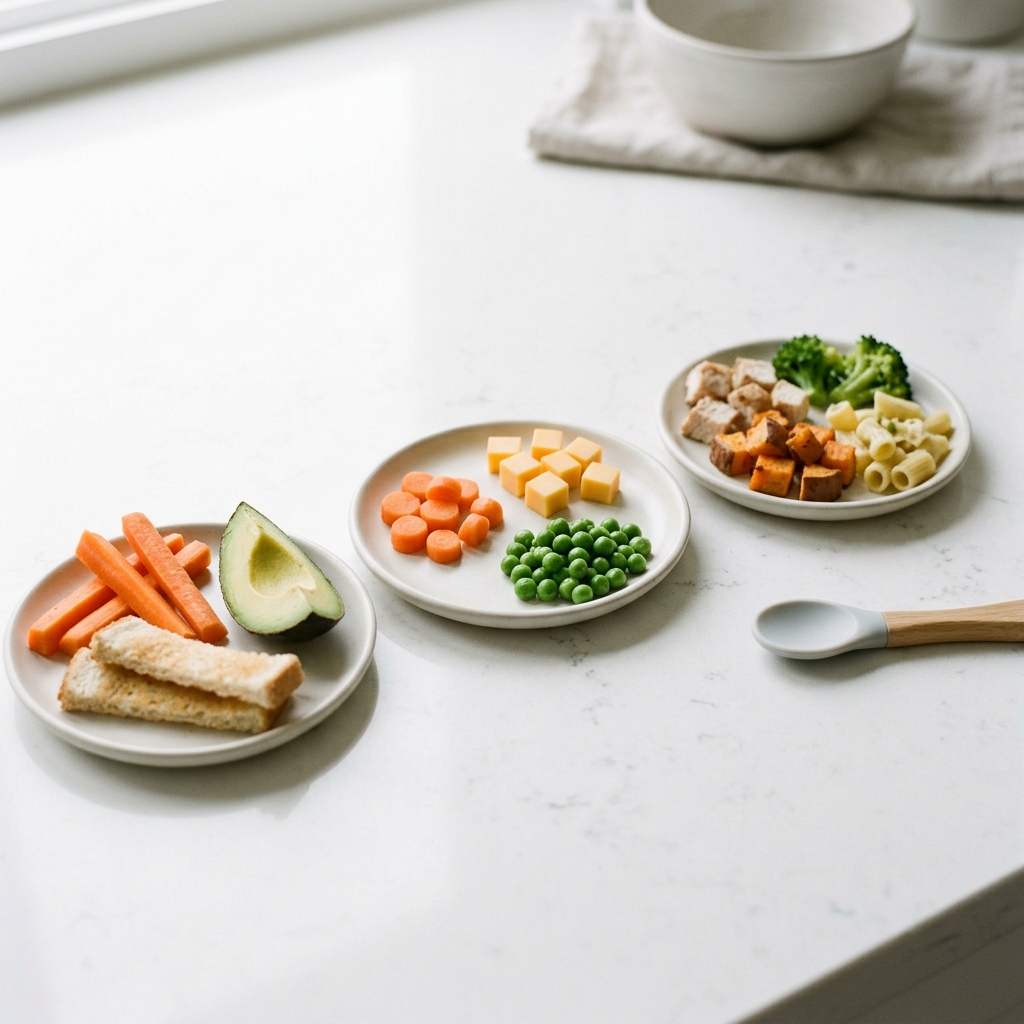
Shape: strips roughly the length and width of an adult finger. Big enough to grip with some protruding. Counterintuitive, and it's the single most common thing people get wrong.
Good at this stage: steamed carrot batons, broccoli or cauliflower florets with a long stem to hold, roasted sweet potato wedges, courgette strips, soft-cooked green beans, avocado wedges (leave a bit of skin on one end for grip), banana with the peel pulled halfway down, toast fingers with a thin spread, cooked pasta shapes like penne they can thread a finger through, strips of soft-cooked chicken or well-cooked meat, omelette cut into strips.
What to expect: very little eaten. Most of it gets squeezed, dropped or worn. That's fine, because milk is still doing the nutritional work. This stage is practice, not feeding. Our 4 week weaning plan covers the portions honestly, and our baby breakfast guide covers the meal where iron is easiest to get in.
9 to 11 Months: The Pincer Grip Arrives
Somewhere around nine months, thumb and forefinger start working together. This is a genuine turning point, and you'll notice it as an obsession with picking up crumbs, bits of fluff and anything tiny on the floor.
Shape: drop to pea-sized pieces. Small enough to pick up precisely, and it gives them the practice they're clearly seeking. Keep offering some strips too, because both grips are in use for a while.
Good at this stage: soft-cooked peas and sweetcorn, small pieces of soft fruit, cubes of cheese, flakes of fish checked carefully for bones, small pieces of well-cooked meat, cooked beans and lentils, chopped pasta, halved and quartered berries, small pieces of soft toast.
What changes: they start eating meaningfully rather than just handling food. Three meals a day is normal by now, and this is the stretch where iron from food genuinely matters, since their birth stores have run down.
12 Months and Beyond
By a year most babies eat a version of whatever you're having, chopped appropriately. They may have a few teeth, though many have very few, and gumming is still doing most of the work.
Shape: bite-sized pieces, still soft, still passing the squash test. The main thing that changes is variety rather than texture.
Good at this stage: whatever's on your plate, minus the salt. Cut-up sandwiches, curry with rice, pasta with sauce, stir fry, casserole, roast dinner chopped small. Our first 100 foods list is a useful prompt for widening the range here.
Still not yet: whole nuts, popcorn, whole grapes, raw hard vegetables, and anything with a lot of added salt. Those stay off for a good while longer.
The Stages in One Box
- 6 to 8 months: finger-length strips, held in the fist, sticking out the top.
- 9 to 11 months: pea-sized pieces, once the pincer grip arrives.
- 12 months plus: bite-sized pieces of family food, minus salt.
- Always: squashes between finger and thumb.
- Never: whole grapes, whole nuts, popcorn, raw hard veg, coin-shaped slices.
Do They Need Teeth First?
No, and this trips up a lot of people watching a gummy seven-month-old hold a carrot baton.
Babies chew with their gums, and gums are surprisingly effective on anything soft. The first teeth to arrive are usually the front incisors, which are for biting pieces off rather than grinding. Molars, the ones that actually chew, don't turn up until somewhere between twelve and eighteen months.
So a baby with no teeth at all can manage steamed vegetables, soft fruit, well-cooked meat and pasta. And a baby with eight teeth still can't handle raw carrot, because the teeth that would grind it aren't there yet. Teeth are not the milestone to wait for. The squash test is.
Finger Foods Away From Home
The stage rules travel, but the practicalities change.
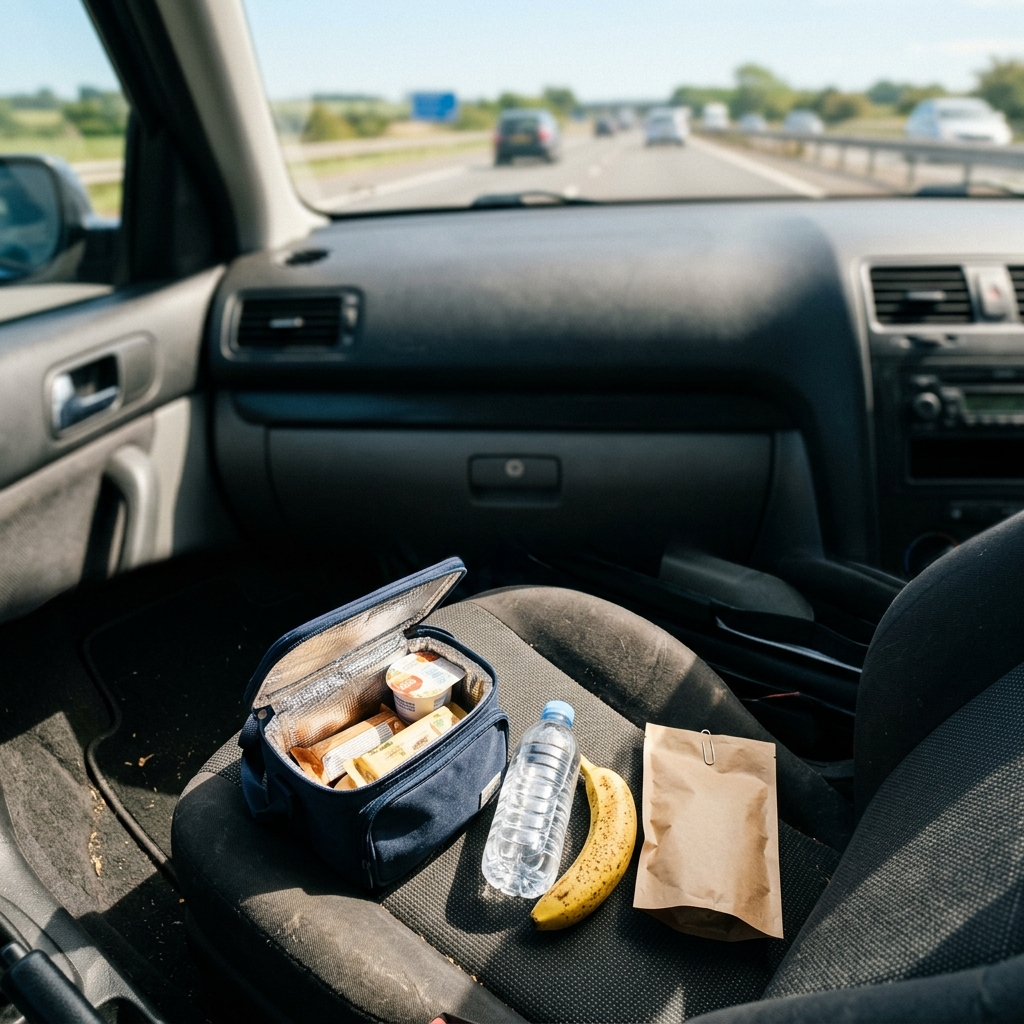
Best out-and-about options: rice cakes, breadsticks, banana in its skin, soft fruit in a pot, cheese cubes, cooked pasta shapes, toast fingers. All survive a bag without refrigeration for a couple of hours.
What to bring: a full-coverage bib with sleeves, a wipeable mat if you're at a table, and more wipes than seems reasonable. A suction bowl helps at home and is largely decorative in a café.
At nursery or with family, write the current stage down rather than assuming. "Strips at the moment, everything soft enough to squash" takes ten seconds to say and prevents grandparents offering whole grapes, which is the most common near-miss there is.
The Shapes That Are Actually Risky
Choking risk is about shape as much as size, and a few specific forms come up again and again.
Round and firm. Whole grapes, cherry tomatoes, blueberries at the early stage. These are exactly the diameter of a small airway. Quarter them lengthways, never across into coins.
Coin-shaped slices. Sausage, carrot, banana sliced into discs. Same problem. Cut lengthways into strips instead.
Hard and smooth. Whole nuts, raw carrot, apple chunks, hard sweets. Nut butter is fine, whole nuts wait until five. Apple is fine grated or cooked soft.
Light and compressible. Popcorn, crisps, marshmallow. These can be inhaled before they're swallowed.
Sticky and thick. A thick layer of nut butter can be hard to clear. Spread it thin.
And the non-negotiables regardless of food: baby sits upright with feet supported, never eats lying back or moving around, and is never left alone with food. Our baby led weaning guide covers the difference between gagging and choking, which is worth knowing before you need it.
When They Just Throw It All on the Floor
Around nine or ten months this becomes a full-time occupation, and it is not defiance.
Dropping things is how babies learn about gravity, cause and effect, and object permanence. Your baby is running an experiment, and the experiment requires an assistant who keeps returning the equipment. It usually passes within a few months.
What helps: a splash mat under the highchair, offering two or three pieces at a time rather than a loaded tray, and calmly ending the meal when everything is going overboard rather than turning it into a game. What doesn't help is reacting strongly, which makes it far more interesting.
Signs You've Got the Stage Wrong
Worth knowing, because the fix is usually the shape rather than the food.
They keep dropping it and getting cross. Pieces are too small for their current grip, or too slippery. Go back to strips, or roll slippery food in something with texture like ground oats.
They mouth it and hand it back. Often too hard. Do the squash test again, and cook it longer.
They lose interest within a minute. Sometimes too easy and no longer interesting. Try smaller pieces if the pincer grip has arrived, or a new texture.
Lots of gagging. Normal early on and it decreases with practice, but if it's constant, check the size and softness again. Gagging that resolves on its own is the reflex working.
The pattern across all of it is that most feeding problems at this age are mechanical, not behavioural. Change the shape before you conclude anything about your baby's appetite or personality.
Clinical Sources & Research
Meet the Editorial Team
The researchers and experts behind PregnancyPlate.

Fiza Izra
Founder & Tech Researcher
A UK-based mother of 3 with a background in tech and data synthesis, Fiza brings real-world experience navigating hyperemesis gravidarum and postnatal depression. She engineers complex clinical guidelines (NHS, ACOG) into accessible tools, ensuring rigorous fact-checking with deep empathy.

Emma Davies
Senior Nutrition Editor
A mum and writer, Emma runs our food safety desk. She is the one who rings the restaurant to ask how long the lettuce sits out, checks every claim against CDC, FDA and NHS guidance, and rewrites the answer until it is usable at 9pm in a drive-thru queue.