Baby's First Foods: A 4-Week Weaning Plan
A week by week weaning plan for baby's first foods, from single vegetables to three meals a day, with the portion sizes nobody tells you are this small.
In this article
Editorial note: This article is researched from official public health and pregnancy food safety guidance, then edited by the PregnancyPlate team for clarity. It is not medical advice. If you are worried about symptoms or a specific exposure, contact your midwife, GP or healthcare provider.
The Fast Answer: Four weeks takes you from one teaspoon of vegetable to something resembling three meals a day. Start around six months. Milk stays the main event the whole time, so don't chase volume. What you're actually building is practice, not nutrition, until roughly month two. Week by week below, with honest portion sizes.
Log first foods and allergens in the PregnancyPlate AppSafety is step one. Nutrition helps your baby thrive.
Knowing a meal is safe does not tell you whether you are getting enough iron, folate, calcium and choline. PregnancyPlate tracks all of it from a photo of your plate.
- See nutrient progress
- Scan meals instantly
- Nourish with confidence
 Scan to download
Open with iPhone camera
Scan to download
Open with iPhone camera
Read three weaning books and you'll get three different week ones. One says pear. One says broccoli, because sweet things first supposedly breed a sweet tooth. One says hand the baby a chicken drumstick and step back.
They can all be right, which is the bit nobody says out loud. The order barely matters. What matters is that you start around six months, you keep offering, and you don't quietly skip the allergens.
So here's a four week shape. Not a rulebook. If your baby sleeps through a meal or hates everything on a Tuesday, you haven't fallen behind.
Before Week One
Two things to sort first.
Check they're ready. Sitting up with steady head control, reaching for things and getting them to their mouth, and no longer pushing everything straight back out with their tongue. All three, roughly together. Waking at night and watching you eat aren't signs. Both start around three months and neither means what people think. Our guide to starting solids goes through this properly.
Pick your moment. Mid-morning tends to work. They're awake, not starving, and you've got the rest of the day to spot a reaction. Offer milk first for the first fortnight, then food. A ravenous baby has no patience for a spoon.
Week One: One Vegetable, Once a Day
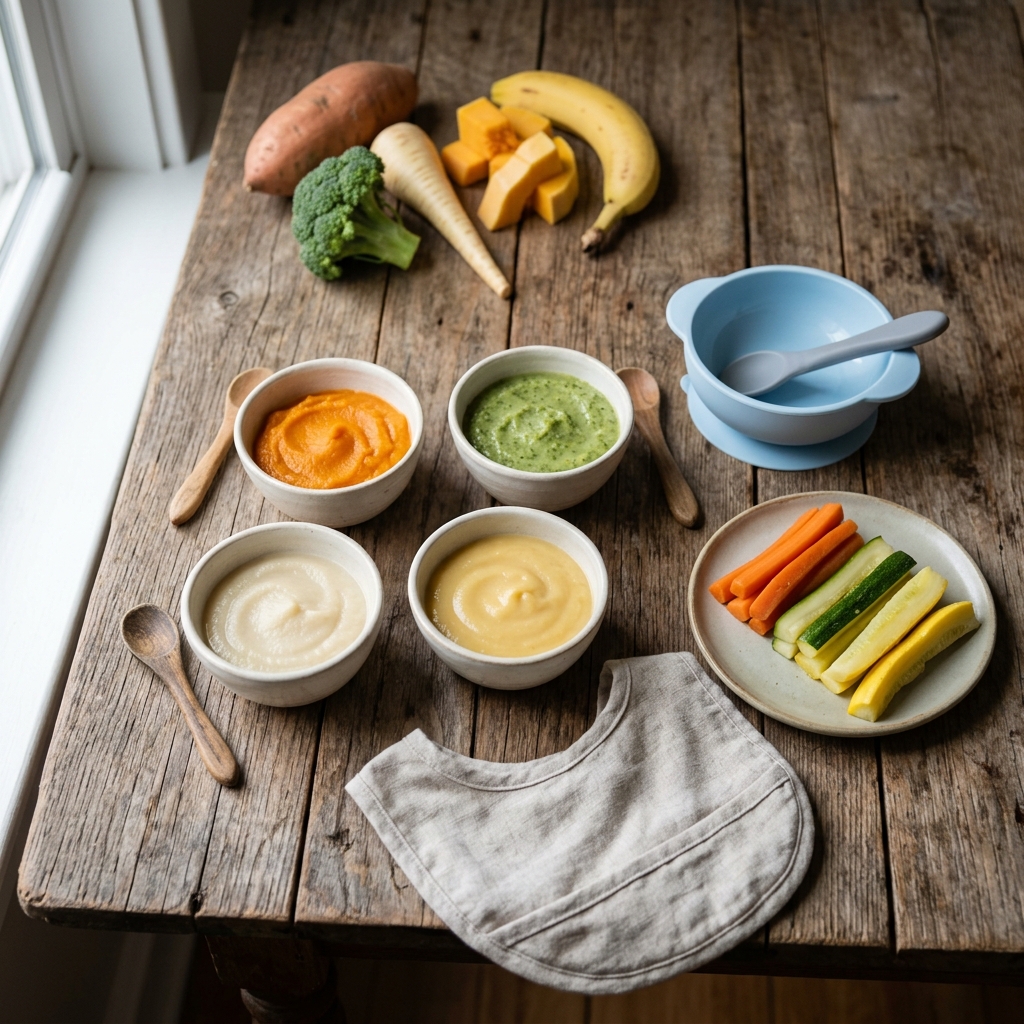
Start with a single vegetable. Steamed and blended, or a soft-cooked finger of it if you're going the baby led route. Broccoli, carrot, sweet potato, courgette, parsnip. Any of them.
Offer it once a day. Same food for two or three days, then swap.
Now the portion size, because this is where everyone panics. One or two teaspoons is a full meal this week. Some babies take one lick and turn away. That's a completed meal. Their stomach is roughly the size of their fist, and milk is still doing all the real work.
Expect mess, gagging faces and most of it reappearing on the bib. All normal.
Week Two: Twice a Day, and Start Allergens
Move to two meals, say mid-morning and early afternoon. Widen the vegetables and bring in fruit: banana, pear, apple, avocado.
This is also the week to start allergens, and it's the part people put off. Don't. Current guidance flipped years ago, and delaying past six to twelve months raises allergy risk rather than lowering it. Start with smooth peanut butter thinned with milk, or a well-cooked egg. A teaspoon is plenty.
Two rules. One new allergen at a time, and offer it in the morning so you've got daylight hours to watch. Once it's gone in without trouble, keep it in the rotation. Regular exposure is what maintains tolerance. Our allergen introduction guide covers the nine to work through and what a reaction looks like.
Portions this week: two to four teaspoons a meal. Still tiny.
Week Three: Iron, and Thicker Textures
Here's where it stops being practice. The iron a baby is born with runs down by around six months, and breast milk is low in it. Food has to start filling that gap.
So bring in iron: well-cooked minced meat, lentils, beans, fish without bones, or iron-fortified baby cereal. Serve it alongside something with vitamin C, like a little fruit or tomato, which helps the iron absorb.
Thicken the texture too. Mash with lumps rather than purée. It feels early. It isn't. Babies who stay on smooth purées too long often fight lumps later, and the window for accepting new textures is more forgiving now than it will be at ten months.
Add a third meal toward the end of the week if they seem keen. Portions creep up to a few tablespoons.
Week Four: Three Meals, Family Food
By now you're aiming at breakfast, lunch and dinner, and the goal shifts. Stop cooking separately. Start adapting what you're already eating.
Your bolognese works, minus the salt. Your curry works, mild and mashed. Scrambled egg, porridge, soft pasta, cooked vegetables from the roast. This is the whole point of weaning, and the sooner you get there the less cooking you're doing.
Keep offering finger foods alongside whatever's on the spoon. Toast fingers, soft fruit, cooked carrot batons. They're learning to self-feed, and that takes months of practice starting now. Our finger foods by stage guide covers what shape to cut them as their grip develops, and our baby food freezer system covers making a month of it in one afternoon.
From here it's about widening the range. Our first 100 foods list is a useful prompt for that, and our baby led weaning versus purees comparison covers how to get it in.
What a Portion Actually Looks Like
The single most common worry is that they're not eating enough. They almost always are. And milk should not drop yet, which our guide to dropping milk feeds covers in full.
- Week 1: 1 to 2 teaspoons, once a day.
- Week 2: 2 to 4 teaspoons, twice a day.
- Week 3: 1 to 2 tablespoons, two or three times a day.
- Week 4: 2 to 4 tablespoons, three times a day.
And milk doesn't drop through any of this. Around 500 to 600ml a day, or breastfeeding on demand, right through the first year. Food adds to milk. It doesn't replace it until much later.
The Plan in One Box
- Week 1: one vegetable, once a day, teaspoons.
- Week 2: twice a day, add fruit, start allergens.
- Week 3: add iron, thicken texture, third meal.
- Week 4: three meals, adapted family food.
- Throughout: milk stays the main source of nutrition.
What You Actually Need to Buy
Far less than the shops suggest. Weaning has an entire industry attached to it and most of it is optional.
The useful list: a few soft-tipped spoons, two or three bowls with suction bases, a full-coverage bib with sleeves, and a highchair your baby can sit upright in with their feet supported. That last detail gets missed. Dangling feet make a baby less stable, and a stable baby eats better and gags less.
What you can skip: a dedicated baby food blender, if you own any blender or a fork. Pouches as a daily habit, since they train sucking rather than chewing. Baby rice, which is bland, low in iron and mostly a hangover from when weaning started at four months.
Gagging Is Not Choking
Worth knowing the difference before you need it, because gagging will happen and it's alarming to watch.
Gagging is loud. Retching, coughing, red face, eyes watering. It's a protective reflex pushing food forward, and it's working. Sit still. Let them sort it out.
Choking is quiet. No sound, no effective cough, and that's exactly what makes it frightening. It needs immediate action.
A paediatric first aid course is the best hour you'll spend before weaning. Most areas run them free or cheap.
Foods to Keep Out of the First Year
Short list, and each one has a reason.
Honey, until twelve months. It can carry spores that cause infant botulism. This one's absolute.
Salt. Babies under one should have less than 1g a day, and their kidneys can't handle more. This rules out stock cubes, gravy, most sauces and most bread-heavy meals as a base. Cook yours unsalted, take theirs out, then season yours.
Whole nuts and other choking shapes: whole grapes, cherry tomatoes, raw carrot sticks, popcorn. Quarter grapes and tomatoes lengthways. Nut butter is fine, whole nuts aren't until five.
Added sugar, which is about preference more than harm. Start sweet and everything else tastes worse by comparison.
Also skip unpasteurised cheese, raw or runny eggs unless they're British Lion stamped, and rice drinks as a milk substitute under five.
When It Goes Wrong
It will, and none of these mean anything's broken.
They refuse everything for days. Common, especially around teething or a cold. Keep offering without pressure. A food often needs eight or ten exposures before it's accepted, and forcing it is the one thing that reliably backfires.
Constipation. Fairly usual as their gut adjusts. More water with meals, more fruit and vegetables, less baby rice. Speak to your health visitor if it drags on.
Nappies change colour and smell. Yes. Immediately and permanently. Sweetcorn will reappear intact and that's normal.
You're weeks "behind" someone else's baby. Ignore it. Progress between six and twelve months varies enormously, and where a baby is at seven months predicts very little.
One last thing. Vitamin D drops are recommended for all breastfed babies from birth, and for formula-fed babies once they're taking under 500ml a day. It's easy to forget in the middle of everything else. If you're still breastfeeding, our breastfeeding nutrition guide covers your side of it too.
Meet the Editorial Team
The researchers and experts behind PregnancyPlate.

Fiza Izra
Founder & Tech Researcher
A UK-based mother of 3 with a background in tech and data synthesis, Fiza brings real-world experience navigating hyperemesis gravidarum and postnatal depression. She engineers complex clinical guidelines (NHS, ACOG) into accessible tools, ensuring rigorous fact-checking with deep empathy.

Emma Davies
Senior Nutrition Editor
A mum and writer, Emma runs our food safety desk. She is the one who rings the restaurant to ask how long the lettuce sits out, checks every claim against CDC, FDA and NHS guidance, and rewrites the answer until it is usable at 9pm in a drive-thru queue.