Batch Cooking Baby Food: A Freezer System That Takes One Afternoon
A simple freezer system for homemade baby food: what to batch, what freezes badly, portion sizes by stage, and the storage and reheating rules that matter.
In this article
Editorial note: This article is researched from official public health and pregnancy food safety guidance, then edited by the PregnancyPlate team for clarity. It is not medical advice. If you are worried about symptoms or a specific exposure, contact your midwife, GP or healthcare provider.
The Fast Answer: One afternoon gets you three or four weeks of baby food. Cook a handful of single ingredients, blend or mash to the right texture, freeze in ice cube trays for the early months and small pots later. Cool it fast, freeze it the same day, use within a month, and reheat until piping hot then cool before serving. That's the whole system.
Track what your baby is actually eating in the PregnancyPlate AppSafety is step one. Nutrition helps your baby thrive.
Knowing a meal is safe does not tell you whether you are getting enough iron, folate, calcium and choline. PregnancyPlate tracks all of it from a photo of your plate.
- See nutrient progress
- Scan meals instantly
- Nourish with confidence
 Scan to download
Open with iPhone camera
Scan to download
Open with iPhone camera
Making baby food from scratch every day is a nice idea that survives about four days. Batch cooking is what makes homemade actually sustainable, and it's less work than people assume because babies eat tiny amounts of a few things.
The whole system fits in one afternoon and a stack of ice cube trays.
Why Cubes Rather Than Pots
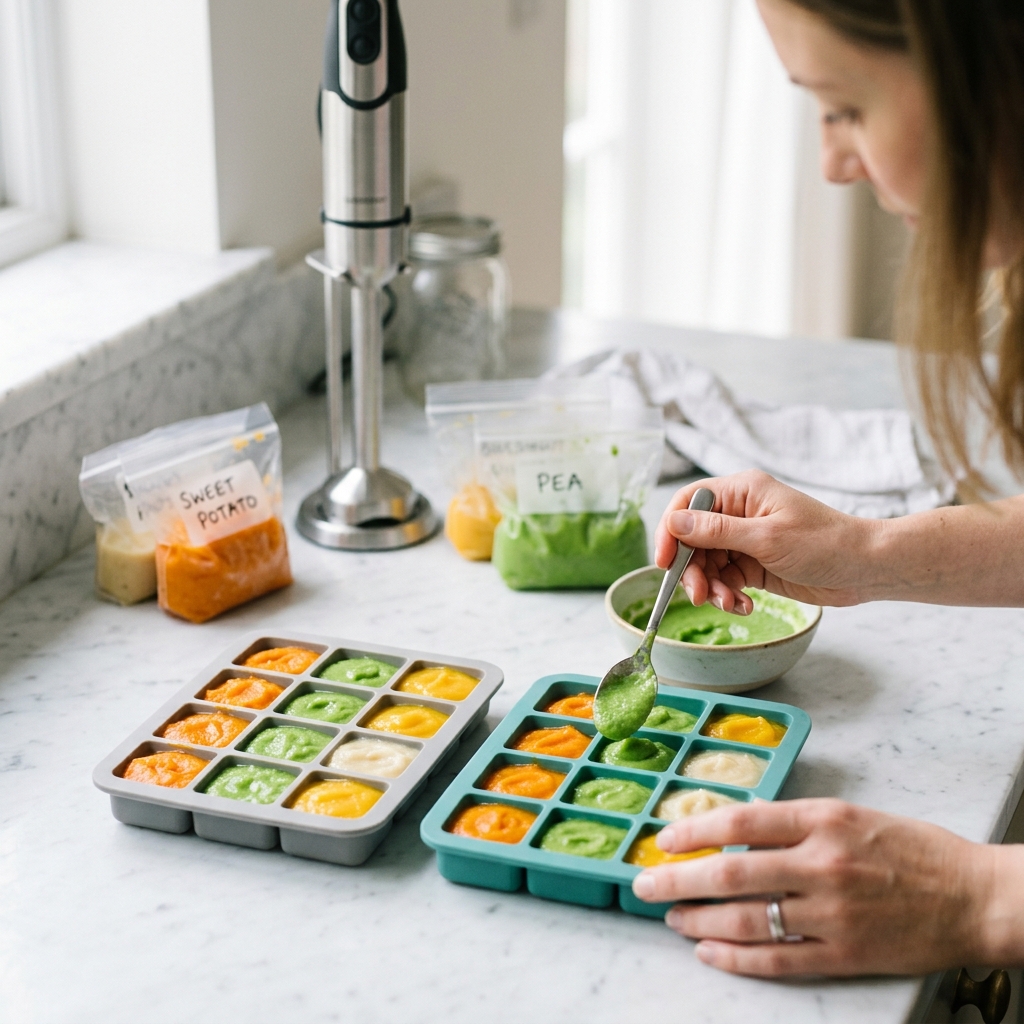
An ice cube tray holds roughly 15 to 30ml per compartment, which is almost exactly one early weaning portion. That's the trick that makes this work.
Freeze single ingredients as cubes and you can combine them later without cooking anything: one carrot cube plus one lentil cube, or two sweet potato and one pea. As your baby grows you simply defrost more cubes rather than making bigger batches. And when one food gets rejected for a fortnight, which happens, you haven't lost a whole tub.
Once frozen solid, pop the cubes out and bag them by ingredient. The trays go back into service the same afternoon.
The Afternoon Itself
Pick five or six ingredients, cook them together, blend separately. Roughly ninety minutes including cleanup.
In the oven: sweet potato, butternut squash and carrot, roasted until soft. Roasting beats boiling here because less flavour leaches out.
On the hob: a pan of red lentils, and a steamer basket over it with broccoli, courgette and green beans.
Blend each one separately with a splash of the cooking water, your baby's usual milk, or plain water. Aim for the texture your stage needs, which for the first few weeks is smooth and for month two onward is deliberately lumpier.
Fill the trays, cool, freeze. Cool as fast as you can, then get them in the freezer the same day.
That's six ingredients, forty-odd cubes, and about a month of variety for an early eater. Our 4 week weaning plan shows how to work through them.
Portion Sizes by Stage
Useful for knowing how much to defrost, and reassuring if you think your baby isn't eating enough.
- 6 to 7 months: 1 to 2 cubes per meal, once or twice a day.
- 7 to 9 months: 2 to 4 cubes, two or three times a day.
- 9 to 12 months: 4 to 6 cubes, three times a day, alongside finger foods.
Milk stays the main source of nutrition throughout the first year, so these amounts are meant to look small.
The Storage Rules That Matter
Babies are more vulnerable to food poisoning than adults, so this part is worth getting right rather than eyeballing.
Cool it fast. Get cooked food cooled and into the fridge or freezer within an hour or two. Spreading it into shallow trays speeds this up considerably, which is another advantage of cubes over tubs.
Freeze on the day you cook. Not after two days in the fridge.
Fridge life is short. Homemade baby food keeps around two days refrigerated. Anything longer goes in the freezer.
Freezer life is about a month for good quality, and label everything with the ingredient and date. Frozen purees all look identical, and you will not remember.
Defrost properly. Overnight in the fridge, or straight from frozen in a pan or microwave. Never on the counter.
Reheat until piping hot all the way through, then stir and cool before serving. Piping hot kills bacteria; the cooling is so you don't burn their mouth. Test on the inside of your wrist.
Never refreeze, and throw away anything left in the bowl after a meal. Saliva introduces bacteria, so the leftovers of a portion your baby has been eating from aren't safe to keep.
The System in One Box
- Freeze single ingredients as cubes, then combine on the day.
- Cool fast, freeze same day, use within about a month.
- Label everything. Frozen purees are indistinguishable.
- Reheat piping hot, then cool. Never refreeze.
- Bin what's left in the bowl once they've eaten from it.
What You Actually Need
Very little, despite an entire industry suggesting otherwise.
Genuinely useful: three or four ice cube trays, ideally silicone so the cubes pop out without a fight. Freezer bags or boxes to decant into. A stick blender, which is easier to clean than a jug blender and fine for these quantities. A fork, which handles more than you'd think once you're past smooth purees.
Skip: a dedicated baby food maker, which steams and blends in one machine and duplicates a pan and a blender you already own. Pouch-filling kits. Branded baby food storage pots at several times the price of ice cube trays.
If you own a blender and a saucepan, you're equipped. The only genuine purchase is the trays.
Scaling Up As They Grow
The cube system runs out of usefulness around nine or ten months, and that's a good sign rather than a problem.
By then your baby is eating three meals, textures are lumpier, and defrosting six cubes per meal gets silly. Two things change. Move from cubes to small pots of about 150 to 200ml, and stop freezing single ingredients in favour of freezing actual meals: dhal, bolognese, chicken casserole, fish pie mix.
This is also the point where batch cooking for the baby quietly merges with batch cooking for the household. You cook one thing, you take out their portion before seasoning, and both freezers get filled from the same pan. That's the version worth arriving at, because it's the one that survives going back to work.
What Freezes Well and What Doesn't
Freezes beautifully: root vegetables, squash, peas, broccoli, lentils, beans, apple and pear, cooked meat in sauce, fish in sauce, casseroles, dhal, bolognese.
Freezes badly: anything with a high water content that collapses on thawing, so cucumber, lettuce and melon are out. Potato purees can turn gluey. Cooked pasta and rice go mushy, so freeze the sauce and cook those fresh. Banana and avocado brown and are better fresh anyway, since both need no cooking. Dairy-heavy sauces can split, though stirring usually rescues them.
Cheats worth knowing: frozen peas, spinach and berries are already prepped and hold their nutrients well, so there's no need to buy those fresh to freeze. And plain frozen vegetables from the supermarket blend into perfectly good puree in minutes.
Getting Texture Right, Not Just Smooth
The most common batch cooking mistake is freezing a month of perfectly smooth puree and then discovering your baby has moved on.
Texture should progress faster than feels natural. Smooth for perhaps the first two weeks, then mashed with lumps, then roughly chopped. Babies who stay on smooth purees too long often resist lumps later, and the window for accepting new textures is more forgiving at seven months than at ten.
So batch in stages rather than all at once. Do a smooth run, then when you next cook, blend less. An easy trick: blend most of the batch smooth and leave a portion deliberately chunky, then stir the two together in whatever ratio suits that week. You control the texture at serving time instead of committing to it a month ahead.
Iron Needs a Plan of Its Own
One thing to build in deliberately, because it's the most common gap in homemade baby food.
Vegetable purees are lovely and contain very little iron. From around six months your baby's own stores run down and food has to start supplying it. So batch some iron alongside the vegetables: red lentils, well-cooked minced beef or lamb blended into a sauce, chicken thigh, or beans.
Freeze those as cubes too, and combine one iron cube with one or two vegetable cubes at mealtimes. Adding a vitamin C source in the same meal, like a little fruit puree or tomato, improves how much of the plant iron gets absorbed. Our first 100 foods list flags which foods carry the most.
Seasoning, and the Salt Line
Batch cooking makes it tempting to cook one meal for everyone. You can, with one rule.
No added salt, and that includes stock cubes, gravy, soy sauce and most jarred sauces. Babies under one should have less than 1g of salt a day and their kidneys can't handle more. Cook the batch unsalted, take out your baby's portion, then season the rest for yourself.
Herbs and spices are actively encouraged. Cinnamon, cumin, mild paprika, garlic, basil, ginger. There's no reason to withhold flavour, only salt, and babies fed exclusively bland food often become toddlers who reject anything else. A mild dhal is better weaning food than plain baby rice on every measure.
If you're already batch cooking for yourself, our freezer meals guide covers the adult half of the same afternoon.
Clinical Sources & Research
Meet the Editorial Team
The researchers and experts behind PregnancyPlate.

Fiza Izra
Founder & Tech Researcher
A UK-based mother of 3 with a background in tech and data synthesis, Fiza brings real-world experience navigating hyperemesis gravidarum and postnatal depression. She engineers complex clinical guidelines (NHS, ACOG) into accessible tools, ensuring rigorous fact-checking with deep empathy.

Emma Davies
Senior Nutrition Editor
A mum and writer, Emma runs our food safety desk. She is the one who rings the restaurant to ask how long the lettuce sits out, checks every claim against CDC, FDA and NHS guidance, and rewrites the answer until it is usable at 9pm in a drive-thru queue.