First 100 Foods: A Weaning List by Category
A first 100 foods list for weaning, grouped by category with the ones worth prioritising, why variety matters early, and how to track it without the pressure.
In this article
Editorial note: This article is researched from official public health and pregnancy food safety guidance, then edited by the PregnancyPlate team for clarity. It is not medical advice. If you are worried about symptoms or a specific exposure, contact your midwife, GP or healthcare provider.
The Fast Answer: The point of a 100 foods list isn't the number. It's variety before the fussy stage, which for most babies arrives somewhere between twelve and eighteen months. Foods accepted before then tend to stay accepted. Herbs and spices count. So does every individual bean. The full list is below, grouped so you can see your gaps at a glance.
Track your first 100 foods in the PregnancyPlate AppSafety is step one. Nutrition helps your baby thrive.
Knowing a meal is safe does not tell you whether you are getting enough iron, folate, calcium and choline. PregnancyPlate tracks all of it from a photo of your plate.
- See nutrient progress
- Scan meals instantly
- Nourish with confidence
 Scan to download
Open with iPhone camera
Scan to download
Open with iPhone camera
The "100 foods before one" idea has spread fast, and like most parenting targets it's half useful and half a stick to beat yourself with.
The useful half is real though. There's a window in the first year where babies accept new flavours and textures with very little fuss, and it closes. Toddler food refusal isn't a discipline problem, it's a developmental stage called neophobia, and it arrives on schedule regardless of how you've parented. What you got in before it counts for a lot.
So treat the list as a prompt for variety, not a scorecard. Nobody's checking.
What Counts as a Food
More generously than you'd think, which is the bit that makes 100 achievable.
Each individual vegetable, fruit, grain, protein and dairy item counts once. So do herbs and spices, which is not a technicality: early exposure to flavour is a real part of why this works. Cinnamon counts. Cumin counts. Basil counts.
Different forms of the same thing don't count twice. Apple puree and apple slices are one food. But related items with different flavours do count separately, so butternut squash and courgette are two, and red lentils and chickpeas are two.
Vegetables (aim for 25)
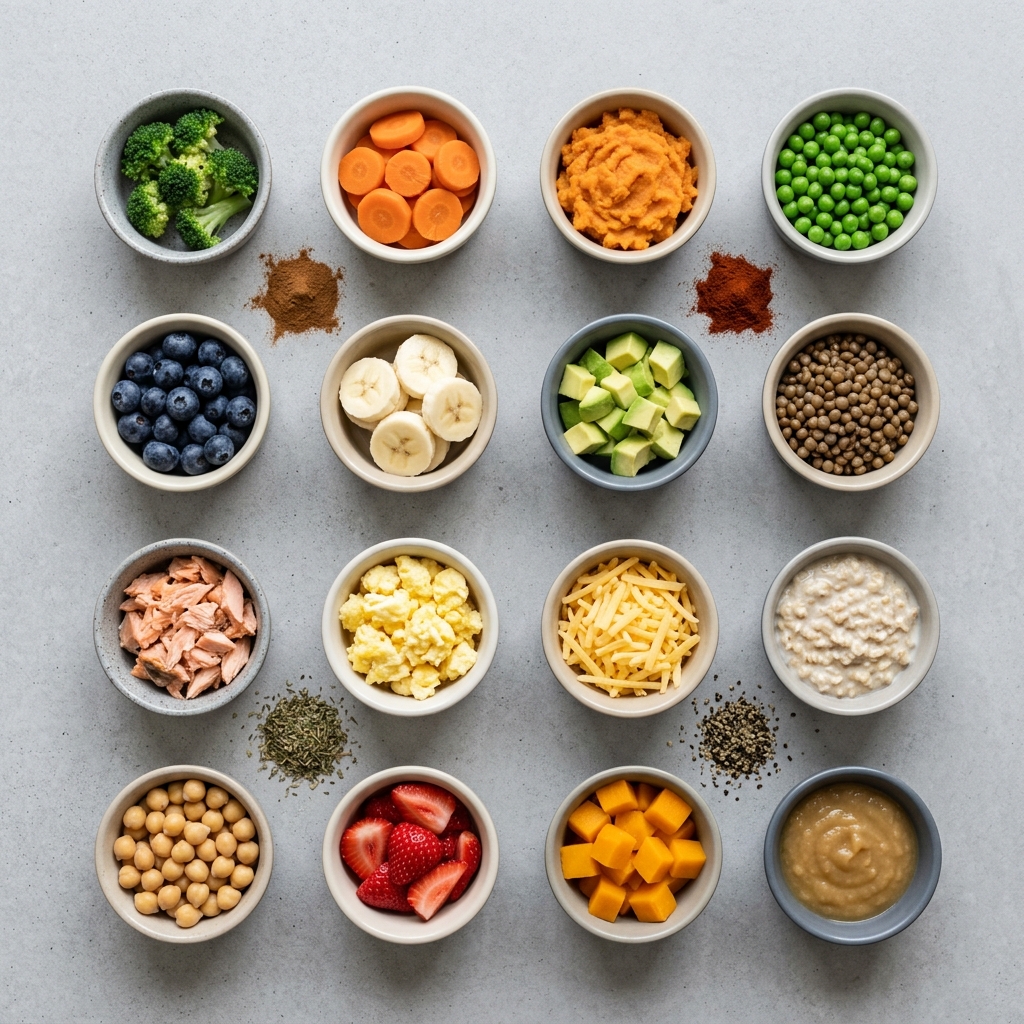
Broccoli, cauliflower, carrot, parsnip, sweet potato, white potato, butternut squash, pumpkin, courgette, aubergine, green beans, peas, sweetcorn, spinach, kale, cabbage, Brussels sprouts, asparagus, beetroot, cucumber, tomato, red pepper, yellow pepper, mushroom, leek, onion, celery, swede, turnip, pak choi.
Start here in week one. Vegetables are the hardest sell later, so front-load them while your baby has no opinions. Bitter greens especially.
Fruit (aim for 20)
Banana, apple, pear, peach, nectarine, plum, apricot, mango, papaya, melon, watermelon, strawberry, raspberry, blueberry, blackberry, orange, satsuma, kiwi, pineapple, avocado, grape (quartered lengthways), cherry (stoned and quartered), fig, date, prune.
Easy wins, and useful for constipation, which turns up for nearly every baby once solids start. Prunes, pears and apricots earn their place there.
Protein (aim for 20)
Chicken, turkey, beef, lamb, pork, salmon, cod, haddock, mackerel, sardines, trout, egg, red lentils, green lentils, chickpeas, black beans, kidney beans, butter beans, cannellini beans, tofu, tempeh, peanut butter, almond butter, cashew butter, tahini, hummus.
This is the group that matters most nutritionally. Iron stores run down around six months and this is where the replacement comes from. Red meat, dark poultry meat and lentils are the heavy hitters, and pairing them with something containing vitamin C helps absorption.
Note how many of these are also allergens. That's deliberate. Egg, peanut, fish, sesame and tree nuts all belong here and all should go in early and stay in the rotation, which our allergen introduction guide covers properly.
Grains and Carbohydrates (aim for 15)
Oats, rice, quinoa, pasta, couscous, bulgur wheat, barley, wholemeal bread, pitta, rye bread, rice cakes, oatcakes, polenta, buckwheat, millet, wheat cereal, cornmeal.
Straightforward, and they're mostly delivery vehicles for everything else. Watch the salt in bread, which counts toward the under-1g daily limit faster than people expect.
Dairy (aim for 10)
Full-fat yogurt, cream cheese, cheddar, mozzarella, parmesan, cottage cheese, ricotta, butter, whole milk in cooking, custard made without added sugar.
Full fat, always, until two. Cow's milk as a main drink waits until twelve months, but using it in cooking from six months is fine. Keep unpasteurised cheeses out.
Herbs, Spices and Extras (aim for 10)
Cinnamon, cumin, coriander, paprika (sweet, not hot), turmeric, mild curry powder, basil, oregano, thyme, rosemary, mint, dill, garlic, ginger, nutmeg, vanilla.
The most skipped group and the one that does the most work. Babies fed bland food for a year become toddlers who reject flavour. There's no reason to withhold spice, only salt. A mild dhal is better weaning food than plain baby rice on every measure.
The Ones Worth Prioritising
If 100 feels like a lot, these earn their place first.
- Iron-rich: red meat, chicken thigh, lentils, beans, fortified cereal.
- The nine allergens: egg, peanut, cow's milk, wheat, soya, fish, shellfish, sesame, tree nuts.
- Bitter greens: broccoli, kale, spinach, sprouts. Hardest to introduce later.
- Oily fish: salmon, sardines, mackerel, for omega-3.
- At least five spices, so flavour is normal rather than alarming.
The List in One Box
- 25 vegetables, 20 fruit, 20 protein, 15 grains, 10 dairy, 10 herbs and spices.
- Herbs and spices count. They're the most skipped and most useful group.
- Front-load vegetables, especially bitter ones, before opinions arrive.
- A refused food isn't a failed food. It often takes eight to ten goes.
- 100 is a prompt, not a target. Sixty varied foods is a good year.
What Doesn't Go on the List
A few things stay off until after the first birthday, and each has a reason.
Honey. Not until twelve months, because of the risk of infant botulism. This one is absolute, and it includes honey baked into things.
Salt. Under-ones should have less than 1g a day. That rules out stock cubes, gravy, soy sauce, most shop-bought sauces and a lot of bread if you're not watching. Cook unsalted, take their portion out, then season yours.
Added sugar. Not dangerous, just unhelpful. Start sweet and everything else tastes worse by comparison.
Whole nuts, popcorn, whole grapes and raw hard vegetables. Choking shapes. Nut butters are fine, whole nuts wait until five.
Unpasteurised cheese, raw or runny eggs unless British Lion stamped, shark, swordfish and marlin, and rice drinks as a milk substitute under five.
Everything else on the list above is fair game from six months.
A Realistic Timeline
Spreading 100 foods across six months sounds like a lot until you divide it.
Months 6 to 7. Perhaps 15 to 20 foods. Single vegetables, a few fruits, first allergens. Portions are teaspoons and most of it ends up elsewhere.
Months 8 to 9. Another 30 or so. Proteins arrive properly, textures thicken, and you start adapting family meals rather than cooking separately.
Months 10 to 12. The remaining 50. This is the easy stretch, because by now they're eating roughly what you eat and every family meal adds two or three new things without effort.
The curve is deliberately back-loaded. Almost nobody hits 100 by racing at the start, and trying to tends to produce a stressful mealtime culture that costs you more than the variety gains.
Rejection Is Part of It
A food offered once and spat out has not been tried. It's normal for a baby to need eight or ten exposures before accepting something, and the research on this is consistent enough to rely on.
So put the broccoli back on the tray next week. And the week after. Without commentary, without a performance of eating it yourself, and definitely without pressure, which is the one approach that reliably makes things worse.
Some foods will never land. That's true of adults too.
One practical trick that costs nothing: offer the new thing alongside something they already like, rather than on its own. A baby facing a plate of unfamiliar food will often reject the lot. The same baby, given a familiar favourite with one new item beside it, will usually at least investigate. Pairing beats persuading.
Keeping Track Without Making It a Project
A list this long is impossible to hold in your head, especially on no sleep, and that's the only real argument for tracking it.
The value isn't the tally. It's spotting the gap. Most families discover around month three that they've done thirty vegetables and four spices, or plenty of chicken and no oily fish. You don't notice that without writing it down somewhere.
The first 100 foods log in the app is built for exactly this: tick each one off as it goes in, and it shows you which category is falling behind rather than just counting up. Then you can aim the next week's meals at the gap.
One last thing worth saying, because these lists breed anxiety. A baby who eats fifty foods in their first year is doing completely fine. The list exists to widen the range, not to rank you against someone on the internet who fed their six-month-old miso-glazed aubergine. Our 4 week weaning plan is the calmer place to start, and our comparison of baby led weaning and purees covers how to get the food in.
Meet the Editorial Team
The researchers and experts behind PregnancyPlate.

Fiza Izra
Founder & Tech Researcher
A UK-based mother of 3 with a background in tech and data synthesis, Fiza brings real-world experience navigating hyperemesis gravidarum and postnatal depression. She engineers complex clinical guidelines (NHS, ACOG) into accessible tools, ensuring rigorous fact-checking with deep empathy.

Emma Davies
Senior Nutrition Editor
A mum and writer, Emma runs our food safety desk. She is the one who rings the restaurant to ask how long the lettuce sits out, checks every claim against CDC, FDA and NHS guidance, and rewrites the answer until it is usable at 9pm in a drive-thru queue.