Back to Work While Breastfeeding: Eating, Pumping and Storing Milk
Going back to work while breastfeeding: how to eat on a schedule you don't control, pumping logistics, and the milk storage rules that are worth memorising.
In this article
Editorial note: This article is researched from official public health and pregnancy food safety guidance, then edited by the PregnancyPlate team for clarity. It is not medical advice. If you are worried about symptoms or a specific exposure, contact your midwife, GP or healthcare provider.
The Fast Answer: Two problems collide when you go back. You still need around 450 to 500 extra calories a day, on a schedule someone else now controls. And you need to remove milk roughly as often as your baby would, or supply drifts down. The storage rule worth memorising is 4 hours at room temperature, 4 days in the fridge, 6 months in the freezer. Everything else is logistics.
Keep your intake on track in the PregnancyPlate AppThe thing nobody quite prepares you for is that breastfeeding at home is flexible and breastfeeding around a job is not. At home you eat when you're hungry and feed when the baby wants. At work, both of those are scheduled by other people.
Most of the difficulty is practical rather than physiological, which is good news, because practical problems have practical answers.
Eating on Someone Else's Schedule
Breastfeeding costs roughly 450 to 500 extra calories a day and that doesn't pause because you're in a meeting. The common pattern is skipping breakfast in the rush, missing lunch, and arriving home ravenous and depleted.
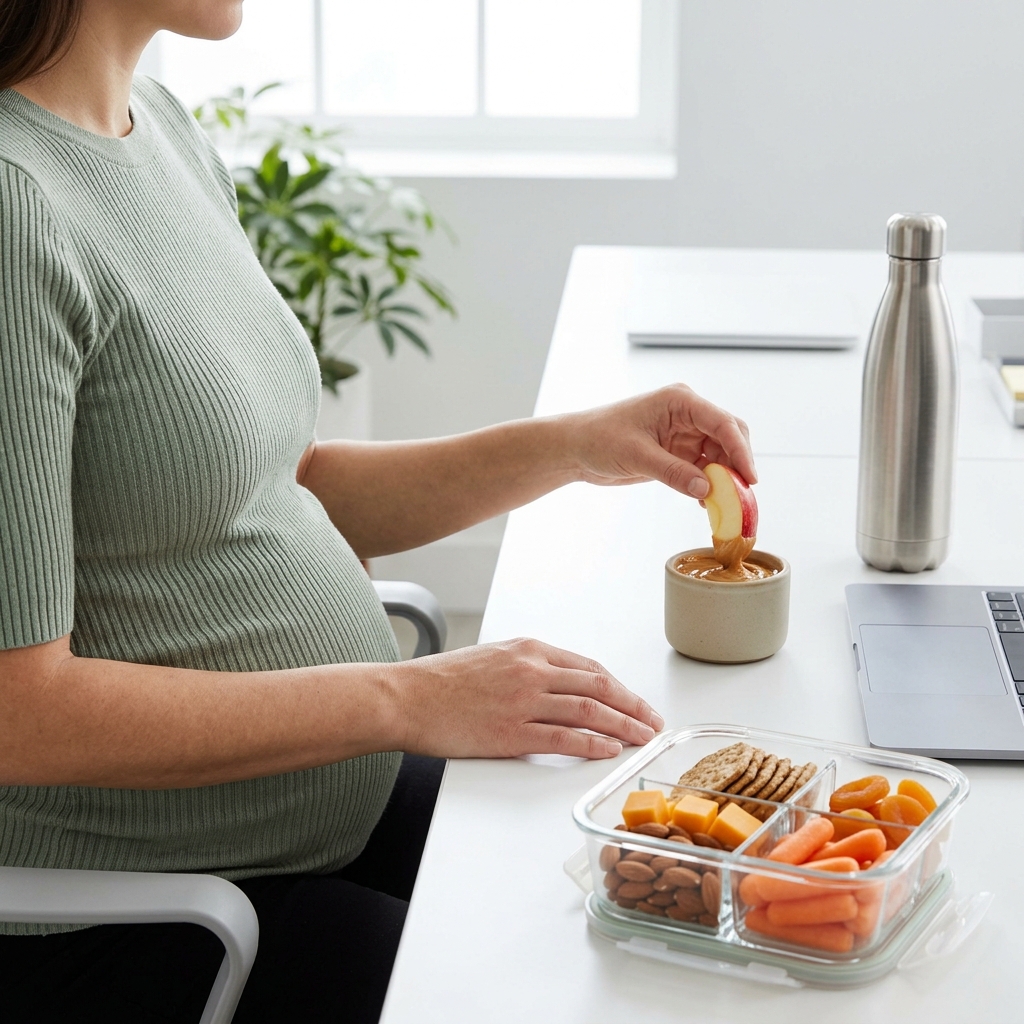
The fix is a stocked drawer rather than better intentions. Keep food at your desk that needs no fridge, no preparation and no decision: nuts, oatcakes, cereal bars, dried fruit, nut butter sachets, tinned fish, crackers. Add yogurt and cheese to the office fridge if you have one.
Then eat on the same rhythm you'd pump. If you're taking a break to express anyway, that's the natural cue to eat something. Pairing the two means one reminder covers both, and you're sitting down regardless. Our breastfeeding nutrition guide covers the targets in detail.
Hydration is the one people underestimate. A large bottle on your desk that you refill twice is easier to track than trying to remember glasses.
How Often to Pump
The principle is simple: milk removal drives supply, so if you remove less than your baby would have, your body reads that as reduced demand.
Roughly, aim to pump as often as your baby would feed during those hours. For a full day away that's commonly two or three sessions, each around 15 to 20 minutes. Younger babies feed more often, so more sessions; older babies on solids often need fewer.
What helps output: a well-fitting flange, which matters more than the pump itself and is very commonly the wrong size. Looking at a photo or video of your baby. Being somewhere you can actually relax, because stress genuinely inhibits letdown. And hand expression at the end of a session, which typically gets more out than the pump alone.
Don't judge your supply by what the pump produces. A pump is far less effective than a baby, and low output is normal rather than diagnostic. Our low milk supply guide covers what actually indicates a problem.
The Storage Rules
Worth committing to memory, because you'll apply them daily. These are the standard NHS and CDC figures for healthy full-term babies.
- Room temperature (up to 25C): 4 hours, ideally used sooner
- Fridge (4C or below): up to 4 days at the back, not the door
- Freezer: about 6 months for best quality, up to 12 months acceptable
- Cool bag with ice packs: around 24 hours, which covers the commute
- Thawed in the fridge: use within 24 hours, and never refreeze
- Left over after a feed: use within 2 hours, then discard
Two practical notes. Store in small amounts, 60 to 120ml, because thawing 200ml for a baby who takes 90ml wastes the rest. And label everything with the date, since expressed milk in identical bottles is impossible to tell apart.
Milk separating into layers in the fridge is normal. Swirl it rather than shaking. And breast milk varies in colour depending on what you've eaten, which is also normal.
Back to Work in One Box
- 4 hours room temp, 4 days fridge, 6 months freezer.
- Pump as often as your baby would feed during those hours.
- Pair eating with pumping. One reminder covers both.
- Freeze in 60 to 120ml portions, and label with the date.
- Pump output is not a supply measurement.
What to Actually Carry
The bag gets heavy fast, so it's worth being deliberate about it.
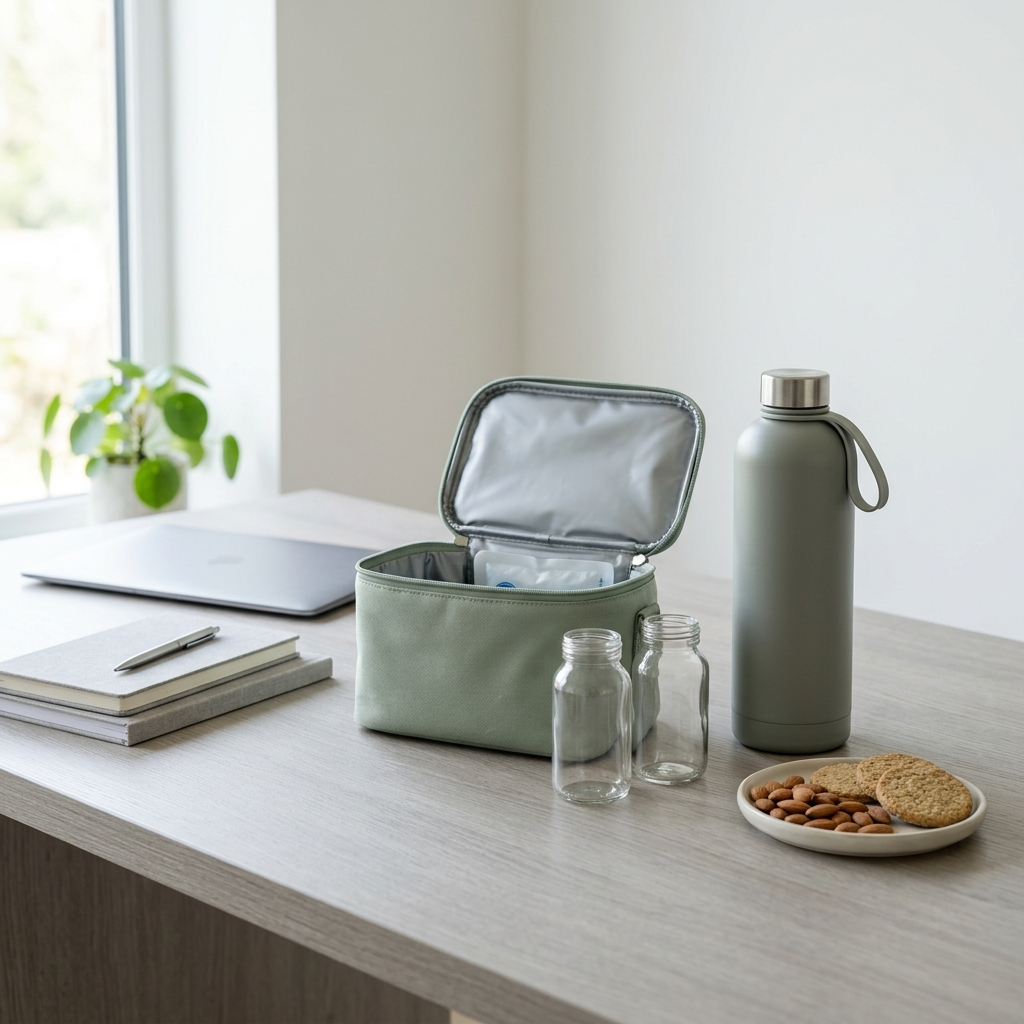
Non-negotiable: the pump and its parts, spare bottles or bags, a cool bag with ice packs, and breast pads. A spare top, because leaks happen and a visible one ruins a day.
Worth having: a hands-free pumping bra, which turns a session from twenty minutes of sitting still into twenty minutes of answering email. Wet wipes or a small bottle of washing-up liquid for parts. A spare set of pump parts so a forgotten valve doesn't end the day.
Worth knowing: pump parts don't need sterilising between every use during a working day. Refrigerating them in a sealed bag between sessions is widely used and saves a lot of faff, though they do need washing properly once daily. Check your own pump's guidance, since manufacturers differ.
Dress for it too. Two-piece outfits and anything that unbuttons or lifts from the waist make this vastly easier than a dress with a back zip.
What Your Employer Has to Provide
Worth knowing before you negotiate, because a lot of women assume they have no standing.
In the UK, tell your employer in writing that you're breastfeeding. That triggers a legal duty to carry out a risk assessment and to provide somewhere suitable to rest, which in practice supports a private space. There's no explicit statutory right to paid pumping breaks. But many employers accommodate it, and refusing reasonable adjustments can amount to discrimination. A toilet is not a suitable space, and you're entitled to say so.
In the US, the PUMP Act gives most employees the right to reasonable break time and a private, non-bathroom space to express milk.
Practically: raise it a few weeks before you return, in writing, and be specific. How many breaks, roughly how long, and what you need in the space. A fridge, a lockable door and a plug socket cover most of it.
The Fortnight Before You Go Back
The transition goes far better with a run-up than a cold start.
Start a small freezer stash a few weeks ahead. Not an enormous one. A few days' worth is plenty, and expressing obsessively for weeks is exhausting for no real gain.
Introduce a bottle if your baby hasn't had one, and get someone else to give it. Many babies refuse a bottle from the person who smells of milk. Then do a practice day, pumping at the times you'll actually be pumping, so your body starts adjusting before the real thing.
Then let the pattern settle. Many babies reverse-cycle, meaning they feed less during the day and more in the evening and overnight to make up for it. That's normal, it's not a supply problem, and it usually eases as they take more solids.
Nursery, Childminder or Grandparents
Whoever has your baby needs a bit more information than you'd assume, and getting it down in writing saves repeated conversations.
Label every bottle with your baby's name and the date it was expressed. Most nurseries require both. Send slightly less than you think per bottle, since 60 to 90ml portions mean less gets poured away, and send a spare.
Ask how they warm it. Breast milk should be warmed gently in warm water, never in a microwave, which creates hot spots and damages some of the immune components. Ask what happens to what's left too, because milk from a bottle your baby has drunk from needs using within two hours.
One genuinely useful thing to mention: paced bottle feeding. Holding the baby upright with the bottle horizontal, so they work for it rather than having it pour in. It reduces overfeeding, which is the usual reason a carer reports your baby suddenly needing far more than you're producing.
If You Want to Stop, or Cut Down
Going back to work doesn't have to mean carrying on exactly as before, and combination feeding is a completely reasonable outcome rather than a failure.
If you're dropping feeds, do it gradually. Cut one session at a time and leave several days between drops, which lets supply adjust and substantially reduces the risk of blocked ducts and mastitis. Dropping several at once is the main cause of both.
Plenty of women end up breastfeeding morning and evening and formula or expressed milk during the day, which keeps the feeds that matter most to them without the logistics of pumping at work. Our postpartum nutrition guide covers eating well through whichever version you land on.
Meet the Editorial Team
The researchers and experts behind PregnancyPlate.

Fiza Izra
Founder & Tech Researcher
A UK-based mother of 3 with a background in tech and data synthesis, Fiza brings real-world experience navigating hyperemesis gravidarum and postnatal depression. She engineers complex clinical guidelines (NHS, ACOG) into accessible tools, ensuring rigorous fact-checking with deep empathy.

Emma Davies
Senior Nutrition Editor
A mum and writer, Emma runs our food safety desk. She is the one who rings the restaurant to ask how long the lettuce sits out, checks every claim against CDC, FDA and NHS guidance, and rewrites the answer until it is usable at 9pm in a drive-thru queue.