Choline During Pregnancy: The Forgotten Brain-Building Nutrient
Many popular prenatal vitamins contain absolutely zero choline. Here is why this nutrient is critical for fetal brain development and how to get enough of it through your diet.
In this article
Editorial note: This article is researched from official public health and pregnancy food safety guidance, then edited by the PregnancyPlate team for clarity. It is not medical advice. If you are worried about symptoms or a specific exposure, contact your midwife, GP or healthcare provider.
I spend hours every week reviewing the nutrition labels of the most popular prenatal vitamins on the market, and there is one glaring omission that consistently shocks me. A massive percentage of high-end, heavily marketed prenatal supplements contain absolutely zero choline. If they do contain it, the dosage is often so low that it barely makes a dent in your daily requirement.
Choline is frequently called the forgotten nutrient of pregnancy. While we are all strictly advised to take folic acid to prevent neural tube defects, choline is rarely mentioned in standard prenatal appointments. Yet, a growing body of clinical research shows that choline is just as critical as folate for your baby's developing brain and spinal cord. When I dug into the exact biological function of this nutrient, the data was overwhelmingly clear. We need to be talking about choline much more than we currently are.
What is Choline and Why Does Your Baby Need It?
Choline is an essential nutrient that plays a foundational role in cellular growth and metabolism. During pregnancy, your demand for choline skyrockets because it is required for almost every aspect of fetal development. First and foremost, choline is a critical building block for the fetal brain. It is used to produce a neurotransmitter called acetylcholine, which is responsible for memory, mood, muscle control, and other essential brain and nervous system functions.
Your next meal, a little less guesswork.
Scan your plate for pregnancy food-safety guidance and a nutrition breakdown. Keep your meals and nutrient progress in one place.
 Scan with your iPhone
to get the app
Furthermore, choline works synergistically with folate. Just like folic acid, choline helps prevent neural tube defects, which are serious abnormalities of the brain and spinal cord. According to the ACOG (American College of Obstetricians and Gynecologists), adequate choline intake during pregnancy is essential for fetal neurodevelopment and can have long-lasting effects on a child's cognitive function and memory. Some studies even suggest that high maternal choline intake can improve a child's processing speed and attention span well into their school years.
Beyond the brain, choline is heavily utilized by the placenta. It helps transport nutrients across the placental barrier to the baby and regulates epigenetic markers, which essentially turn certain genes on or off. Because your body prioritizes the baby, it will actively shuttle your own choline stores through the placenta. If you are not consuming enough choline in your diet, your own liver function and muscle health can suffer as a result.
The Prenatal Vitamin Gap
If choline is so important, why isn't it standard in every prenatal vitamin? The answer comes down to basic chemistry and manufacturing logistics. Choline salts are incredibly bulky. To fit the recommended daily allowance of choline into a single capsule alongside iron, calcium, and all your B vitamins, the pill would be the size of a golf ball. It would be impossible to swallow, especially for women battling severe morning sickness.
Because manufacturers want to keep their pills small and palatable, they simply leave choline out or include a token amount, such as 10mg or 20mg. When you consider that your daily requirement is vastly higher, this tiny inclusion is essentially statistically insignificant. This means that even if you are diligently taking your premium prenatal vitamin every single morning, you are likely relying almost entirely on your diet to fulfill your choline needs.
This widespread deficiency is exactly what Registered Dietitian Lily Nichols highlights in her widely cited book, Real Food for Pregnancy. Nichols is a massive authority in the prenatal space, and her work is heavily credited with shining a spotlight on the critical importance of choline for fetal brain development, placental health, and cellular function. As she points out, we are currently facing a massive "Choline Gap" where over 90% of expectant mothers do not meet the basic adequate intake for choline. In her book, she breaks down the science showing that standard prenatal guidelines for choline are often set far too low, and she emphasizes sourcing it from high-quality, nutrient-dense foods like eggs and liver.
She also highlights the "Cognitive Performance Factor," pointing to clinical research that links higher maternal choline intake, especially in the third trimester, to measurable improvements in a child's processing speed, long-term memory, and sustained attention span as they grow. Another notable book in this specific prenatal functional nutrition niche is Functional Maternity by Sarah Thompson, which also heavily outlines the biochemical importance of choline and methyl donors during pregnancy.
How Much Choline Do You Actually Need?
The math here is precise. The NIH (National Institutes of Health) and the FDA have established clear adequate intake levels for pregnant women. When you are pregnant, you need 450 milligrams of choline every single day. If you choose to breastfeed, that requirement jumps even higher to 550 milligrams per day, because choline is heavily secreted into breast milk to continue supporting the infant's rapid brain growth.
To put that 450mg target into perspective, a large portion of the population falls short of this goal even when they are not pregnant. When your demand increases to support a growing fetus, the deficit becomes much wider. Reaching 450mg requires intentional, focused dietary choices.
The Best Dietary Sources of Choline
Because you cannot rely on your prenatal vitamin, you have to look to your plate. Animal products are generally the most concentrated sources of choline, but there are plant-based options available for vegetarian and vegan mothers as well. Here is a breakdown of the most efficient ways to hit your 450mg daily target.
Eggs (The Choline Powerhouse)
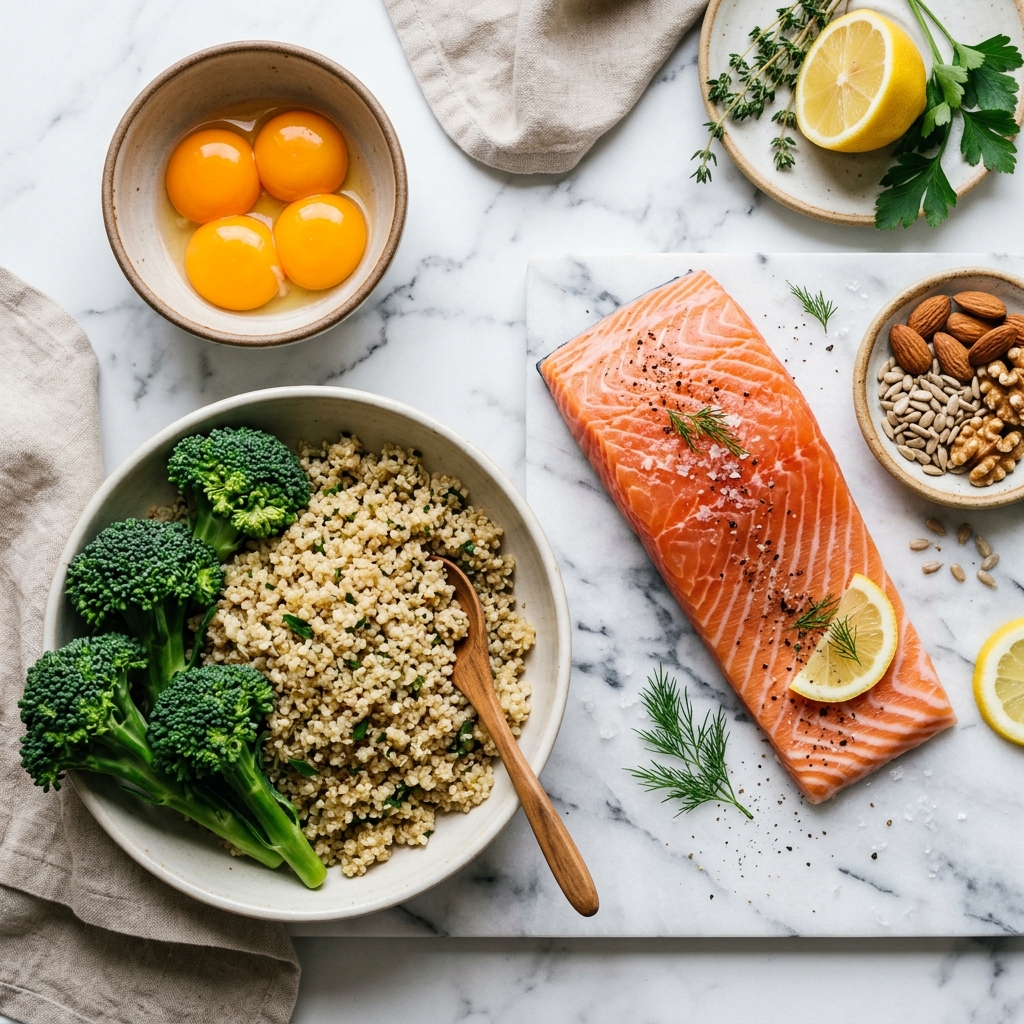
Eggs are unequivocally the easiest and most accessible source of choline. A single large, hard-boiled egg contains roughly 147 milligrams of choline. This means that eating just two eggs for breakfast provides nearly two-thirds of your daily requirement. It is crucial to note that almost all the choline is concentrated within the yolk, so egg white omelets will not help you reach your goal. Because food safety is paramount, you must ensure your eggs are cooked safely. If you live in a region where eggs are pasteurized or stamped with the British Lion mark, you can refer to our detailed runny eggs safety guide to understand the exact parameters for safe consumption.
Beef Liver
Organ meats are nutritional powerhouses. A three-ounce serving of pan-fried beef liver contains a staggering 356 milligrams of choline. However, liver comes with a significant clinical warning. As we discussed thoroughly in our pregnancy iron guide, liver contains exceptionally high levels of preformed Vitamin A (retinol). Consuming too much Vitamin A during the first trimester can be toxic to the fetus and cause severe birth defects. The NHS strictly advises pregnant women to avoid eating liver or liver products like paté. Therefore, while liver is rich in choline, the risks of Vitamin A toxicity make it an unsafe choice for pregnant women.
Meat, Poultry, and Seafood
Standard cuts of meat are excellent, safe sources of choline. A three-ounce serving of roasted chicken breast provides about 72 milligrams. A similar serving of lean beef offers roughly 115 milligrams. Seafood is also a fantastic option, with a three-ounce fillet of Atlantic salmon delivering 71 milligrams of choline alongside a healthy dose of DHA, another critical nutrient for brain development. Ensure all meat and seafood are cooked to a safe internal temperature of 165°F (74°C) for poultry and 145°F (63°C) for whole cuts of beef and fish.
Plant-Based Choline Sources
If you are vegetarian or vegan, reaching 450mg of choline requires meticulous meal planning. Roasted soybeans are one of the best plant-based options, offering 107 milligrams per half-cup serving. Cruciferous vegetables like broccoli and Brussels sprouts are also helpful. A half-cup of boiled broccoli contains about 31 milligrams of choline. Quinoa, kidney beans, and shiitake mushrooms also contribute to your daily total, though in much smaller amounts than animal proteins.
Managing Intake During the First Trimester
I fully recognize that recommending a plate of eggs and roasted chicken to a woman suffering from severe first-trimester nausea borders on cruel. If you are in the thick of morning sickness, the very thought of a hard-boiled egg might send you running to the bathroom.
This is where clinical pragmatism has to take over. During those incredibly difficult early weeks, you must prioritize basic survival and hydration over optimal nutrition. As my colleague Fiza often emphasizes in her golden rule survival guide, if all you can keep down is plain toast and dry cereal, you should eat the toast and cereal. Do not let the stress of missing your daily choline target compound the misery of morning sickness.
If you absolutely cannot tolerate choline-rich foods for weeks on end, this is the time to speak directly to your healthcare provider. They may recommend an isolated choline supplement to bridge the gap until your nausea subsides and you can resume a varied diet.
The Bottom Line
Choline is a non-negotiable nutrient for building your baby's brain and protecting their spinal cord. Because your standard prenatal vitamin is almost certainly lacking in this area, you must actively incorporate choline-rich foods into your daily rotation. Whether that means adding two fully cooked eggs to your morning routine, roasting salmon for dinner, or strategically snacking on roasted soybeans, intentional dietary choices are your best defense against a choline deficit.
Navigating these nutritional requirements can feel overwhelming, especially when you are balancing food safety rules and unpredictable food aversions. Take it one meal at a time, rely on safe cooking practices, and remember that every small, nutrient-dense choice you make is directly supporting your baby's remarkable development.
Audit Your Prenatal Vitamins Automatically
Are you unsure if your current prenatal vitamin contains enough choline, iron, or folate? The PregnancyPlate App features an advanced supplement scanner. Simply snap a photo of your vitamin's nutrition label, and our AI-driven database will instantly cross-reference the ingredients against ACOG and NHS guidelines, highlighting exactly what you are missing.
Sources
- American College of Obstetricians and Gynecologists (ACOG), Nutrition During Pregnancy.
- National Institutes of Health (NIH), Choline: Fact Sheet for Health Professionals.
- National Health Service (NHS), Keeping Well In Pregnancy.
Meet the Editorial Team
The researchers and experts behind PregnancyPlate.

Fiza Izra
Founder & Tech Researcher
A UK-based mother of 3 with a background in tech and data synthesis, Fiza brings real-world experience navigating hyperemesis gravidarum and postnatal depression. She engineers complex clinical guidelines (NHS, ACOG) into accessible tools, ensuring rigorous fact-checking with deep empathy.

Emma Davies
Senior Nutrition Editor
A mum and writer, Emma runs our food safety desk. She is the one who rings the restaurant to ask how long the lettuce sits out, checks every claim against CDC, FDA and NHS guidance, and rewrites the answer until it is usable at 9pm in a drive-thru queue.
Make sense of every plate.
Scan your plate for pregnancy food-safety guidance and a nutrition breakdown. Keep your meals and nutrient progress in one place.
Scan with your iPhoneto get the app