C-Section Recovery: What to Eat for Healing, Wind and the Constipation Nobody Warns You About
A caesarean is abdominal surgery as well as a birth. What to eat for wound healing, the trapped wind problem, and why constipation catches almost everyone.
In this article
Editorial note: This article is researched from official public health and pregnancy food safety guidance, then edited by the PregnancyPlate team for clarity. It is not medical advice. If you are worried about symptoms or a specific exposure, contact your midwife, GP or healthcare provider.
The Fast Answer: A caesarean is major abdominal surgery on top of giving birth, and eating for it is different from eating for a vaginal birth. Three things carry most of the weight: protein and vitamin C for wound healing, fibre and fluid for the constipation that catches almost everyone, and iron, because blood loss is roughly double. Trapped wind is the other thing nobody mentions, and food choices genuinely help.
Track your recovery nutrition in the PregnancyPlate AppSafety is step one. Nutrition helps your baby thrive.
Knowing a meal is safe does not tell you whether you are getting enough iron, folate, calcium and choline. PregnancyPlate tracks all of it from a photo of your plate.
- See nutrient progress
- Scan meals instantly
- Nourish with confidence
 Scan to download
Open with iPhone camera
Scan to download
Open with iPhone camera
Around one in three births in the UK is a caesarean, and yet almost all postpartum food advice is written as though everyone had a vaginal birth. The nutrients overlap, but the problems are not the same.
You're recovering from a birth and from abdominal surgery at once. Your body is rebuilding blood volume. It's closing a wound through several layers of tissue. And your digestive system has been handled, anaesthetised, then given opioids. Each of those has a food answer.
When I went through the RCOG and NHS recovery guidance for this, what struck me was how much of it is about the bowel rather than the wound. That matches what women actually report, and it's the part most food articles skip entirely.
Protein Is the One That Actually Builds Tissue
Wound healing runs on protein. Your body is knitting together skin, fat, fascia, muscle layers and the uterine wall, and every one of those repairs is built from amino acids.
Requirements go up after surgery, and they're already up from breastfeeding if you're feeding. Aim for protein at every meal and most snacks rather than one big hit at dinner. Eggs, Greek yogurt, cheese, chicken, fish, beans, lentils, tinned tuna, nut butter.
The practical problem is that protein takes preparation, and you have neither hands nor energy. That's the argument for the freezer. It matters more after a caesarean than after a straightforward birth, because you also can't lift much for six weeks. Our freezer meals guide covers what's worth banking.
Vitamin C and Zinc: The Wound Nutrients
Less known, and genuinely useful. Collagen is the scaffolding your wound heals on, and your body can't make collagen without vitamin C. Zinc does its own job in tissue repair and immune function.
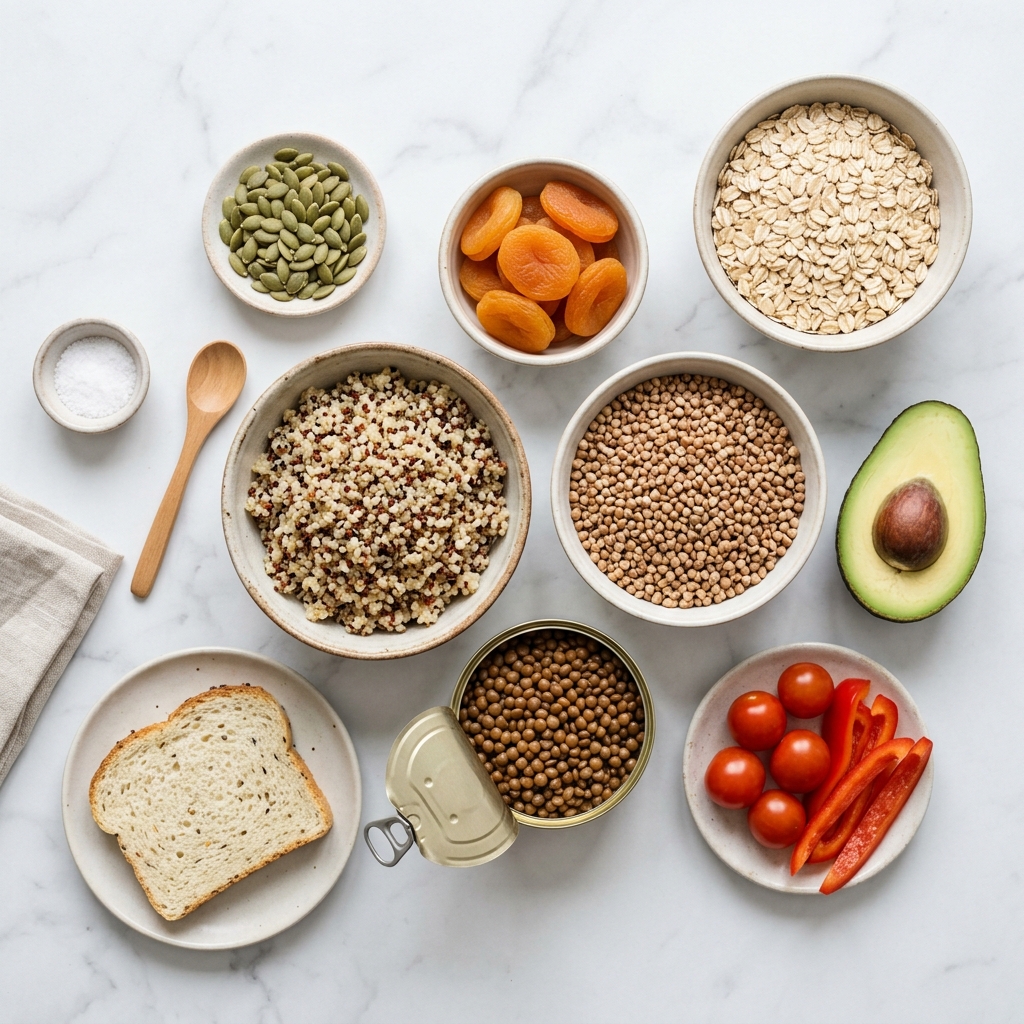
Neither needs a supplement if you eat reasonably. Vitamin C: peppers, citrus, strawberries, kiwi, broccoli, tomatoes. Zinc: meat, shellfish, eggs, beans, nuts, seeds, wholegrains.
There's a neat overlap worth exploiting. Vitamin C also multiplies how much iron you absorb from plants. So a bowl of beans with peppers and tomatoes does three jobs at once: protein, wound healing, iron.
The Constipation Nobody Warns You About
Ask anyone who has had a caesarean what surprised them most and a lot of them will say this, not the wound.
Several things stack up at once. Opioid painkillers slow the gut, and that's their most reliable side effect. Surgery stalls bowel movement on its own. You're moving less. Pregnancy hormones are still clearing. And plenty of women are frankly frightened of pushing with a fresh abdominal wound.
Getting ahead of it is far easier than fixing it. Fluid first, because fibre without fluid makes constipation worse rather than better. Then fibre from food you can actually face: porridge, wholegrain toast, prunes, pears, kiwi, beans, lentils, dried apricots. Prunes and kiwi both have decent evidence behind them.
Gentle movement helps as much as any food. Short walks around the house, as soon as you're able. And ask about a stool softener rather than toughing it out. They're routinely offered after a caesarean, and there's no prize for declining. Our fibre and constipation guide has the food list.
Trapped Wind Is Real and It's Worse Than Expected
The other thing that blindsides people. Gas pain after abdominal surgery can be sharp, can sit under the ribs or even in the shoulder, and often hurts more than the incision itself.
It happens because your bowel has been handled during the operation and takes a few days to start moving normally again. Food doesn't cause it, but food choices in the first few days can make it noticeably better or worse.
Worth avoiding for the first few days: fizzy drinks, drinking through a straw, chewing gum, and very large meals. All of them add air. Beans, sprouts, cabbage and cauliflower are famously gassy and can wait a week.
Worth trying: peppermint tea, warm drinks generally, small frequent meals rather than big ones, and moving as much as you're allowed. Walking is the single most effective thing.
It does resolve, usually within a few days, and once it does you can eat normally.
Recovery Eating in One Box
- Protein at every meal. It is what the wound is built from.
- Vitamin C and zinc for collagen and tissue repair.
- Fluid before fibre. Fibre without fluid makes constipation worse.
- Skip fizzy drinks, straws and gum for the first few days. They add air.
- Iron matters more here. Caesarean blood loss is roughly double.
Iron, Because You Lost More Than You Think
Average blood loss at a caesarean is roughly double that of an uncomplicated vaginal birth. That's expected and planned for, but it means your iron stores take a bigger hit at exactly the moment you have least capacity to cook.
Low iron after birth doesn't announce itself clearly. It looks like exhaustion, breathlessness on stairs, dizziness and brain fog, all of which are easy to write off as newborn life. If those are lingering past the first few weeks, ask for a blood test rather than assuming it's just tiredness.
Food sources: red meat, dark poultry meat, lentils, beans, fortified cereals, dried apricots. Pair the plant ones with vitamin C, and keep tea and coffee an hour away from iron-rich meals since both block absorption. If you were prescribed iron tablets in hospital, take them, and take them with orange juice rather than a cup of tea. Our iron guide covers the mechanics.
The First Few Days, Realistically
In hospital you'll usually start on clear fluids and move up as your bowel wakes, guided by your team rather than by any plan you make.
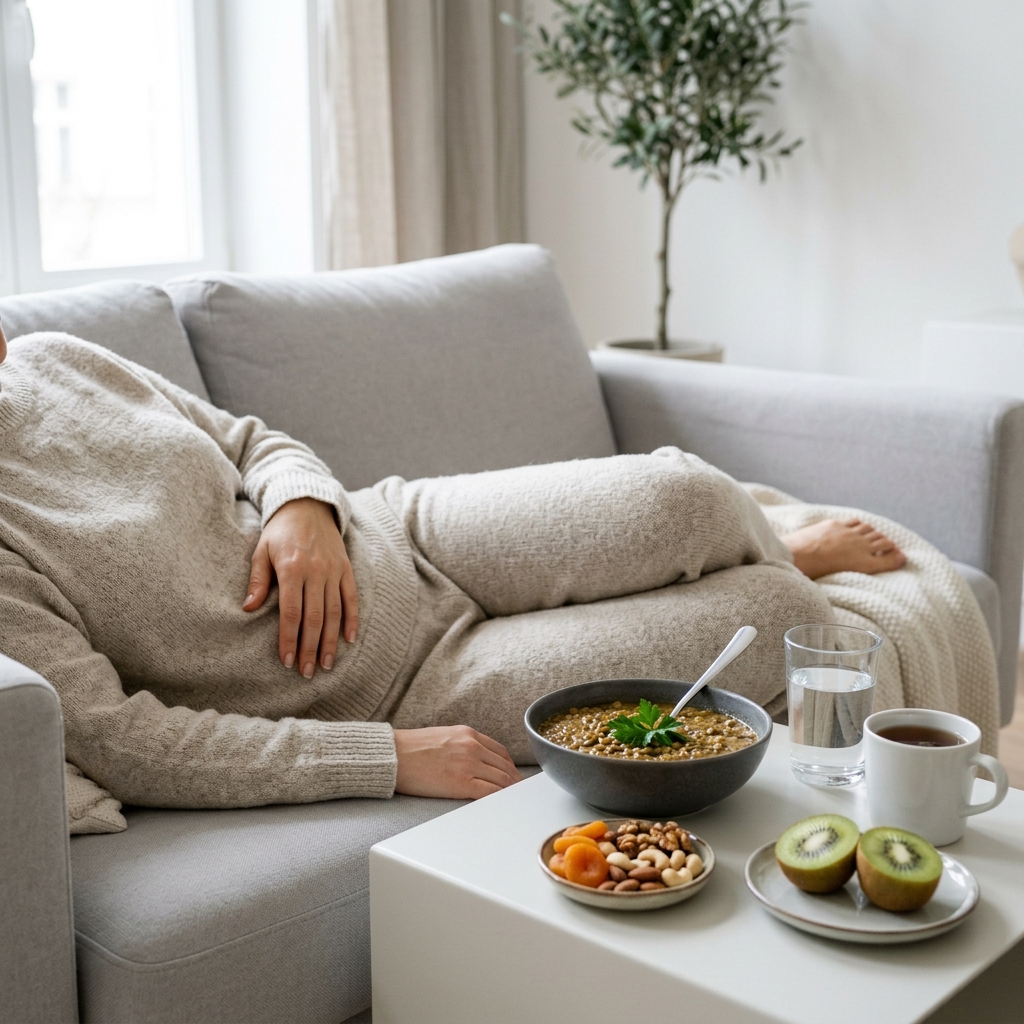
Once you're eating properly again, small and frequent beats three meals. Your abdomen is swollen and tender, sitting up is work, and large meals are uncomfortable. Warm, soft, easy food tends to go down best in the first week: soup, porridge, scrambled eggs, dhal, stew, rice pudding. Many cultures push warming foods on new mothers and, whatever the traditional reasoning, warm soft food is genuinely easier on a recovering abdomen.
Keep water within reach of wherever you feed, because you will be thirsty and unable to get up. Our postpartum recovery guide covers the wider six-week picture, and our breastfeeding nutrition guide covers feeding on top of healing.
If You Know a Caesarean Is Coming
Planned sections have one real advantage: you can prepare, and preparation matters more here than for any other birth route because your lifting and standing are restricted for weeks.
Fill the freezer with single portions rather than family-sized ones. Move everything you use daily to counter height and out of low cupboards, since bending is uncomfortable and reaching up is worse. Stock the one-handed shelf: nuts, oatcakes, cheese, fruit, yogurt, cereal bars. Buy a big water bottle with a straw lid for beside the bed, and use straws only after the wind settles. And get the stool softener conversation done before the birth rather than on day three.
Feeding a Baby While You Can't Sit Up Easily
The bit that makes caesarean recovery harder than it sounds. Feeding a newborn takes hours a day, and every position puts weight somewhere near the incision.
A few things genuinely help. The rugby hold keeps the baby off your abdomen entirely, and most people find it easier than the cradle hold for the first fortnight. Pillows across your lap take the pressure off. Set up properly before you sit down, because standing back up is the hard part.
What belongs within arm's reach: a large water bottle, snacks that need no preparation, your phone, muslins. Nuts, oatcakes, cheese, bananas, yogurt, flapjacks. Build the pile before you sit, not after.
If you're breastfeeding, you're doing wound repair and milk production at the same time. Both draw on protein and fluid. That's not a reason to worry. It's a reason to eat more than feels necessary and drink more than you think.
When to Ask for Help
Nutrition is the small half of caesarean recovery. Contact your midwife, GP or maternity unit straight away if you have any of the following. None of it is a food problem and none of it should wait.
Get Medical Help If You Have
- A temperature, or you feel feverish and unwell
- A wound that is increasingly red, hot, swollen or leaking
- Pain getting worse rather than steadily better
- Heavy or foul-smelling bleeding
- Calf pain or swelling, which can signal a clot
- Chest pain or breathlessness, which needs urgent attention
The visible healing takes about six weeks. Underneath it takes longer, which is why the lifting restrictions run as long as they do.
Eating well won't speed that up dramatically. Eating badly does slow it down. And the gap between the two is mostly protein, fluid, and having food within arm's reach.
Clinical Sources & Research
This article is general information about eating during caesarean recovery and does not replace the advice of your midwife, GP or maternity team. Follow their guidance on pain relief, wound care, activity and when to resume normal eating.
Meet the Editorial Team
The researchers and experts behind PregnancyPlate.

Fiza Izra
Founder & Tech Researcher
A UK-based mother of 3 with a background in tech and data synthesis, Fiza brings real-world experience navigating hyperemesis gravidarum and postnatal depression. She engineers complex clinical guidelines (NHS, ACOG) into accessible tools, ensuring rigorous fact-checking with deep empathy.

Emma Davies
Senior Nutrition Editor
A mum and writer, Emma runs our food safety desk. She is the one who rings the restaurant to ask how long the lettuce sits out, checks every claim against CDC, FDA and NHS guidance, and rewrites the answer until it is usable at 9pm in a drive-thru queue.