Can You Eat Chicken Salad While Pregnant? (Listeria, Store-Bought vs Homemade & Deli Counter Rules)
Can you eat chicken salad while pregnant? Mostly yes, with rules. The listeria logic for homemade, deli counter and store bought tubs, made simple.
In this article
Editorial note: This article is researched from official public health and pregnancy food safety guidance, then edited by the PregnancyPlate team for clarity. It is not medical advice. If you are worried about symptoms or a specific exposure, contact your midwife, GP or healthcare provider.
The Fast Answer: Yes, you can eat chicken salad while pregnant, if you pick the right kind. Homemade with freshly cooked chicken and shop bought mayo is genuinely fine. The deli counter tub that has been sitting open all week is the one your OB would side-eye. The difference is listeria, and it has almost nothing to do with the chicken or the mayo. Here is the whole logic, made simple.
Check any meal for safety and nutrition in the PregnancyPlate AppSafety is step one. Nutrition helps your baby thrive.
Knowing a meal is safe does not tell you whether you are getting enough iron, folate, calcium and choline. PregnancyPlate tracks all of it from a photo of your plate.
- See nutrient progress
- Scan meals instantly
- Nourish with confidence
 Scan to download
Open with iPhone camera
Scan to download
Open with iPhone camera
Chicken salad should be the perfect pregnancy food. Protein, easy to eat when nothing else appeals, no cooking smells to set off your nausea. And yet you are here at some odd hour googling whether it is allowed, probably with a sandwich already in your hand.
I get asked about this one constantly, and the confusion makes sense, because the answer genuinely is "it depends." Not on the chicken. Not on the mayo. On how long it has been sitting cold, and where.
Why Chicken Salad Is a Listeria Question, Not a Chicken Question
The pathogen that matters here is Listeria monocytogenes. It is rare, but pregnancy makes you roughly ten times more susceptible than the general population, and it is one of the few bugs that can cross the placenta. That is why the rules exist.
Here is the thing that makes listeria different from ordinary food poisoning bacteria: it grows happily in your fridge. Most bugs go dormant in the cold. Listeria just slows down and keeps multiplying. So a chicken salad that was perfectly safe on Monday is a slightly different proposition by Friday, even though it has been refrigerated the whole time and smells completely fine.
That is the entire framework. Chicken salad is cooked chicken (safe), commercial mayo (pasteurized, safe, and if you want the deep dive our mayonnaise guide has it), plus time spent sitting cold. The first two are non-issues. The third is the whole game.
Homemade: The Gold Standard
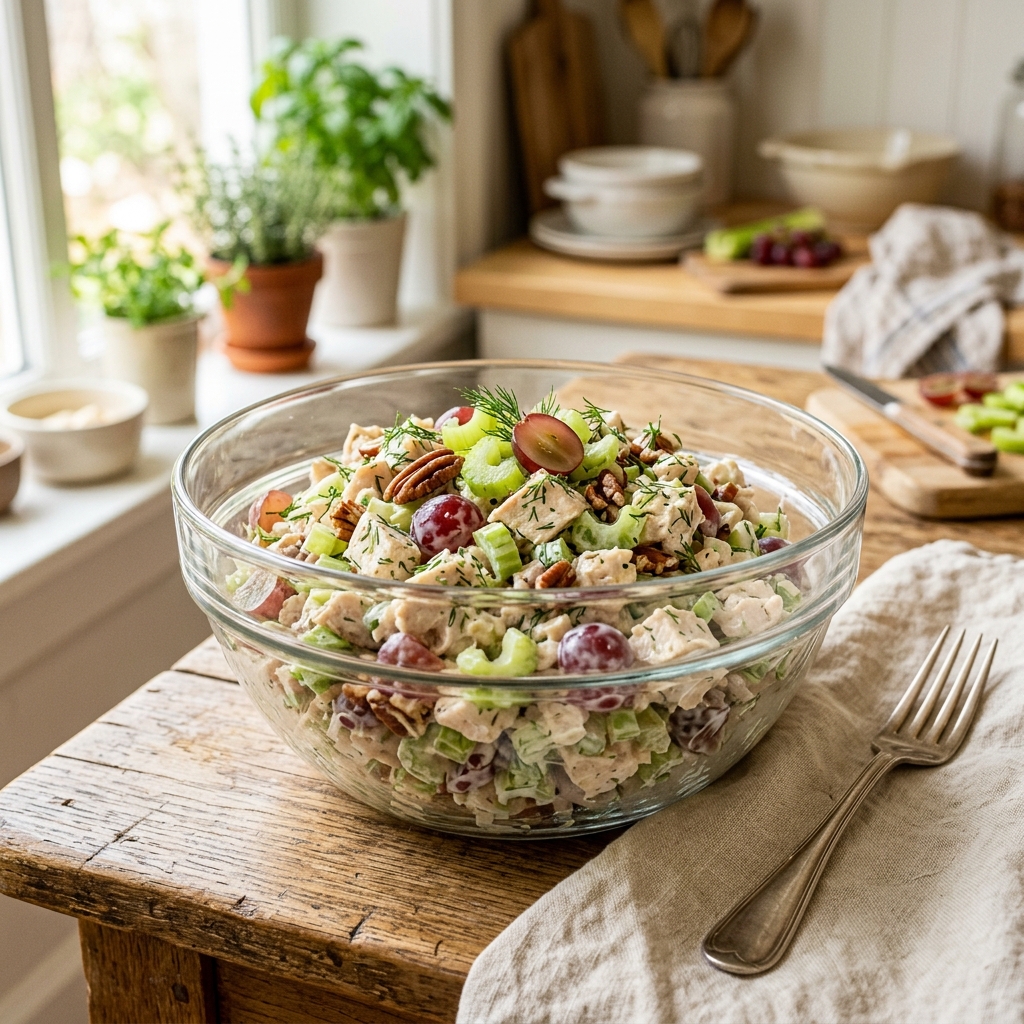
Make it yourself and you control the clock. Cook the chicken fresh, or use yesterday's properly stored roast chicken, mix with shop bought mayo, eat it over the next couple of days. That is as safe as chicken gets in pregnancy.
The rules that matter:
- Use commercial mayo, not homemade. Shop bought mayo is made with pasteurized egg. Homemade mayo uses raw egg, and that is a separate risk you don't need.
- The two hour rule. Cold food should not sit out at room temperature for more than two hours, and only one hour on a hot day. The picnic bowl that has been on the table all afternoon is done, whatever a shame it feels to bin it.
- Three to four days in the fridge, maximum. That is the FDA's line for cooked chicken dishes, and with listeria's fridge trick, pregnancy is not the time to push it to day six.
- Cold cooked chicken is fine, by the way. A lot of mums worry the "cold chicken" part is itself a problem. It isn't, if it was properly cooked and properly stored. We covered that whole question in our cold chicken guide.
Store-Bought Tubs: Read the Clock
The sealed tub of chicken salad from the supermarket chiller is commercially made, date stamped, and produced under proper controls. Caution rather than avoid. Buy it, check the use by date, eat it within a day or two of opening, and keep it properly cold in between.
What moves a tub from fine to skip is the open time. An opened tub is on the same three to four day countdown as homemade, except you don't know how the shop handled it before you got there. So: sealed and in date, go ahead. Open since who knows when at the back of the fridge, that is a no.
The Deli Counter: The One to Skip
Here is where I get strict, and it is the same logic public health agencies use for deli meats generally. The scooped chicken salad at a deli counter or salad bar has an unknown history. You cannot see when the batch was made, how long the bowl has been in the case, what it has been cross-contaminated with by shared scoops, or whether the case has held proper temperature all week.
Any one of those is probably fine. All of them stacked together, multiplied by listeria's love of cold environments, is exactly the profile of food that outbreak reports keep coming back to. While you are pregnant, the deli counter scoop is the version to pass on. Not because any given scoop is likely to hurt you, but because it is the version where you can verify nothing.
Same reasoning applies at sandwich chains. Some are better than others about batch dating and turnover, and we did a full audit of Jersey Mike's chicken salad if that is your usual order. The short version: freshness and turnover decide everything.
What About Costco and the Big Rotisserie Tubs?
The warehouse club tubs are made from rotisserie chicken, produced in volume with high turnover, which actually works in their favor. The catch is the size. A giant tub takes most families a week to finish, and day seven chicken salad is not a pregnancy food. If your household will demolish it in three days, fine. If it lingers, decant half into the freezer-bound bin or buy the smaller size while you are pregnant.
Already Ate It and Now Worrying?
Take a breath. The odds are enormously in your favor. Listeriosis is rare even among pregnant women, and one deli counter sandwich is very unlikely to be the exception. What you should actually do: nothing, unless symptoms show up. Listeriosis looks like flu, fever, aches, chills, sometimes an upset stomach, and can appear anywhere from a few days to several weeks after exposure. If you get a fever in the next month, call your midwife or OB and mention what you ate. That single sentence gets you the right test and, if needed, antibiotics that handle it. Worry is optional; the phone call, if symptoms come, is not.
How to Make a Properly Great Pregnancy Chicken Salad
Since you are making it at home now, make it earn its place. A few upgrades that turn it from beige to actually good for you:
- Greek yogurt for half the mayo. Keeps it creamy, doubles the protein, adds calcium. The classic pregnancy swap because it works.
- Add crunch that counts. Celery and apple are traditional. Walnuts add omega 3s. Grapes make it feel fancy for zero effort.
- Serve it on something whole grain. The fiber helps with the constipation nobody warned you about, and it slows the blood sugar bump.
- A proper portion of chicken. Aim for a generous cup. That is roughly 25 to 30 grams of protein, a solid dent in the 75 to 100 grams a day pregnancy actually wants from you.
The Verdict, Version by Version
Chicken Salad in Pregnancy: The Cheat Sheet
- Homemade, commercial mayo, eaten within 3 to 4 days: Safe. The gold standard.
- Sealed supermarket tub, in date, kept cold: Safe. Eat within a day or two of opening.
- Chain-made, high turnover, freshly prepared: Caution. Ask when it was made. Fresh batch, fine.
- Deli counter or salad bar scoop: Skip while pregnant. Unknown age plus shared utensils plus listeria's fridge trick is the one combination not worth it.
- Anything left out over two hours: Bin it. Pregnant or not, honestly.
And if the sandwich question has now spiraled into "wait, what about all deli food," our complete pregnancy sandwich guide sorts the entire category in one read.
Same Logic, Different Tubs: Tuna, Egg and Coronation
Everything above transfers straight across to the whole mayo-salad family. Tuna salad follows the identical rules, plus the mercury note: light tuna two to three servings a week is fine. Egg salad is safe when the eggs are fully cooked and the mayo is commercial, which in shop versions they always are. Coronation chicken is just chicken salad in fancier dress, same countdown. And canned chicken, if that is your base, is actually the safest starting point of all, since canning sterilizes it completely. The framework never changes: cooked protein plus commercial mayo is safe on day one, and the clock plus the counter is what decides everything after that.
Quick Answers to the Questions That Follow
Q: Can I eat chicken salad from a cafe or sandwich shop?
A: A busy shop making batches fresh that morning, reasonable. Ask when it was made, they will know. A quiet place scooping from a tub of unknown age, apply the deli counter rule and pass.
Q: Does lemon juice or vinegar in the recipe make it safer?
A: Marginally, acidity slows bacteria, but nowhere near enough to change any of the rules. Make it for flavour, not protection.
Q: Can I freeze chicken salad to stop the clock?
A: Technically yes, practically no, mayo splits when thawed and the texture is a tragedy. Freeze cooked chicken plain and mix fresh salad from it in minutes instead.
Q: Is rotisserie chicken itself safe to use?
A: Yes, hot and fresh from the store, and it makes brilliant chicken salad. Strip it, chill it within two hours, use it within three to four days, same as everything else.
Clinical Sources & Research
- Centers for Disease Control and Prevention (CDC), Listeria Prevention: People at Higher Risk.
- Food and Drug Administration (FDA), Safe Food Handling and Storage Times.
- American College of Obstetricians and Gynecologists (ACOG), Nutrition During Pregnancy.
Meet the Editorial Team
The researchers and experts behind PregnancyPlate.

Fiza Izra
Founder & Tech Researcher
A UK-based mother of 3 with a background in tech and data synthesis, Fiza brings real-world experience navigating hyperemesis gravidarum and postnatal depression. She engineers complex clinical guidelines (NHS, ACOG) into accessible tools, ensuring rigorous fact-checking with deep empathy.

Emma Davies
Senior Nutrition Editor
A mum and writer, Emma runs our food safety desk. She is the one who rings the restaurant to ask how long the lettuce sits out, checks every claim against CDC, FDA and NHS guidance, and rewrites the answer until it is usable at 9pm in a drive-thru queue.




Related posts