Is Korean Food Safe During Pregnancy? Korean BBQ, Raw Dishes and Bibimbap
At Korean barbecue you are the cook, so doneness and the raw-meat tongs are on you. Plus which dishes are genuinely raw, and the bibimbap egg.
In this article
Editorial note: This article is researched from official public health and pregnancy food safety guidance, then edited by the PregnancyPlate team for clarity. It is not medical advice. If you are worried about symptoms or a specific exposure, contact your midwife, GP or healthcare provider.
The Fast Answer: Korean food is largely stews, soups and grilled meat, all of which are fine. Three things need attention. At Korean barbecue you cook the meat yourself, so doneness is on you, and the tongs that touched raw meat must not touch your food. Raw dishes exist on the menu, including yukhoe beef tartare and raw marinated crab, and those are a clear no. And bibimbap often arrives with a raw egg yolk, which is worth asking to have cooked.
Track your nutrition in seconds in the PregnancyPlate AppSafety is step one. Nutrition helps your baby thrive.
Knowing a meal is safe does not tell you whether you are getting enough iron, folate, calcium and choline. PregnancyPlate tracks all of it from a photo of your plate.
- See nutrient progress
- Scan meals instantly
- Nourish with confidence
 Scan to download
Open with iPhone camera
Scan to download
Open with iPhone camera
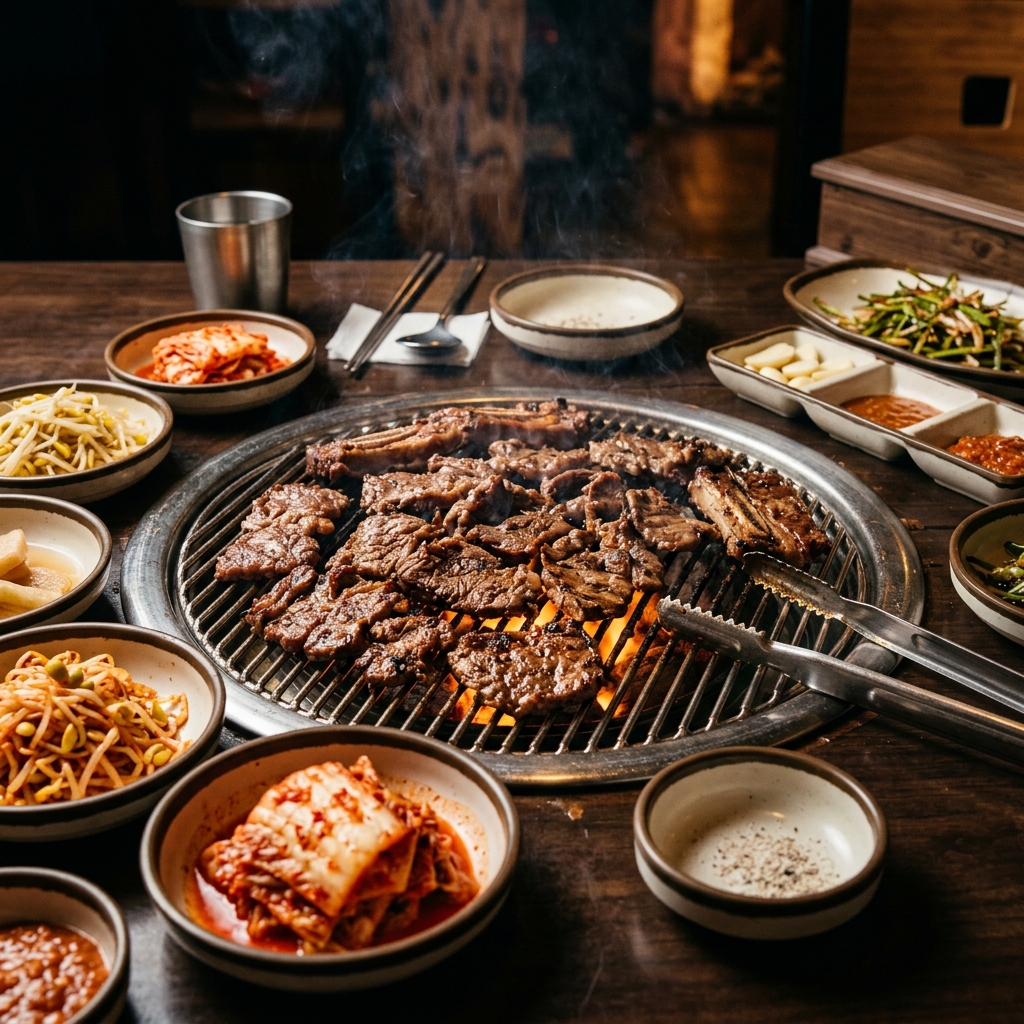
Korean restaurants are unusual in one respect that matters in pregnancy: at a barbecue table, the kitchen hands you raw meat and you become the cook.
That is not a problem, but it does move two food safety decisions from a trained chef to you and whoever you came with.
Korean Barbecue: Two Jobs That Are Now Yours
Cooking it through. Thin slices cook fast, which is convenient and also how things get eaten underdone when everyone is talking. Pork belly and chicken need to be cooked right through with no pink. Beef in whole slices is safer than minced, but pregnancy guidance is stricter about pink meat than general advice, because of toxoplasmosis as well as bacteria, so cook beef through too.
Thin cuts reach temperature quickly, so this costs you very little. Give it another thirty seconds and check the centre before it goes on your plate.
Not cross-contaminating. This is the one people miss. The tongs used to put raw meat on the grill have touched raw meat. If those same tongs then move cooked meat to your plate, or you eat with chopsticks that touched the raw plate, you have undone the cooking.
Korean barbecue restaurants know this and usually provide separate tongs and scissors for raw handling, kept apart from your eating chopsticks. Use the raw tongs only for raw meat, and let cooked pieces be lifted with something else. If only one pair of tongs is on the table, ask for another. It is a routine request.
The same applies to the plate the raw meat arrived on. It should not be used for anything else.
The Raw Dishes
Korean menus include genuinely raw items, which are clearly named once you know them.
Yukhoe is raw beef tartare, usually with a raw egg yolk on top. Both halves are on the avoid list in pregnancy.
Hoe is raw fish, the Korean equivalent of sashimi. Avoid, as with any raw fish.
Ganjang gejang is raw crab marinated in soy sauce. It is delicious and it is raw shellfish, which is one of the clearest no-go foods in pregnancy.
Sannakji is live octopus. Not a pregnancy question so much as an everyone question, but no.
None of these is served by accident, and none is a surprise ingredient inside something else. Avoiding them is simply a matter of knowing the names.
The Egg Question
Eggs turn up in several places and the answer is the same each time.
Bibimbap is often topped with a raw or barely cooked egg yolk, which you stir through the hot rice. In a stone bowl, dolsot bibimbap, the bowl is hot enough to cook the egg if you stir it in quickly, but you cannot be sure it reaches a safe temperature.
US guidance in pregnancy is to cook eggs until both white and yolk are firm. So ask for the egg fully cooked, or ordered without it. Most kitchens will fry it through without blinking.
UK advice differs, since British Lion marked eggs are considered safe runny in pregnancy, but you cannot assume a restaurant uses them, and this is not a British dish.
The same applies to a soft egg in ramyeon or on top of a stew. Our runny eggs guide covers the reasoning in full.
The Menu, Item by Item
| Dish | Verdict | Notes |
|---|---|---|
| Bulgogi, galbi, samgyeopsal | Safe cooked through | You are the cook. No pink, and use the raw tongs only for raw meat. |
| Jjigae stews: kimchi, doenjang, sundubu | Safe | Served bubbling. Among the best things to order. |
| Bibimbap | Ask for a cooked egg | Everything else in the bowl is cooked. |
| Japchae, tteokbokki, jjajangmyeon | Safe | Cooked through. |
| Korean fried chicken | Safe | Fried through. Sauce is a sugar and salt consideration. |
| Kimbap | Generally safe | Usually cooked fillings. Check nothing raw inside, and eat it fresh. |
| Kimchi | Safe | A salted vegetable ferment, widely eaten through pregnancy in Korea. Salt is the consideration. |
| Banchan side dishes | Eat early | Small cold dishes, often refilled and shared. Fine fresh and cold. |
| Yukhoe, hoe, ganjang gejang | Avoid | Raw beef, raw fish, raw crab. |
| Soju, makgeolli, beer | No | No known safe amount of alcohol in pregnancy. |
| Barley tea | Safe | Caffeine free, and usually what is poured by default. |
Korean Food in One Box
- Separate tongs for raw meat. Ask for a second pair.
- Cook it through, which takes seconds with thin cuts.
- Yukhoe, hoe and raw crab are the named raw dishes to skip.
- Ask for the bibimbap egg cooked.
- Stews are excellent, and the sodium is the main cost.
Kimchi and Banchan
Two things worth their own note, because both get asked about.
Kimchi is fine. It is cabbage salted and fermented with chilli and garlic, and it is eaten throughout pregnancy in Korea as an ordinary staple. Fermentation produces an acidic, salty environment that is not hospitable to the bacteria pregnancy guidance worries about. The genuine consideration is salt rather than safety, and it is high.
Banchan need a little thought, not because of what they are but because of how they are served. They are small cold dishes brought out at the start, often refilled, and shared across the table. Most are cooked or pickled vegetables, which are low risk.
Treat them like any shared cold plate: eat some early while they are fresh and properly cold, rather than picking at them across a two hour meal. Anything containing raw seafood is the exception and should be skipped.
How to Handle the Grill Without Making It Awkward
Most people worry more about the social side of this than the food safety side.
In practice, nobody notices. At a barbecue table someone usually takes charge of the grill anyway, and if that is not you, the whole problem disappears: let someone else cook and serve yourself from the cooked side of the grill.
If you are cooking, the two habits are small. Keep the raw tongs on the raw plate rather than putting them down next to your bowl, and move cooked pieces with a second pair or with the serving scissors. Asking a server for another pair of tongs takes five seconds and is a completely normal request in any Korean restaurant.
One thing worth doing deliberately: cut the thickest piece open before eating it rather than judging by the outside. Marinated meat like galbi caramelises quickly on the surface, which makes it look more done than it is.
If none of this appeals, order from the stew and rice side of the menu instead. Jjigae arrives bubbling from the kitchen and needs nothing from you at all.
Pregnant and Eating Korean Food Regularly
Worth a note if this is your everyday food rather than an occasional meal out.
The nutrition is generally good. Plenty of vegetables, fermented foods, tofu, fish and meat, and relatively little deep frying compared with other cuisines. The pattern of a soup, rice and several vegetable sides is a well balanced way to eat.
The one thing to keep an eye on over weeks rather than one meal is salt. Kimchi, soy sauce, soybean paste and stew broth are all salty, and a daily diet built on them adds up. That matters most in the second half of pregnancy, when swelling and blood pressure are being watched.
Practical adjustments that do not change how you eat: drink the broth less rather than draining the bowl, keep one salty side rather than three, and rinse kimchi if you are eating a lot of it. None of that is necessary for an occasional meal, and all of it helps if this is daily.
Sodium, Spice and How You Will Feel
Safety here comes down to three asks. Comfort is where the rest sits.
Sodium is very high. Soy sauce, doenjang, gochujang, kimchi and stew broth all carry a lot of salt, and a Korean meal can deliver a large share of a day's worth. In the second half of pregnancy that shows up as swollen fingers and ankles the same evening. Water alongside helps, and our swelling guide covers the rest.
Spice is safe and will worsen heartburn, which gets worse anyway as the baby takes up more room. Milder stews like doenjang jjigae or sundubu without extra chilli are gentler than tteokbokki or a heavily spiced barbecue marinade. Our heartburn guide ranks the triggers.
Smoke at the table is worth mentioning for the first trimester. Barbecue restaurants are full of cooking smells and smoke, which is a common nausea trigger. A table near the extraction, or a stew restaurant instead, is a reasonable adjustment.
One more thing about shared grills specifically. If several people are cooking on the same grill and some of them like their beef rare, cooked and undercooked pieces end up side by side on the same surface. Keeping your pieces to one area, or cooking yours last once the grill is hottest, avoids the guesswork of which slice came from where.
Why It Is Worth Ordering
With those handled, this is a genuinely good cuisine in pregnancy.
Beef and pork bring heme iron, the most absorbable form, and pregnancy roughly doubles your requirement to around 27mg a day. Our iron guide explains why that matters.
Stews are warm, salty and hydrating, which is the profile that works best when nausea is the problem. Sundubu, a soft tofu stew, is gentle and high in protein and calcium.
Tofu, egg and fish dishes give plenty of non-meat protein options.
Vegetables are everywhere, which is unusual for a restaurant meal and useful for the fibre pregnancy digestion needs.
Leftovers follow the usual rules: fridge within two hours, eaten within a couple of days, reheated once until steaming. Rice is a one day item, and our leftovers guide has the timings. Our eating out guide has the four questions that work on any menu.
Clinical Sources & Research
This article is general information and does not replace advice from your midwife, GP or obstetrician. If you develop a fever or stomach symptoms after eating something you are unsure about, contact your maternity team.
Meet the Editorial Team
The researchers and experts behind PregnancyPlate.

Fiza Izra
Founder & Tech Researcher
A UK-based mother of 3 with a background in tech and data synthesis, Fiza brings real-world experience navigating hyperemesis gravidarum and postnatal depression. She engineers complex clinical guidelines (NHS, ACOG) into accessible tools, ensuring rigorous fact-checking with deep empathy.

Emma Davies
Senior Nutrition Editor
A mum and writer, Emma runs our food safety desk. She is the one who rings the restaurant to ask how long the lettuce sits out, checks every claim against CDC, FDA and NHS guidance, and rewrites the answer until it is usable at 9pm in a drive-thru queue.