The Blood Sugar Crash Behind Your Pregnancy Nausea
Why a healthy smoothie or fruit breakfast can make pregnancy nausea worse, how the blood sugar crash works, and the pairing rule that stops it happening.
In this article
Editorial note: This article is researched from official public health and pregnancy food safety guidance, then edited by the PregnancyPlate team for clarity. It is not medical advice. If you are worried about symptoms or a specific exposure, contact your midwife, GP or healthcare provider.
The Fast Answer: Low blood sugar makes pregnancy nausea worse, and a lot of "healthy" breakfasts cause exactly that. Fruit smoothies, juice and plain toast spike your glucose then drop it inside an hour, and the drop lands as fresh nausea. The fix isn't eating less sugar, it's never eating carbohydrate on its own. Add protein or fat to everything and eat every two to three hours.
Spot your own crash pattern in the PregnancyPlate AppSafety is step one. Nutrition helps your baby thrive.
Knowing a meal is safe does not tell you whether you are getting enough iron, folate, calcium and choline. PregnancyPlate tracks all of it from a photo of your plate.
- See nutrient progress
- Scan meals instantly
- Nourish with confidence
 Scan to download
Open with iPhone camera
Scan to download
Open with iPhone camera
Here's a pattern I've seen described hundreds of times in pregnancy forums, always with the same bafflement. Someone feels rough, decides to be sensible, and makes a fruit smoothie. Twenty minutes later they feel fine. An hour after that they feel worse than when they started.
They conclude the smoothie disagreed with them. It didn't. What disagreed with them was what happened forty minutes after it.
How the Crash Works
Blood sugar and nausea are linked in both directions, and that's what makes this so easy to fall into.
Eat fast-absorbing carbohydrate on its own and glucose rises quickly. Your body responds with insulin. Because the rise was steep, the correction tends to overshoot, and you end up lower than you started. That low is what you feel: shaky, sweaty, irritable, headachy, and nauseous.
Then the trap closes. Feeling sick, you reach for the only thing you can face, which is usually more plain carbohydrate. Toast, crackers, a biscuit. Same spike, same crash, an hour later. Repeat all day.
Pregnancy makes it worse for two reasons. Placental hormones increase insulin resistance, so glucose handling is less stable than usual. And the overnight fast is longer than any other gap in your day, which is precisely why mornings are the worst of it.
The Foods That Cause It
Mostly things with a health halo, which is why nobody suspects them.
Fruit smoothies. The worst offender. Blending destroys the fibre structure that would have slowed absorption, so a smoothie behaves closer to juice than to fruit. Three bananas' worth of sugar with none of the braking.
Fruit juice, including fresh-pressed. Same problem, more concentrated.
Plain toast, crackers and dry cereal, the classic nausea foods. They work briefly and then contribute to the cycle.
Low-fat flavoured yogurt, where the fat that would have slowed digestion has been removed and sugar added in its place.
Cereal bars and granola, marketed as breakfast, structurally closer to confectionery.
Dried fruit on its own. Fine with nuts, a sugar hit by the handful.
None of these are bad foods, and this isn't an argument for cutting them. A smoothie with yogurt blended through it behaves completely differently from the same smoothie without. It's the eating-alone part that causes the trouble.
Why It Hits Hardest in the First Trimester
The crash cycle and first trimester nausea reinforce each other in a way that's worth understanding, because it explains why weeks 6 to 12 feel so relentless.
Nausea narrows what you can face down to plain, dry, beige food, which is almost entirely fast carbohydrate. That's the exact diet most likely to produce crashes. So the nausea drives the food choice, the food choice deepens the crash, and the crash worsens the nausea.
Breaking in anywhere works. Even small additions help: a slice of cheese with the crackers, milk instead of water, peanut butter scraped onto the toast. You're not trying to eat well in the ordinary sense during those weeks. You're trying to stop the floor falling out every ninety minutes.
And it does pass. For most women the whole pattern eases by around week 14, at which point eating gets dramatically easier and this stops being something you have to think about.
The One Rule That Fixes It
Never eat carbohydrate alone.
That's the whole thing. Protein and fat slow how fast the stomach empties, which flattens the glucose curve and removes the crash at the other end. You don't have to give up any of the foods above, you just have to stop eating them on their own.
In practice:
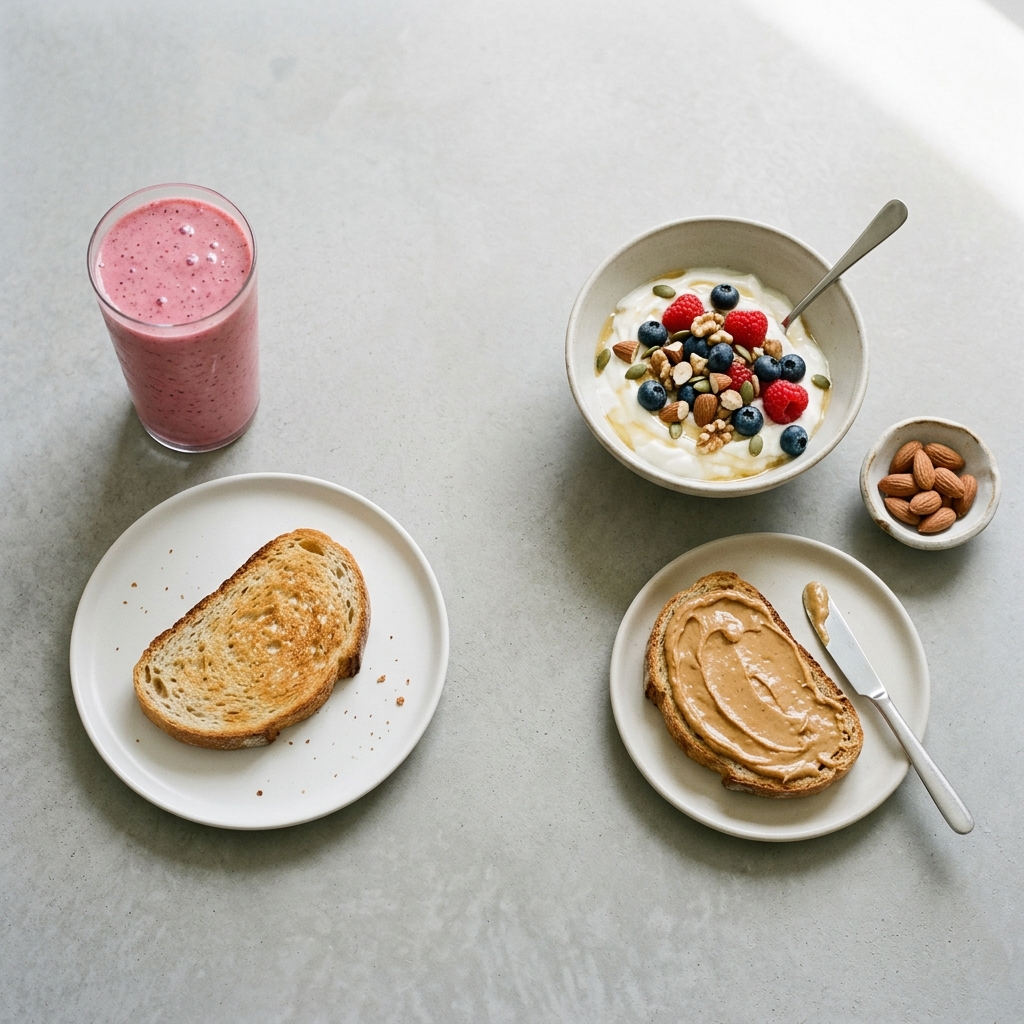
- Toast becomes toast with peanut butter, or with egg.
- The smoothie gets Greek yogurt or nut butter blended in, and less fruit.
- An apple gets a handful of nuts or a piece of cheese.
- Cereal gets whole milk and seeds, not skimmed.
- Crackers get cheese.
Same foods, different company, completely different curve.
Whole Fruit Is Not the Problem
Worth being clear, because this is where people overcorrect and start cutting fruit entirely.
An apple is not a glass of apple juice. The fibre in whole fruit physically slows how fast the sugar reaches your bloodstream, and it comes with vitamin C, folate and potassium. Cutting fruit out is the wrong lesson.
What changes is the form and the company. Whole beats blended, blended beats juiced. And whatever form you pick, put something with it. Berries with yogurt. Banana with peanut butter. Apple with cheese.
The same goes for carbohydrate generally. Nobody needs to go low-carb in pregnancy, and doing so is actively unhelpful, since your baby's brain runs on glucose. This is about pairing and pacing, not restriction.
Eat Before You're Hungry
The second half of the fix is timing, and it's counterintuitive when you feel sick.
Aim to eat something small every two to three hours, before hunger arrives. Hunger in pregnancy is often the crash announcing itself, and by then you're already behind. Waiting until you feel like eating means eating at your lowest point, which is when you have the least tolerance for anything.
The overnight gap is the one to plan around. Keep something dry by the bed and eat it before you sit up, then have a proper breakfast an hour later once the first wave has passed. This is the most repeated piece of midwife advice about morning sickness, and blood sugar is the mechanism behind why it works. Our pregnancy breakfast ideas are built around it.
The Fix in One Box
- Never eat carbohydrate on its own. Add protein or fat every time.
- Eat every two to three hours, before hunger arrives.
- Smoothies and juice are the main culprits, despite the health halo.
- Something dry before you sit up, then breakfast an hour later.
- Whole fruit beats blended fruit, because the fibre is the brake.
A Day That Doesn't Crash
Roughly what the pattern looks like in practice.
Before getting up: oatcakes or plain crackers, kept by the bed.
Breakfast: Greek yogurt with berries and nuts, or eggs on wholegrain toast.
Mid-morning: cheese and an apple.
Lunch: a sandwich with real protein in it, plus something on the side.
Afternoon: hummus and vegetable sticks, or a handful of nuts with dried apricots.
Dinner: protein, vegetables, and a modest portion of slow carbohydrate.
Before bed: milk and an oatcake, which shortens the overnight fast and makes the morning easier.
Notice there's no meal larger than the ones around it. Even spacing is doing as much work as the food choices.
How to Tell If This Is Your Problem
Not everyone's nausea is blood sugar. Here's how to find out whether yours is, without any equipment.
Keep a rough note for three days of what you ate, when, and when the nausea hit. You're looking for one specific pattern: nausea landing 60 to 90 minutes after eating something carb-heavy on its own, often with shakiness, sweating or a headache alongside it.
If that pattern shows up more than a couple of times, the fix in this article will help. If your nausea is constant regardless of food, or triggered mainly by smells, it's a different mechanism and pairing your snacks won't do much, though it won't hurt either.
Three days is usually enough to see it. Logging your meals and how you felt afterwards in the app makes the pattern obvious quickly, because it lines the timings up for you rather than leaving you to remember what you ate four hours ago while feeling awful.
When It's Not Just Blood Sugar
Two things worth separating out, because this article shouldn't talk you out of getting help.
Hyperemesis gravidarum is not severe morning sickness and doesn't respond to snack timing. If you can't keep fluids down for 24 hours, you're losing weight, or you're passing very little dark urine, contact your midwife or GP. There's effective treatment and no reason to endure it.
Gestational diabetes is the other side of the same coin. If you're getting significant crashes alongside extreme thirst, or you have risk factors, mention it at your next appointment rather than self-managing. Screening usually happens around week 28. Our gestational diabetes meal plan covers what changes if you're diagnosed, and interestingly the underlying advice is nearly identical: spread carbohydrate out, always pair it, never let it ride alone.
For everyone else, this is one of the few pregnancy problems with a genuinely simple fix. Our first trimester nausea guide covers what tends to stay down while you're sorting the timing out.
Meet the Editorial Team
The researchers and experts behind PregnancyPlate.

Fiza Izra
Founder & Tech Researcher
A UK-based mother of 3 with a background in tech and data synthesis, Fiza brings real-world experience navigating hyperemesis gravidarum and postnatal depression. She engineers complex clinical guidelines (NHS, ACOG) into accessible tools, ensuring rigorous fact-checking with deep empathy.

Emma Davies
Senior Nutrition Editor
A mum and writer, Emma runs our food safety desk. She is the one who rings the restaurant to ask how long the lettuce sits out, checks every claim against CDC, FDA and NHS guidance, and rewrites the answer until it is usable at 9pm in a drive-thru queue.