Pregnant With a Toddler: How to Eat When There's No Time
Second pregnancies are harder to eat well in, and not because you know less. No naps, no quiet, and a toddler's leftovers as lunch. What actually works.
In this article
Editorial note: This article is researched from official public health and pregnancy food safety guidance, then edited by the PregnancyPlate team for clarity. It is not medical advice. If you are worried about symptoms or a specific exposure, contact your midwife, GP or healthcare provider.
The Fast Answer: A second pregnancy is harder to eat well in, and not because you know less. There is no resting through the first trimester, no quiet lunch, and your own meals become whatever the toddler left. Three things fix most of it: eat the toddler's meals with them rather than after, keep a one-handed snack supply within reach, and accept that your iron stores are probably lower than last time. That last one is worth a blood test.
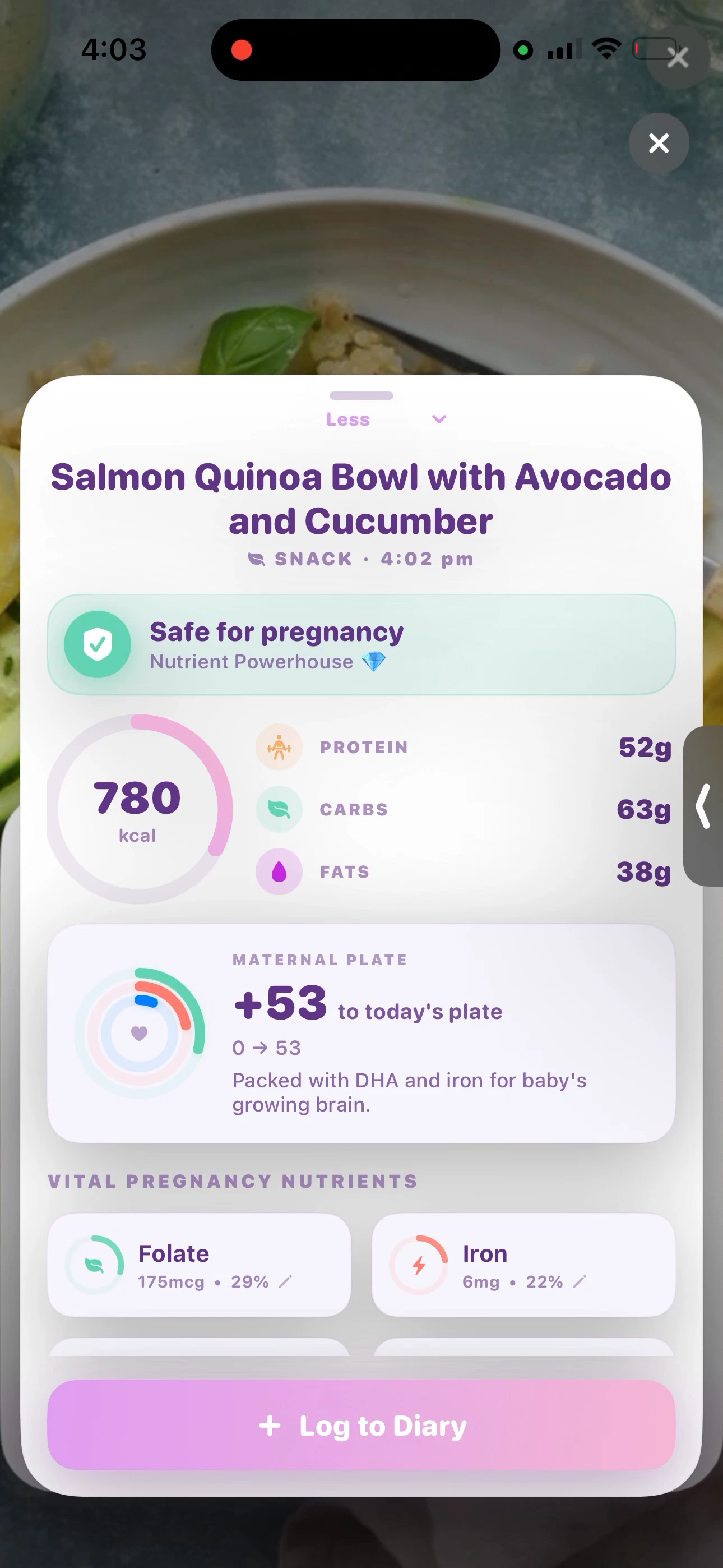
Track your nutrition in seconds in the PregnancyPlate AppYour next meal, a little less guesswork.
Scan your plate for pregnancy food-safety guidance and a nutrition breakdown. Keep your meals and nutrient progress in one place.
 Scan with your iPhone
to get the app
Everyone tells you the second pregnancy is easier because you know what you are doing. In the ways that matter for eating, it is considerably harder.
The first time, first trimester exhaustion meant going to bed at eight. This time there is a two-year-old who needs a bath, a story and four glasses of water. Nausea has to be managed at a soft play centre. And the meal you cook gets eaten cold, standing up, or not at all.
Why It's Genuinely Harder
Worth naming, because most people assume they are just coping badly.
You cannot rest through the sickness. First trimester fatigue is not optional tiredness, and last time you could lie down. Now you cannot, and the nausea is worse for it, because rest genuinely reduces it.
Your iron stores start lower. Pregnancy depletes them, birth costs more, and breastfeeding uses more again. If your pregnancies are close together, you may be starting this one already run down. This is the single most common physiological difference and it is measurable.
Meals stop being yours. You cook for a toddler at five, eat their leftovers, then have nothing at eight when you are actually hungry.
Smells are everywhere. Nappies, half-eaten yoghurt, whatever is under the sofa. First trimester aversions are much harder to avoid with a small child in the house.
You are lifting a toddler while growing a baby, which is its own physical cost and one nobody accounts for.
Eat With Them, Not After Them
The single highest-value change, and it costs nothing.
Most parents of small children cook a toddler tea at five and eat properly at eight or nine, if at all. Pregnant, that gap is too long: it drops your blood sugar and makes nausea and exhaustion markedly worse.
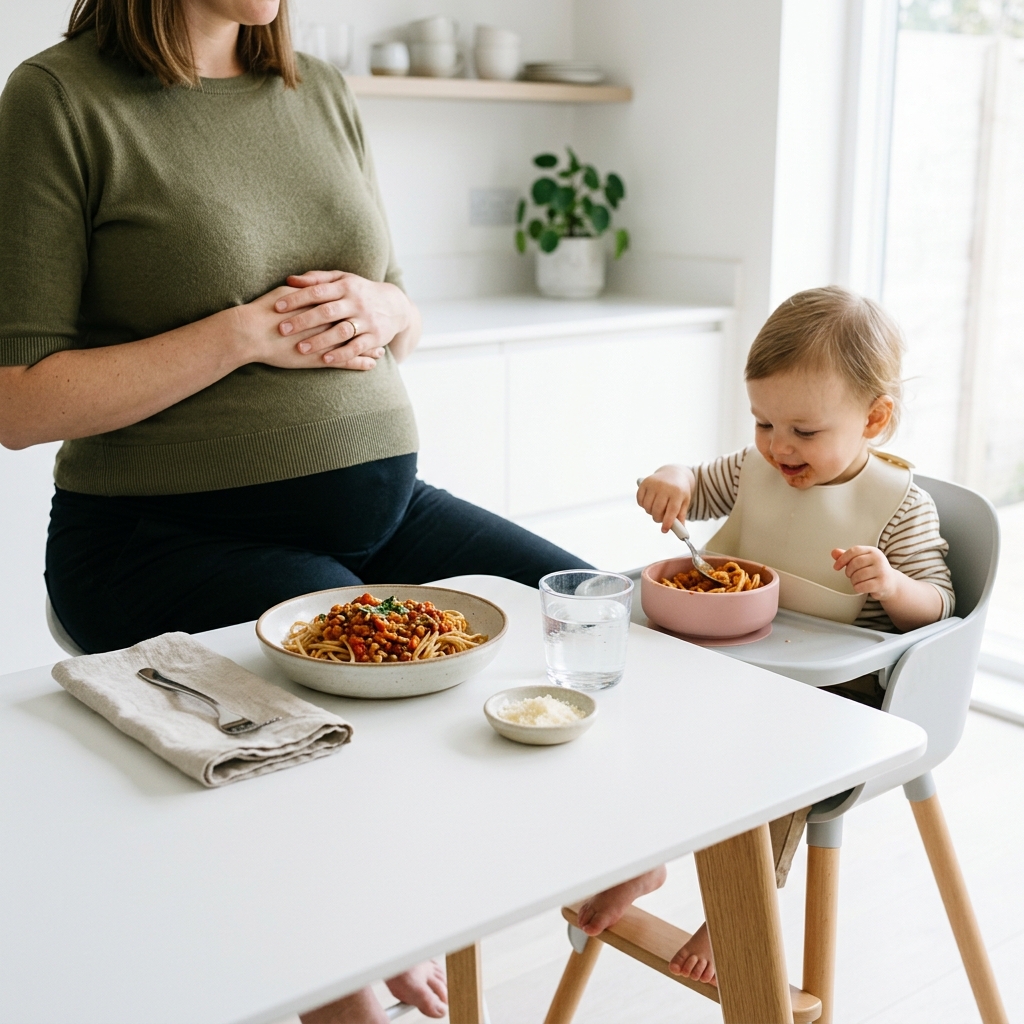
So eat with them. Make the toddler meal something you would also eat, plate up two portions, and sit down together. Pasta with a lentil sauce, jacket potatoes with beans and cheese, scrambled eggs on toast, a fish pie. All are perfectly good pregnancy meals and none is a compromise.
You also get the thing everyone recommends and nobody manages: eating in front of your child, which is the strongest influence on how they eat. It solves two problems at once.
The Toddler-Leftovers Trap
Everyone does it. Half a fish finger, the crusts, three chips, a yoghurt with the fruit picked out.
The problem is not that it is unhealthy. It is that it is nutritionally random and never adds up to a meal. Toddler portions are small, often beige, and rarely contain the iron and protein you need. You end up feeling like you have eaten while having had almost nothing that counts.
The fix is not willpower, it is sequencing. Plate your own portion first, before they start, so what you eat is decided rather than salvaged. If you genuinely want to finish their food afterwards, fine, but eat yours first.
Worth knowing on food safety too: their leftovers have been sat at room temperature and handled, so the two-hour rule applies, and anything they have been eating from directly is not worth keeping.
Iron Deserves a Test, Not a Guess
If your pregnancies are close together, this is the thing most likely to be genuinely wrong rather than just hard.
Ask for a ferritin level, not just a standard full blood count. Ferritin measures stores and can be low while haemoglobin still reads normal, and stores are exactly what a previous pregnancy depletes.
The symptoms are easy to dismiss as normal life with a toddler: exhaustion, breathlessness on the stairs, dizziness, feeling cold, brain fog. That overlap is precisely why it goes unnoticed second time round.
Food-wise, prioritise it deliberately rather than hoping. Red meat or dark poultry meat a couple of times a week, lentils and beans in the toddler-friendly meals, fortified cereal, and vitamin C alongside plant sources. Our iron guide covers the mechanics.
Second Pregnancy in One Box
- Eat with the toddler, not their leftovers at nine o'clock.
- Plate yours first, so your meal is decided rather than salvaged.
- Ask for ferritin. Stores start lower the second time.
- Keep one-handed snacks in the changing bag, car and buggy.
- Lower the standard. Beans on toast is a real pregnancy dinner.
One-Handed and Portable
You will spend a lot of this pregnancy standing at a park, pushing a buggy or supervising a bath. Food has to survive that.
Worth keeping permanently stocked in the changing bag, the car and by the sofa: nuts, oatcakes, cereal bars, dried apricots, bananas, cheese portions, nut butter sachets, crackers. Nothing that needs a plate or a fork.
The changing bag one matters most, because that is where you will be when the blood sugar drops, and a toddler snack pot of raisins is not going to hold you.
Keep water everywhere too. Dehydration worsens nausea, headaches and the Braxton Hicks that tend to arrive earlier in a second pregnancy.
One thing worth doing on a good day: make up a box of snacks and split it across the bag, the car and a shelf you can reach from the sofa. Deciding what to eat is the part that fails when you are exhausted, so remove the decision while you have the energy to make it.
Meals That Work for Both of You
The practical shortlist, because the constraint is real: it has to suit a toddler, be eaten by five, and actually count nutritionally for you.
Lentil bolognese. Iron and fibre, mild, freezes well, and toddlers generally accept it. The single best entry on this list.
Jacket potatoes with beans and cheese. Iron, calcium, fibre, and almost no effort.
Fish pie or salmon with mash and peas. Omega-3 and protein, soft textures, and it reheats.
Scrambled eggs on toast. Choline and protein in five minutes, and it works as a tea or a rescue dinner.
Mild chicken or chickpea curry with rice. Batch it, freeze it in adult and toddler portions.
Pasta with a hidden-vegetable tomato sauce, with grated cheese and a tin of lentils stirred through your half.
The pattern worth noticing: these are all things where you can add iron to your own portion without cooking twice. A tin of lentils or beans stirred into your half of anything is the laziest useful habit in this entire article.
Managing First Trimester Nausea With a Toddler
The genuinely hard bit, since the standard advice assumes you can control your environment.
Move breakfast earlier and split it. Something dry before you get up, then a proper breakfast once they are settled with something. The overnight fast is what makes mornings worst, and it is covered in our first trimester nausea guide.
Batch the cooking on a weekend so weekday evenings need no smells. Our meal prep routine and freezer meals guide both apply here, and this is the pregnancy where they earn the most.
Outsource the nappies if there is anyone to outsource them to, at least during the worst weeks. It is a reasonable ask.
Lower the standard for a few weeks. More screen time, more picnic teas, more shop-bought. A fortnight of that harms nobody, and it is not the same as giving up.
Telling Them, and the Feeding Questions
Two practical things that come up.
If you are still breastfeeding, you can usually continue through pregnancy, though supply often drops and nipples can become uncomfortable. It is worth discussing with your midwife, particularly if you have a history of preterm birth. Your nutritional needs are higher again if you are feeding and pregnant at once.
Toddlers notice. Being sick, going to bed early and not eating gets registered even when nothing is said. A simple explanation, whenever you are ready to give one, tends to land better than pretending nothing is happening.
The honest summary is that second pregnancies are less restful and more physical, and the eating suffers first because it is the easiest thing to drop. Getting your iron checked and eating at five with the toddler covers most of it. Our complete pregnancy meal plan has the wider picture for when there is time to read it, which there may not be.
Clinical Sources & Research
Meet the Editorial Team
The researchers and experts behind PregnancyPlate.

Fiza Izra
Founder & Tech Researcher
A UK-based mother of 3 with a background in tech and data synthesis, Fiza brings real-world experience navigating hyperemesis gravidarum and postnatal depression. She engineers complex clinical guidelines (NHS, ACOG) into accessible tools, ensuring rigorous fact-checking with deep empathy.

Emma Davies
Senior Nutrition Editor
A mum and writer, Emma runs our food safety desk. She is the one who rings the restaurant to ask how long the lettuce sits out, checks every claim against CDC, FDA and NHS guidance, and rewrites the answer until it is usable at 9pm in a drive-thru queue.
Make sense of every plate.
Scan your plate for pregnancy food-safety guidance and a nutrition breakdown. Keep your meals and nutrient progress in one place.
Scan with your iPhoneto get the app