Is Street Food Safe During Pregnancy? Markets, Vans and Festival Stalls
Street food is not riskier than a restaurant by default. The risk is holding time, cold sauces and handwashing. What to order at a market and what to skip.
In this article
Editorial note: This article is researched from official public health and pregnancy food safety guidance, then edited by the PregnancyPlate team for clarity. It is not medical advice. If you are worried about symptoms or a specific exposure, contact your midwife, GP or healthcare provider.
The Fast Answer: Street food is not riskier than a restaurant by default, and in one important way it is safer, because you can watch it being cooked. The risk sits in three specific places: food that has been held warm rather than cooked to order, the cold sauces and toppings added at the end, and handwashing at a stall with no sink. Order what comes off the grill steaming, be careful with the garlic mayo, and carry hand gel.
Track your nutrition in seconds in the PregnancyPlate AppYour next meal, a little less guesswork.
Scan your plate for pregnancy food-safety guidance and a nutrition breakdown. Keep your meals and nutrient progress in one place.
 Scan with your iPhone
to get the app
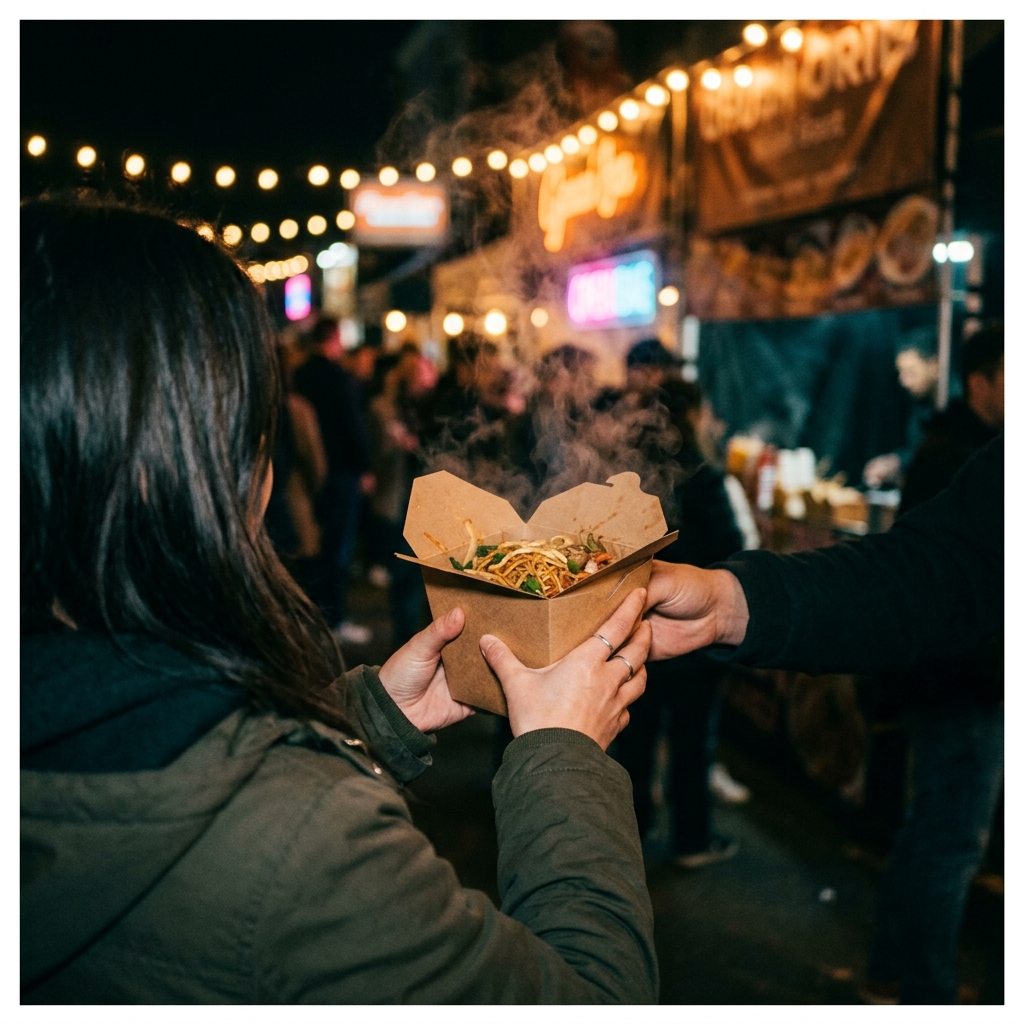
A street food market is one of the very few places where you can watch your entire meal being made. You see the raw ingredient, the heat, the pan and the plate. In a restaurant, all of that happens behind a wall.
Which makes it strange that street food gets treated as the risky option in pregnancy. The honest position is more useful than a blanket avoid, because the risk is not spread evenly across a market. It clusters in a few predictable places, and once you can see them you can eat almost anywhere.
Why a Stall Is Not Automatically Riskier
Mobile caterers, market stalls and food vans in the UK have to register with the local authority in the same way a restaurant does. They are inspected, and they are given a Food Hygiene Rating from 0 to 5. Displaying it is compulsory in Wales and Northern Ireland and voluntary in England, but the rating is public either way, and you can look up any trading name on the Food Standards Agency website before you leave the house.
That is more than most people know about the restaurant they booked.
The bigger protection is structural. Cooking to order at high heat, handed straight over, is the safest way food can reach you. There is no holding period, no cooling and reheating, no tray sitting under a lamp. The pathogens that matter in pregnancy are killed by proper cooking, and they need time and moderate warmth to grow back.
I spent a Saturday morning at a street food market with a probe thermometer and a notebook, which is an odd way to spend a weekend, and the pattern was clear within an hour. Anything handed to me straight off a griddle or out of a fryer was extremely hot, hotter than most restaurant plates. The variable was never the cooking. It was whatever had been portioned into a tray at the back and was waiting for a queue that had not arrived yet.
The Rule That Covers Most of It
Order what is cooked to order. Skip what is sitting and waiting.
UK rules require hot food to be held at 63°C or above. Food is allowed to sit below that for display purposes for up to two hours, once, and then it has to be used or thrown away. That is a legal allowance built for practical service, and it means a tray of pulled pork at three in the afternoon can be entirely within the rules and still be at the end of its window.
Cooking is the part that does the work. A core temperature of 70°C held for two minutes, or roughly 75°C instantaneous, kills the organisms that cause most food poisoning. In American terms that is 165°F for poultry and 160°F for anything minced.
You are not going to stand in a queue with a thermometer. Steam is the proxy. If the food is visibly steaming and too hot to eat immediately, it has been cooked or held properly. If it is warm, ask for a fresh portion. Vendors are asked this constantly and most will simply put it back on the heat.
Where Street Food Actually Goes Wrong
Five failure points, and none of them is the cooking itself.
Holding time. Pulled meats, hog roast, curries, paella and rice dishes are all cooked in bulk and then held. Rice deserves a specific mention, because Bacillus cereus spores survive cooking and multiply in rice left at room temperature, which is the classic reheated rice problem.
Undercooked meat. Burgers and chicken cooked fast on a busy griddle are the two that get rushed. Minced meat has to be cooked through because bacteria are mixed throughout it rather than sitting on the surface, so a rare burger is a genuinely different proposition to a rare steak.
Raw egg sauces. Garlic mayo, aioli, some tartare sauces and some dressings are made with raw egg. British Lion stamped eggs are considered safe to eat raw or lightly cooked in pregnancy. A stall's homemade aioli in an unlabelled tub may or may not be made with them, and non-Lion or imported eggs are not covered by that advice.
Cross-contamination. One set of tongs for raw and cooked, one board, one pair of gloves worn all afternoon. Gloves worn continuously are worse than clean bare hands, because they feel like protection while transferring exactly the same bacteria.
Chilled ready-to-eat items. This is the listeria seam, and it matters more in pregnancy than the rest. Listeria grows at fridge temperatures, and pregnant women are around ten times more likely to develop listeriosis than the general population. Soft cheese samples, cured meat samples, pre-dressed slaws and salads sitting out are where it lives, not the hot grill.
A Stall by Stall Verdict
The market as you would actually walk through it.
| Stall | Verdict | What to do |
|---|---|---|
| Burger van | Safe cooked through | Ask for well done, no pink. Skip raw onion garnish if it looks like it has been out a while. |
| Chicken skewers, jerk, souvlaki | Safe cooked to order | Take it off the grill, not from the pile keeping warm at the side. |
| Hog roast and pulled pork | Caution | Ask when it came off. Take it carved from the hot joint rather than scooped from a tray. |
| Paella, curry and rice pans | Caution | Fine when it is bubbling and being stirred. Avoid late in the day when the pan has gone quiet. |
| Wok noodles and stir fry | Safe | Cooked hot and fast to order. One of the best options at any market. |
| Falafel and halloumi wraps | Safe | Fried fresh. Cooked halloumi is fine regardless of the milk it started as. |
| Tacos and quesadillas | Safe with one check | Ask about the cheese. Fresh white cheeses can be unpasteurised, which our Mexican food safety guide covers. |
| Crepes and hot doughnuts | Safe | Batter is cooked through. Skip fresh cream that has been sitting in a warm tent. |
| Oysters and raw bar | Avoid | No preparation makes raw shellfish safe in pregnancy. |
| Sushi and poke | Avoid the raw fish | Raw fish needs documented freezing first, which a stall rarely can confirm. Cooked and vegetarian options are fine. |
| Cheese and charcuterie samples | Avoid | Cured meat samples and soft or unpasteurised cheese are the highest listeria risk at any market. |
| Soft serve machines | Caution | Safety depends entirely on how often the machine is stripped and cleaned. Pre-wrapped ice cream has no such variable. |
| Smoothie and juice stalls | Caution | Fruit washing is invisible and the juice is unpasteurised. Ask, or choose something cooked. |
Read down the caution column and the pattern is the same one every time. Nothing there is dangerous because of how it was cooked. It is dangerous because of what happened after.
The Cold Half of the Stall
Every hot dish at a market gets finished with something cold, and that is the half nobody inspects.
Sauces. A commercial squeezy bottle is made with pasteurised egg and is not the problem. An unlabelled tub of pale garlic sauce with a spoon in it is worth one question, because raw egg and a warm tent are a bad combination.
Slaw and salad. Pre-dressed and sitting out is the listeria scenario. It has also been handled, dressed and left, which is the exact profile of the ready-to-eat foods pregnancy guidance warns about.
Garnishes. Chopped coriander, shredded lettuce and sliced tomato are added by hand at the end, usually by the person also taking the cash. Asking for it without salad is a normal request and nobody blinks.
None of this makes a market a minefield. It just means the safest order at a street food stall is the hot thing, made now, with the cold extras kept simple.
Street Food in One Box
- Cooked to order beats everything. Steaming hot, handed straight over.
- Skip the tray at the back that has been waiting for a queue.
- Question unlabelled pale sauces, not the sealed bottles.
- Samples are the listeria risk, not the grill.
- Carry hand gel and eat earlier in the day.
Markets and Festivals Have a Handwashing Problem
The food is usually fine. The setting is the issue.
There is rarely a sink you can reach, the toilets are portable and often out of soap, and you are eating with your hands after handling cash, gates and a buggy. Carry hand gel and use it before eating, with the caveat that alcohol gel does not deal with norovirus, so wash properly when you find running water.
Two other festival specifics. Once you have your food, your own two hour clock starts, so a portion carried around for an afternoon is not worth going back to. And standing in heat and queues brings on dehydration and swelling fast, which our guide to pregnancy swelling gets into properly.
The most useful practical tip is about timing. Go early. Stock is fresh, holding trays have not been standing, staff are not exhausted and the queues are shorter. The same stall is a different proposition at noon and at six.
Street Food Abroad
Everything above still applies, plus water.
In countries where tap water is not safe to drink, it is also not safe in ice, in unpeeled washed salad, or in the rinse water for plates and cups. The traditional line is cook it, peel it, boil it or forget it, and it holds up well.
Two things change abroad. Unpasteurised dairy is far more common and often not labelled, so soft cheeses and fresh cheeses need more caution than at home. And traveller's diarrhoea is a bigger deal in pregnancy, because dehydration matters more and fewer medications are available to you. Our guide to eating abroad while pregnant covers country by country thinking, and the same logic runs through our barbecue safety guide for anything cooked outdoors.
If You Have Already Eaten Something
Most of the time nothing happens, and worrying retrospectively is not a plan.
Watch for vomiting, diarrhoea, fever or severe cramps in the next day or two, and focus on fluids. Listeria is the one with a long tail, because symptoms can appear anywhere from a few days to about ten weeks later and often look like flu rather than food poisoning. If you get an unexplained fever and aches in the weeks after eating something questionable, mention the meal when you call your midwife, because it changes what they test for.
Do not take anti-diarrhoeal medication without asking first. Our food poisoning in pregnancy guide has the symptom timelines and the thresholds for calling.
The wider point is worth holding on to. Pregnancy does not mean nine months of avoiding places where food is interesting. It means ordering the thing that is cooked in front of you, asking one question about the sauce, and washing your hands. Our buffet guide and takeaway guide apply the same three tests to the other two situations where food sits and waits.
Clinical Sources & Research
This article is general food safety information and does not replace advice from your midwife or GP. If you develop a fever after eating something you are unsure about, contact your maternity team rather than waiting it out.
Meet the Editorial Team
The researchers and experts behind PregnancyPlate.

Fiza Izra
Founder & Tech Researcher
A UK-based mother of 3 with a background in tech and data synthesis, Fiza brings real-world experience navigating hyperemesis gravidarum and postnatal depression. She engineers complex clinical guidelines (NHS, ACOG) into accessible tools, ensuring rigorous fact-checking with deep empathy.

Emma Davies
Senior Nutrition Editor
A mum and writer, Emma runs our food safety desk. She is the one who rings the restaurant to ask how long the lettuce sits out, checks every claim against CDC, FDA and NHS guidance, and rewrites the answer until it is usable at 9pm in a drive-thru queue.
Make sense of every plate.
Scan your plate for pregnancy food-safety guidance and a nutrition breakdown. Keep your meals and nutrient progress in one place.
Scan with your iPhoneto get the app