How Much Should My Baby Eat? Portions by Age From Six Months
There is no gram target, and milk stays the main source of calories until one. Realistic portions by age, the fist rule, and the fullness cues that matter.
In this article
Editorial note: This article is researched from official public health and pregnancy food safety guidance, then edited by the PregnancyPlate team for clarity. It is not medical advice. If you are worried about symptoms or a specific exposure, contact your midwife, GP or healthcare provider.
The Fast Answer: There is no gram target, and that is not a dodge. Until twelve months, milk is still the main source of calories and solids are practice. Start at one or two teaspoons once a day, build to three meals by around nine to twelve months, and use their own fist as the portion guide rather than an adult plate. You decide what and when. They decide how much. Wildly variable intake day to day is normal.
Track what your baby is eating in the PregnancyPlate AppYour next meal, a little less guesswork.
Scan your plate for pregnancy food-safety guidance and a nutrition breakdown. Keep your meals and nutrient progress in one place.
 Scan with your iPhone
to get the app
Almost every weaning question eventually becomes this one. Not what to give, but how much of it, and whether the amount that just went in was enough.
It is the question with the least satisfying answer, because the real one is a range so wide it sounds like nobody is paying attention. Here is the range, why it is that wide, and the handful of things that genuinely tell you whether feeding is going well.
Why Nobody Will Give You a Number
Two reasons, and both are in your favour.
The first is that babies are born able to regulate their own appetite. Left to it, they eat to their needs across a week rather than a day, which is why a baby can clear a whole bowl on Monday and refuse the identical bowl on Tuesday. Weight gain follows the week, not the meal.
The second is that in the first year, solid food is not primarily about calories. Milk is doing that job. Early weaning is about learning to move food around the mouth, manage texture, chew, swallow and accept new flavours. Those are motor skills, and a teaspoon teaches them as well as a bowl does.
So a portion target would be measuring the wrong thing. What matters is the shape of the day and the direction of travel over weeks.
Milk Is Still the Answer Until One
This is the part that reframes everything else.
Breast milk or first infant formula stays the main drink for the whole of the first year. At six months a formula fed baby is typically taking somewhere around 500 to 600ml a day, and a breastfed baby feeds on demand. Solids sit alongside that, not instead of it.
Milk volume comes down gradually as solids go up, and it does so on its own if you let it. By twelve months most babies are on roughly three meals a day plus two milk feeds. From twelve months whole cow's milk can become the main drink, at around 350ml a day, or about three servings of dairy in total.
The mistake worth avoiding is cutting milk to make room for food. It runs the wrong way round, because milk is still the more nutrient dense of the two. Our guide to dropping milk feeds covers the order to do it in and the signs they are ready.
One vitamin D note while we are here. Breastfed babies need a daily supplement of 8.5 to 10 micrograms from birth. Formula fed babies do not need one until they are taking less than 500ml of formula a day, at which point they do.
Portions by Age
Realistic amounts, with the caveat that a baby at the bottom of this table and one at the top can both be thriving.
| Age | Meals a day | Roughly how much | What it is for |
|---|---|---|---|
| 6 to 7 months | One, building to two | 1 to 2 teaspoons, moving to a few tablespoons | Taste and texture. Milk unchanged. |
| 7 to 9 months | Two, building to three | 2 to 4 tablespoons a meal, or a few finger foods | Iron becomes the point. Chewing develops. |
| 9 to 12 months | Three, plus a snack | 4 to 6 tablespoons, or a small bowl | Solids start doing real nutritional work. |
| 12 to 18 months | Three meals, two snacks | A quarter to a third of an adult portion | Food is now the main event. Milk drops back. |
| 18 months to 2 years | Three meals, two snacks | Roughly a third of an adult portion | Appetite becomes erratic. This is normal. |
Notice what happens at the bottom of that table. Intake looks like it stalls somewhere in the second year, and parents often panic at exactly that point. It is not a stall. Growth slows dramatically after the first year, so appetite slows with it. A one year old triples their birth weight. A two year old does nothing of the sort.
The Fist Rule
The most useful portion tool costs nothing and is attached to the baby.
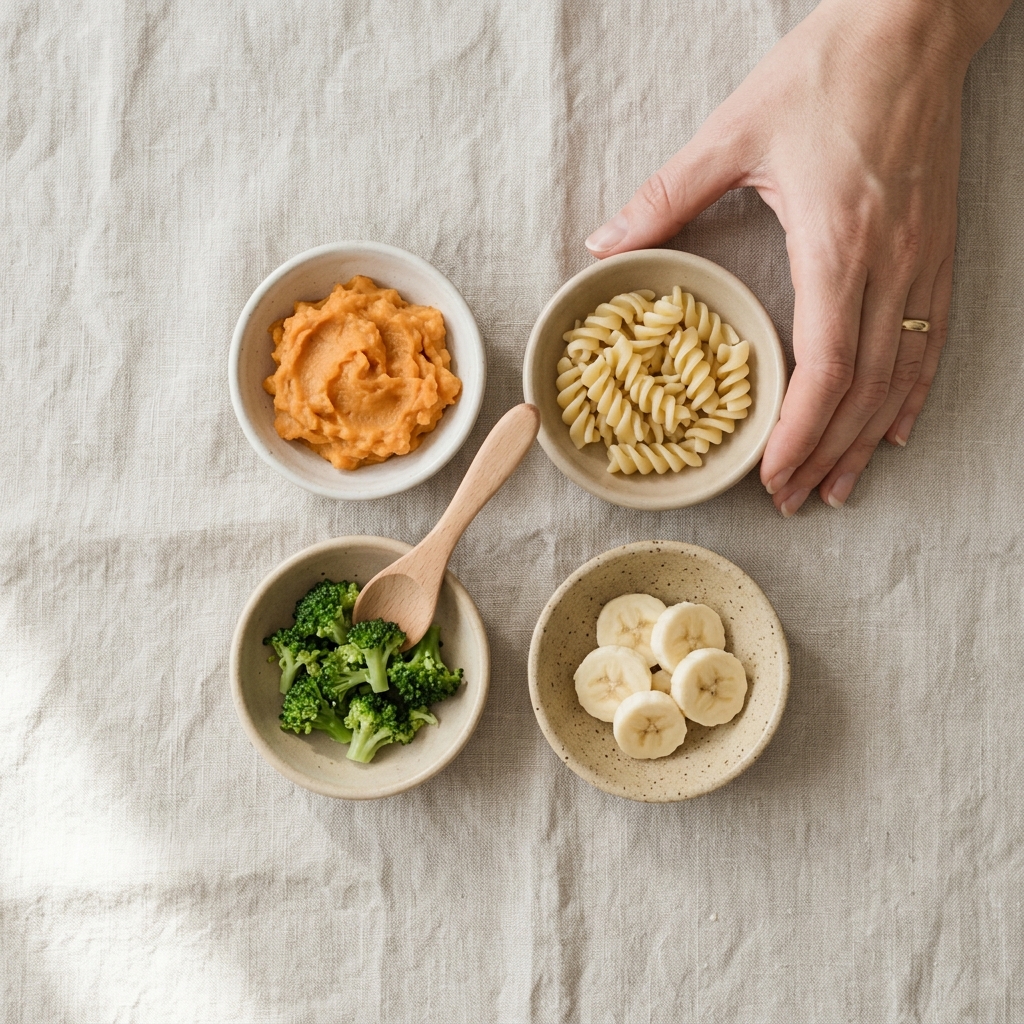
A serving of any single food is roughly the size of your child's own fist or the palm of their hand. Their hand grows as their stomach does, so the guide scales itself. A fist of pasta, a palm of chicken, a fist of vegetables, and if they want more you offer more.
It works because it fixes the actual problem, which is that adult plates and adult bowls make any baby portion look pitiful. Put four tablespoons of casserole in a normal cereal bowl and it looks like you have forgotten to feed them. Put it in a small dish and it looks like dinner.
One mother told us she had started photographing every meal so she could show the health visitor how little her eight month old was eating. The photographs ended up being the reassurance. Laid out side by side, a week of what felt like nothing was actually a lot of small somethings, and the days she remembered as disasters were outnumbered by ones she had forgotten entirely.
That is the general shape of it. Memory is bad at averaging, and feeding is a thing you can only judge on the average.
How to Tell They Have Had Enough
Babies signal fullness clearly. The signals just look like naughtiness once they can move their arms.
Still hungry: leaning towards the spoon, opening their mouth, getting excited when food appears, reaching, keeping their hands open and relaxed.
Finished: turning their head away, closing their mouth, pushing the spoon or bowl away, slowing right down, getting distracted, holding food in their mouth without swallowing, and yes, throwing it on the floor.
Throwing food is the one that gets misread most. Around eight to ten months it is usually a full baby experimenting with gravity rather than a rejection of your cooking. The right response is to end the meal calmly rather than to chase them with one more spoonful.
Which brings up the one habit worth breaking early. Encouraging a baby to finish a bowl teaches them to eat past fullness, and appetite regulation is much easier to keep than to rebuild. The bowl does not know how hungry they are. They do.
Portions in One Box
- Milk is the main food until one. Solids build alongside it.
- Start at teaspoons. Two tablespoons at seven months is a real meal.
- Use their fist, not an adult bowl, to judge a portion.
- Judge the week, never the meal.
- Stop when they signal stop, even with food left.
You Decide What and When, They Decide How Much
This is the single principle that makes the rest of it manageable, and it holds all the way through childhood.
Your job is what goes on the plate, when meals happen, and where they happen. Their job is how much of it they eat, and whether they eat any of it at all. When those roles blur is when mealtimes become a negotiation, and the negotiation is a much harder problem than the eating ever was.
In practice it means offering the food, sitting with them, and taking it away without commentary when they are done. No bargaining, no aeroplanes, no alternative meal produced ten minutes later. Our guide to what to do when a baby will not eat works through the refusal side of this in more detail, including how many exposures a new food genuinely needs.
The Days They Eat Almost Nothing
There will be plenty, and most have an explanation.
Teething makes chewing uncomfortable, so intake drops and cold soft foods do better for a few days. Illness suppresses appetite, and milk goes up while solids go down, which is exactly what should happen. Growth spurts run the other way and produce a week of eating everything in sight.
Timing is the most fixable one. A meal offered straight after a big milk feed lands badly, and so does one offered to an overtired baby at half past six. Try milk and food an hour or so apart, and move the meal earlier if the end of the day is a write off.
Distraction matters more than people expect. A television on, a busy room or a phone at the table all reduce how much a baby eats, because eating well requires paying attention to it.
If the amount is dropping, look at the shape of the day before you look at the food. Snacks and milk creeping closer to meals is the most common cause of a baby who suddenly is not hungry at lunch. Our four week weaning plan lays out a workable daily rhythm, and the finger foods by stage guide helps if the issue is texture rather than appetite.
When It Is Worth Getting Checked
Variation is normal. These are the things that are not, and they are worth a health visitor or GP appointment rather than another week of watching.
Weight. Faltering growth or dropping across centile lines on the chart, rather than one flat weigh-in.
No progress at all. Still refusing everything at eight or nine months, or refusing all lumps and textures beyond about ten months, which can point to a sensory or oral motor issue that is much easier to help early.
Fewer wet nappies than usual, or signs of dehydration during an illness.
Choking rather than gagging. Gagging is loud, red faced and protective, and it is part of learning to eat. Choking is silent. The difference is worth being sure about, and our guide to starting solids explains it properly.
Reactions. Rash, swelling, vomiting or breathing changes after a food need medical input, not a smaller portion.
Short of that list, the useful summary is that a baby who is growing, weeing, developing and reasonably content is eating enough, whatever the bowl looks like. Weigh the week, offer good food, and let them decide the rest. Our first 100 foods list is the easiest way to keep variety going once you stop counting spoons.
Clinical Sources & Research
This article is general information and does not replace advice from your health visitor, GP or dietitian. If you have concerns about your baby's growth or feeding, ask for a weigh-in and a conversation rather than waiting.
Meet the Editorial Team
The researchers and experts behind PregnancyPlate.

Fiza Izra
Founder & Tech Researcher
A UK-based mother of 3 with a background in tech and data synthesis, Fiza brings real-world experience navigating hyperemesis gravidarum and postnatal depression. She engineers complex clinical guidelines (NHS, ACOG) into accessible tools, ensuring rigorous fact-checking with deep empathy.

Emma Davies
Senior Nutrition Editor
A mum and writer, Emma runs our food safety desk. She is the one who rings the restaurant to ask how long the lettuce sits out, checks every claim against CDC, FDA and NHS guidance, and rewrites the answer until it is usable at 9pm in a drive-thru queue.
Make sense of every plate.
Scan your plate for pregnancy food-safety guidance and a nutrition breakdown. Keep your meals and nutrient progress in one place.
Scan with your iPhoneto get the app