Postpartum Hair Loss: Why It Happens and What Food Actually Does
Postpartum hair loss is hormonal, not a diet failure. Why it peaks around four months, what nutrition genuinely affects, and the biotin warning worth knowing.
In this article

Editorial note: This article is researched from official public health and pregnancy food safety guidance, then edited by the PregnancyPlate team for clarity. It is not medical advice. If you are worried about symptoms or a specific exposure, contact your midwife, GP or healthcare provider.
The Fast Answer: Postpartum hair loss is hormonal, not nutritional. It happens because pregnancy kept hair in its growth phase, and after birth all of it enters the shedding phase at once. It typically peaks around three to four months and resolves by a year. No supplement stops it. What food genuinely affects is iron and protein, and low iron can make it worse and last longer. Skip the biotin, for a reason worth reading.
Check your iron and protein in the PregnancyPlate AppIt usually starts in the shower somewhere around month three. Then it's on the pillow, in the hairbrush, wrapped around the baby's fingers. For a lot of women it's genuinely frightening, and the internet immediately suggests it's your fault for not eating well enough.
It isn't. Here's what's actually happening, and the narrow set of things nutrition can and can't change.
Why It Happens
Hair grows in cycles. At any normal moment, most of your hair is in a growth phase and a smaller portion is resting, ready to shed. That's why you lose some hair every day without noticing.
Pregnancy interrupts this. High oestrogen keeps hair in the growth phase for longer, which is why hair often looks thicker and glossier while pregnant. Very little sheds for months.
Then you give birth, oestrogen drops sharply, and all the hair that should have shed gradually over those months enters the shedding phase at roughly the same time. The clinical name is telogen effluvium. You're not losing more hair than normal overall. You're losing several months' worth in a compressed window.
Which explains the timing. It usually starts around two to three months postpartum, peaks around three to four, and settles by six to twelve months. It's temporary, it's expected, and it happens to a large proportion of women regardless of how well they ate.
Where Nutrition Genuinely Matters
Diet won't prevent the hormonal shed. It can affect how bad it gets and how quickly you regrow, and there are two nutrients that matter more than the rest.
Iron is the big one. Low iron, and specifically low ferritin (your iron stores), is independently associated with hair shedding. If you had significant blood loss at birth or a caesarean, or you were low in pregnancy, you may be running on depleted stores at exactly the point the hormonal shed hits. The two stack, and the result is a shed that's heavier and lasts longer.
This is the one genuinely worth acting on. Ask for a full blood count and a ferritin level rather than guessing. Ferritin can be low while your haemoglobin still reads as normal, so the standard anaemia test alone can miss it. Our iron guide covers food sources and absorption.
Protein is the other. Hair is made of keratin, which is protein, and your body treats hair as non-essential when protein is short. It will divert what's available to things that keep you alive first. You need roughly 75 to 100g a day while breastfeeding, and this is the wrong period to be undereating.
The Biotin Warning
Biotin is the supplement most heavily marketed for hair, and there are two things to know.
First, it only helps if you're deficient, and genuine biotin deficiency is rare. If your levels are normal, taking more does not grow hair. The evidence for supplementing in non-deficient people is weak.
Second, and this is the part that matters: high-dose biotin interferes with common blood tests. It can skew thyroid function results and, more seriously, troponin tests, which are used to diagnose heart attacks. Both the FDA and MHRA have issued warnings about this, and there have been cases of misleading results.
That's directly relevant postpartum, because thyroid problems are common after birth and can themselves cause hair loss. If you're taking high-dose biotin and having thyroid bloods, the results may be wrong in either direction. Tell whoever takes your blood that you're taking it.
Given a weak benefit and a real interference risk, biotin is not worth it for most women.
Hair Loss in One Box
- It's hormonal. Months of held-back shedding released at once.
- Peaks at 3 to 4 months, settles by 6 to 12.
- Get ferritin checked, not just haemoglobin. Low stores worsen it.
- Protein matters. Hair is the first thing your body deprioritises.
- Skip biotin. Weak evidence, and it skews thyroid and cardiac blood tests.
What Else Is Worth Eating
Beyond iron and protein, a few nutrients have a genuine role in hair, though none of them is a cure.
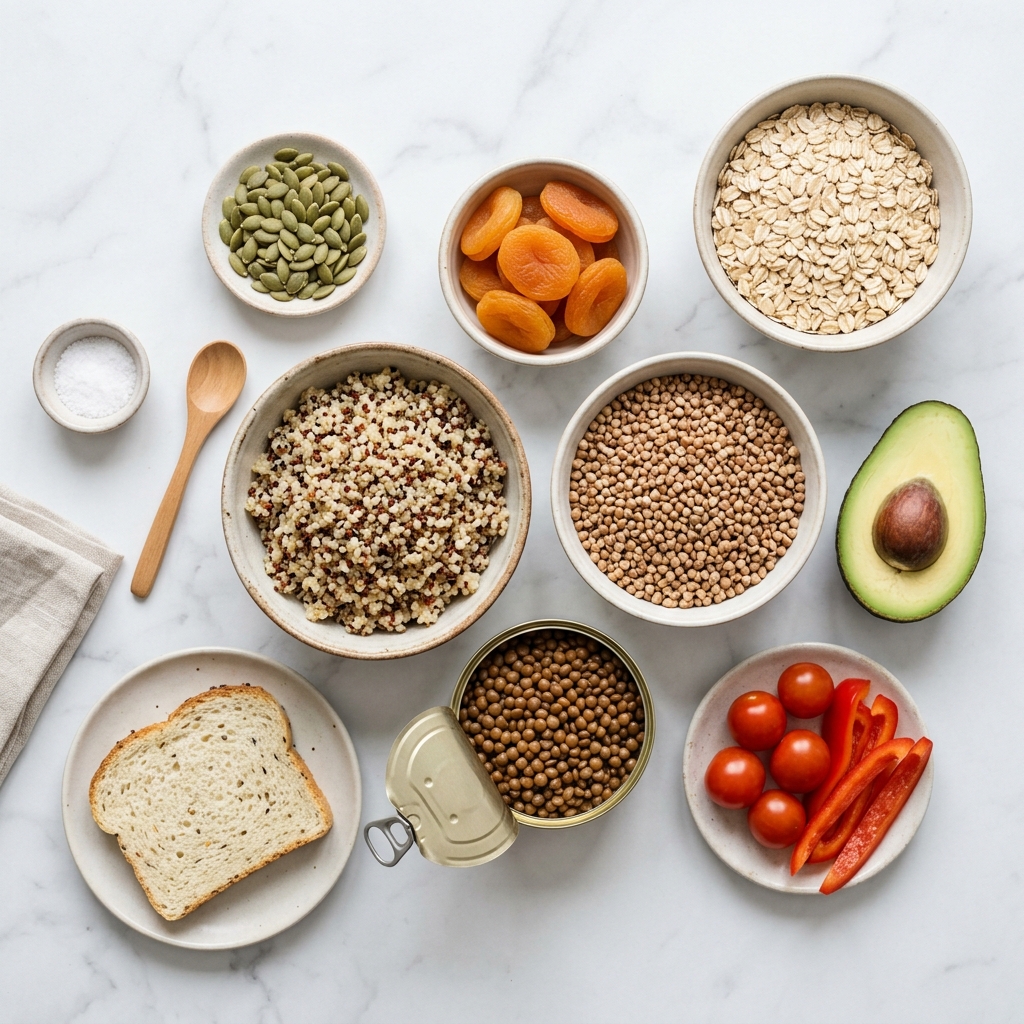
Zinc, which is involved in tissue repair and hair follicle function. Meat, shellfish, beans, nuts, seeds and wholegrains.
Vitamin D, where deficiency is associated with hair loss and is very common in the UK. The 10mcg daily supplement is recommended year-round anyway.
Omega-3 and vitamin C, the first for scalp health and the second because it improves iron absorption, which brings you back to the nutrient that actually matters.
Worth noting what your prenatal does and doesn't cover here. Iron is usually included, zinc often, but the amounts vary. Our guide to prenatal gaps covers what falls outside the pill.
What Helps While You Wait It Out
None of this changes the underlying shed. It reduces the amount you pull out mechanically, which is a meaningful chunk of what ends up in the brush.
Be gentler with wet hair, which is at its most fragile. Use a wide-tooth comb rather than a brush, and start at the ends rather than dragging from the roots.
Loosen your ponytail. Tight styles pulled back daily add traction on top of the hormonal shed, and that combination genuinely does thin the hairline. Scrunchies and low loose styles are kinder than a tight elastic in the same spot every day.
Skip the heat where you can, not because it causes shedding but because it makes the hair you still have more likely to break.
Consider a shorter cut. Practical rather than cosmetic. Less weight and less length means less to pull out, less to get wrapped around small fingers, and a considerably less alarming amount visible in the shower.
The Thing That Makes It Worse
Crash dieting. Rapid weight loss is one of the most reliable triggers of telogen effluvium in its own right, entirely separately from the hormonal one.
So aggressive restriction in the months after birth can produce a second shed layered on top of the first, at the point you're already breastfeeding and sleep deprived. If losing weight matters to you, gradual is genuinely the better strategy here rather than just the polite advice. Our postpartum recovery guide covers eating properly through this stretch.
Stress and poor sleep contribute too, which is an unhelpful thing to be told with a newborn. Nothing to fix there. Just worth knowing it isn't your diet.
Hair Supplements: What You're Paying For
The postpartum hair supplement market is large and the evidence behind it is small. Worth knowing what's in the tub before you spend.
Collagen. Marketed heavily for hair. Your digestive system breaks it down into amino acids like any other protein, so it isn't delivered to your hair as collagen. It's a protein source, and an expensive one compared with eggs.
Hair gummies. Usually biotin plus a multivitamin, often with added sugar. See the biotin section above for why that's not a neutral choice.
Marine or keratin complexes. Some small studies exist, mostly industry funded, mostly in women with existing deficiencies.
The honest position: if you're deficient in iron, correcting that helps. If you aren't, no supplement has been shown to shorten postpartum shedding, because it's a hormonal timing effect rather than a shortage of raw materials. Money is better spent on food you'll actually eat.
Do keep taking a standard postnatal or general multivitamin if you're breastfeeding, particularly vitamin D. That's a different thing from a hair-specific product.
When to See Someone
Most postpartum shedding needs no medical attention at all. A few patterns do.
Patchy or circular bald spots, rather than general thinning. That's a different condition and needs assessing.
No sign of regrowth by around twelve months, or shedding that's still heavy at that point.
Other symptoms alongside it: unusual fatigue, weight changes, feeling cold, low mood, palpitations. Postpartum thyroiditis is common, treatable, and hair loss is one of its signs. Worth a blood test rather than assuming.
Any suspicion of low iron, particularly after a heavy birth or a caesarean, which our C-section recovery guide covers.
The regrowth, when it comes, arrives as a halo of short new hairs around your hairline that stick up and refuse to lie flat. Irritating, and the most reliable sign that it's over.
Clinical Sources & Research
This article is general information and does not replace medical advice. If your hair loss is patchy, prolonged, or accompanied by other symptoms, see your GP for assessment and blood tests.
Meet the Editorial Team
The researchers and experts behind PregnancyPlate.

Fiza Izra
Founder & Tech Researcher
A UK-based mother of 3 with a background in tech and data synthesis, Fiza brings real-world experience navigating hyperemesis gravidarum and postnatal depression. She engineers complex clinical guidelines (NHS, ACOG) into accessible tools, ensuring rigorous fact-checking with deep empathy.

Emma Davies
Senior Nutrition Editor
A mum and writer, Emma runs our food safety desk. She is the one who rings the restaurant to ask how long the lettuce sits out, checks every claim against CDC, FDA and NHS guidance, and rewrites the answer until it is usable at 9pm in a drive-thru queue.