Your Prenatal Doesn't Cover Everything: 5 Nutrients You Still Need From Food
Prenatal vitamins are designed to top up a diet, not replace one. The five nutrients most prenatals underdose or skip, and the foods that close each gap.
In this article
Editorial note: This article is researched from official public health and pregnancy food safety guidance, then edited by the PregnancyPlate team for clarity. It is not medical advice. If you are worried about symptoms or a specific exposure, contact your midwife, GP or healthcare provider.
The Fast Answer: A prenatal is a top-up, not a replacement. It's designed around the nutrients that are hard to eat enough of and small enough to fit in a capsule. Five things routinely fall outside that: choline, calcium, omega-3 DHA, iodine and fibre. Choline is the standout, because the target is 450mg a day and most prenatals contain almost none. All five come from food easily once you know to look.
See which nutrients you're short on in the PregnancyPlate AppSafety is step one. Nutrition helps your baby thrive.
Knowing a meal is safe does not tell you whether you are getting enough iron, folate, calcium and choline. PregnancyPlate tracks all of it from a photo of your plate.
- See nutrient progress
- Scan meals instantly
- Nourish with confidence
 Scan to download
Open with iPhone camera
Scan to download
Open with iPhone camera
There's a comforting assumption behind the prenatal vitamin: take the pill, and the nutrition is handled. Eat what you can manage, the supplement catches the rest.
It doesn't work like that, and not because prenatals are bad. It's a physical constraint. Some nutrients are needed in gram-scale amounts and simply won't fit in a capsule you can swallow. Others compete with each other for absorption, so manufacturers deliberately leave them out. A few just aren't standard.
When I went through the labels of the prenatals stocked in a typical UK supermarket, the pattern was consistent. Folic acid and vitamin D, always. Iron, usually. Choline, almost never. Here are the five gaps and how to close them.
1. Choline, the Big One
Target: 450mg a day. Typical prenatal: 0 to 55mg.
This is the largest gap by a distance, and the least known. Choline does for brain and spinal cord development roughly what folate does, and the evidence on memory and cognitive outcomes is genuinely interesting. Yet it's absent from most prenatals, because it's bulky and would double the pill size.
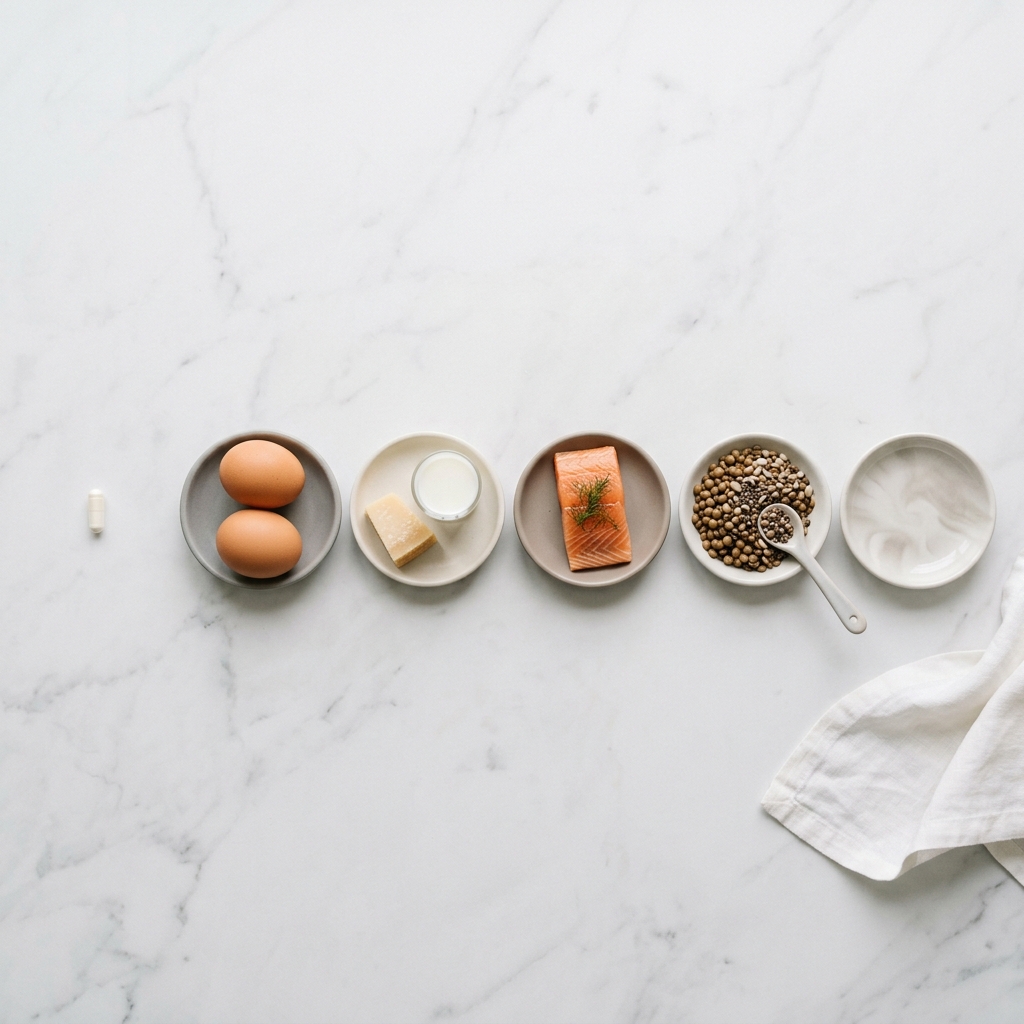
Food closes it easily, but only if you eat the right things. Two eggs give you about 300mg, most of it in the yolk, which makes eggs far and away the most efficient source. Beef, chicken liver (once a week maximum, because of vitamin A), salmon, chicken, soya beans and cruciferous vegetables fill in the rest.
If you've gone off eggs, which happens to plenty of people, this is the gap most worth actively managing. Our full choline guide covers the alternatives.
2. Calcium, Left Out on Purpose
Target: 1,000mg a day. Typical prenatal: 100 to 300mg.
This one isn't an oversight. Calcium and iron compete for absorption in the gut, so putting a full dose of both in one pill makes the iron less useful. Manufacturers include a token amount and assume you'll eat the rest.
Which is reasonable, because calcium is one of the easier targets to hit. A glass of milk is around 300mg. A pot of yogurt, similar. A matchbox of cheddar, about 200mg. Three dairy servings and you're most of the way there.
Without dairy it takes more thought: fortified plant milks (check the carton actually says fortified, many organic ones aren't), tinned sardines with the bones, tofu set with calcium sulphate, kale, and fortified bread. Our calcium in pregnancy guide has the numbers per portion.
3. Omega-3 DHA, Often Missing Entirely
Target: 200mg or more a day. Many prenatals: none.
Plenty of prenatals contain no DHA at all, and those that do often sell it as a separate capsule alongside. DHA is a fat, so it doesn't sit well in a standard tablet.
It matters most in the third trimester, when brain growth accelerates sharply. Two portions of fish a week with one of them oily covers it: salmon, mackerel, sardines, trout. If you don't eat fish, an algae-based supplement does the same job and is where the fish get it from anyway.
Check your own box before buying a separate supplement. And if you're wondering about stopping it late on, our guide to omega-3 in late pregnancy covers that specific question.
4. Iodine, Inconsistent by Brand
Target: around 150mcg a day. Prenatal: sometimes, sometimes not.
Iodine is needed for thyroid hormones, which drive foetal brain development, and requirements rise in pregnancy. The awkward part is how variable prenatals are: some contain a full dose, plenty contain none, and there's no way to tell without reading the label.
Dairy is the main dietary source in the UK, along with white fish and eggs. Worth knowing: most plant milks are not fortified with iodine even when they're fortified with calcium, so switching from cow's milk quietly removes a major source. Seaweed is not the answer either, since it can deliver wildly excessive amounts.
Read your prenatal's label for this one specifically. It's the gap most likely to surprise you.
5. Fibre, In No Pill Anywhere
Target: around 30g a day. Prenatal: zero, always.
Not a vitamin, so nobody thinks of it as a gap. But pregnancy slows the gut, iron supplements make constipation worse, and between them this becomes one of the most common complaints of the second and third trimesters.
Wholegrains, beans, lentils, fruit with skins on, vegetables, nuts and seeds. Dried apricots and prunes are the traditional answer for a reason. Increase it gradually rather than all at once, and drink more water alongside or you'll make things worse. Our fibre and constipation guide has the full list.
The Five Gaps in One Box
- Choline 450mg. Two eggs gets you 300mg. The biggest gap.
- Calcium 1,000mg. Three dairy servings, or fortified alternatives.
- DHA 200mg or more. Two portions of fish weekly, one oily, or algae oil.
- Iodine 150mcg. Dairy, white fish, eggs. Check your label, brands vary.
- Fibre 30g. In no supplement at all. Wholegrains, beans, fruit, water.
The Gaps Get Wider on Some Diets
Three situations where the list above needs more attention, not less.
Vegan and vegetarian. Choline, iodine, DHA and iron all lean heavily on animal foods. Soya beans, quinoa and cruciferous vegetables cover some choline, algae oil covers DHA, and iron comes from lentils and beans paired with vitamin C. Iodine is the awkward one, since plant milks usually aren't fortified with it, so a supplement is often the sensible route. Vitamin B12 also becomes a genuine concern on a vegan diet and isn't on the list above only because most prenatals do include it.
Dairy-free. Removes the main source of calcium and iodine simultaneously, which is easy to miss because people substitute for the calcium and forget the iodine entirely.
Severe aversions. Going off eggs takes out your best choline source, and going off fish takes out DHA. Aversions are usually temporary, but if one lasts a whole trimester it's worth mentioning at an appointment rather than hoping.
What Your Prenatal Does Do Well
Worth saying plainly, because none of this is an argument for skipping it.
Folic acid is the reason prenatals exist. 400mcg daily from before conception through the first twelve weeks, and it prevents neural tube defects in a way diet alone can't reliably match. Some women need a 5mg dose, which is prescription only. Our folate versus folic acid guide explains the difference.
Vitamin D at 10mcg a day, recommended for everyone in the UK through autumn and winter and throughout pregnancy. Very hard to get from food.
Iron, usually included, though absorption is the real issue rather than the dose. Take it away from tea, coffee and calcium, and with something containing vitamin C. Our iron guide covers the mechanics.
Timing Changes How Much You Absorb
A gap you can close without changing what you eat at all, just when you take things.
Iron and calcium compete, so don't take an iron supplement with a glass of milk or a calcium tablet. Separate them by a couple of hours and both work better.
Tea and coffee block iron absorption through their polyphenols, and the effect is substantial. Keep both an hour clear of iron-rich meals and iron tablets.
Vitamin C multiplies plant iron absorption, so pair lentils with peppers, beans with tomatoes, or fortified cereal with a glass of orange juice.
Take fat-soluble vitamins with food containing fat. Vitamins A, D, E and K need it, so a prenatal taken with a meal is absorbed better than one taken on an empty stomach. This also cuts the nausea plenty of women get from taking it first thing.
If your prenatal makes you feel sick, taking it in the evening with dinner rather than in the morning solves it for most people.
How to Check Your Own
Five minutes with the box, once.
Look at the back for choline, iodine and DHA specifically, since those are the three that vary most between brands. Note the calcium figure and assume you're eating the difference. Then stop worrying about the rest, because the vitamin-and-mineral column is generally well covered.
And don't double up on prenatals thinking more is better. Several nutrients, vitamin A especially, are harmful in excess during pregnancy, which is also why liver is limited and why standard multivitamins aren't a substitute for a prenatal.
The honest summary: the pill handles what's hard to eat, food handles what's too bulky to swallow. Knowing which is which is most of the job. If you'd rather see it tracked than estimated, that's exactly what our complete pregnancy meal plan is built around.
Meet the Editorial Team
The researchers and experts behind PregnancyPlate.

Fiza Izra
Founder & Tech Researcher
A UK-based mother of 3 with a background in tech and data synthesis, Fiza brings real-world experience navigating hyperemesis gravidarum and postnatal depression. She engineers complex clinical guidelines (NHS, ACOG) into accessible tools, ensuring rigorous fact-checking with deep empathy.

Emma Davies
Senior Nutrition Editor
A mum and writer, Emma runs our food safety desk. She is the one who rings the restaurant to ask how long the lettuce sits out, checks every claim against CDC, FDA and NHS guidance, and rewrites the answer until it is usable at 9pm in a drive-thru queue.