Are Crumbl Cookies Safe During Pregnancy? Gooey Centres, Dough Toppings and Chilled Flavours
A gooey centre is not raw dough, it is sugar and a short bake. The two things worth knowing are dough toppings and the chilled cheesecake-style cookies.
In this article
Editorial note: This article is researched from official public health and pregnancy food safety guidance, then edited by the PregnancyPlate team for clarity. It is not medical advice. If you are worried about symptoms or a specific exposure, contact your midwife, GP or healthcare provider.
The Fast Answer: Crumbl cookies are safe in pregnancy. The question everyone asks is whether a warm, gooey centre means raw dough, and it does not. That texture comes from sugar, butter and a short bake, while the flour and egg are still cooked. The two things actually worth knowing: any raw cookie dough topping should be heat-treated, which is worth asking about, and the chilled cheesecake-style cookies need to be eaten fresh rather than carried around all day.
Track your nutrition in seconds in the PregnancyPlate AppSafety is step one. Nutrition helps your baby thrive.
Knowing a meal is safe does not tell you whether you are getting enough iron, folate, calcium and choline. PregnancyPlate tracks all of it from a photo of your plate.
- See nutrient progress
- Scan meals instantly
- Nourish with confidence
 Scan to download
Open with iPhone camera
Scan to download
Open with iPhone camera
A warm Crumbl cookie is deliberately soft in the middle, which sets off every pregnancy alarm about raw dough. It is a reasonable worry and the answer is reassuring once you know what makes a cookie gooey.
Here is what is actually happening, and the two items on the menu that genuinely need a thought.
Gooey Is Not the Same as Raw
The reason raw cookie dough is unsafe in pregnancy is usually misunderstood. Most people assume it is the raw egg, and that is part of it. The bigger problem is raw flour, which is a raw agricultural product that has never been heat treated and has been linked to E. coli outbreaks.
Baking solves both. Once a cookie has been through the oven, the flour has been heated and the egg is cooked, even if the centre is still soft.
Softness in a finished cookie comes from the recipe rather than from underbaking: a high ratio of sugar and butter, a thick cookie baked at high heat for a short time so the edges set while the middle stays molten, and sometimes a melted chocolate or filling centre. The dough has reached temperature. It just has not dried out.
So a warm cookie with a soft middle is fine. What would not be fine is actual uncooked dough, which is a different thing entirely and looks it.
The One Thing Worth Asking About
Some cookie flavours, at Crumbl and elsewhere, are topped or filled with cookie dough as a deliberate feature rather than as an accident of baking.
Commercially made edible cookie dough is produced with heat-treated flour and pasteurised egg, which makes it safe. That is why tubs of edible dough are sold as a product and labelled as such. A bakery using a proper edible dough recipe is doing the same thing.
What you cannot assume is that every dough topping has been made that way. If a flavour that week features raw-looking dough pieces, it is a fair question: is the dough heat treated? Staff at a dedicated cookie chain generally know, because they are asked.
If the answer is unclear, pick a different flavour that week. There are usually six or more on rotation. Our raw cookie dough guide explains the flour risk in more detail, including which supermarket products are safe.
Warm Cookies and Chilled Cookies Are Different
The menu splits into two formats each week, and only one of them involves any handling consideration.
| Type | Verdict | Notes |
|---|---|---|
| Warm cookies | Safe | Baked through. Soft centre is texture, not raw dough. |
| Buttercream and frosting toppings | Safe | Made with butter, sugar and pasteurised dairy. No raw egg. |
| Cream cheese frostings | Safe | Commercial cream cheese is pasteurised. Keep chilled ones cold. |
| Chilled cheesecake-style cookies | Eat fresh | A chilled ready-to-eat dairy product. Fine from the shop, less so after hours in a warm bag. |
| Ice cream style cookies | Safe | Commercial ice cream is pasteurised. |
| Mousse and whipped toppings | Safe | Commercial products made with pasteurised ingredients. |
| Cookie dough toppings | Ask | Safe if heat treated, which commercial edible dough is. Worth confirming. |
| Coffee or espresso flavours | Count it | Contains caffeine, usually a small amount, towards your 200mg daily limit. |
| Nut-topped flavours | Safe | Peanuts and nuts are fine in pregnancy unless you are allergic. |
The chilled cookies are the only ones with a timing element. They are dairy-based and sold cold, so they belong in a fridge rather than in a car for the afternoon. Eaten the same day they are completely fine.
Crumbl in One Box
- Gooey centres are baked. Not raw dough.
- Ask about dough toppings. Heat-treated is safe.
- Chilled cookies go in the fridge, not the car.
- Frostings are pasteurised. No raw egg concern.
- One cookie is a large portion. Halving it is normal.
How to Tell a Cookie Is Actually Underbaked
Since the whole question turns on this, it is worth knowing what you are looking at.
Baked but soft: the edges are set and slightly firm, the surface has cracked or domed, the colour has changed from pale dough to golden or browned, and the middle is molten rather than pasty. It holds together when you lift it.
Genuinely raw: the dough is still pale and matte, it has the texture of the mixture rather than of a baked good, and it smears rather than crumbles. You would know.
Commercial bakeries bake to a timer and a temperature, in volume, which is considerably more consistent than a home oven. The chance of a genuinely raw cookie coming out of a production kitchen is low, and the soft centre you are looking at is the product working as designed.
If one ever does look and taste like raw dough, do not eat the rest of it. But the normal gooey middle is not that.
If You Have Already Eaten Raw Dough
Worth covering, because this is the kind of thing people search after the fact.
Most people who eat a bit of raw dough are completely fine. The risks are salmonella from egg and E. coli from flour, and both are uncommon from a small amount.
Watch for stomach cramps, diarrhoea, vomiting or fever over the next few days. Focus on fluids if you feel unwell, and contact your midwife or GP if you cannot keep fluids down, you develop a fever, or symptoms last more than a couple of days. Our food poisoning in pregnancy guide has the thresholds for calling.
Neither of these bacteria behaves like listeria, which is the one that can cross the placenta without making you particularly unwell. That is why the advice around cold cured meat and soft cheese is stricter than the advice around dough.
The Size Is the Real Consideration
Nothing here is a safety issue. The honest nutritional point is portion.
These are large cookies, several times the size of a standard one, and a single cookie can carry as much sugar and as many calories as a full dessert. That is fine as an occasional treat and worth knowing if it becomes a weekly habit.
The thing that matters in pregnancy is how fast that sugar arrives. A large cookie on an empty stomach produces a sharp rise and then a slump an hour or two later, which is easily mistaken for ordinary pregnancy tiredness. Our guide to pregnancy blood sugar crashes explains the mechanism.
Two adjustments that cost nothing: eat it after a meal rather than instead of one, and split it, which is what the box size invites anyway. Half a cookie with a cup of tea is a genuinely different experience from a whole one at four in the afternoon on an empty stomach.
If you have been diagnosed with gestational diabetes, this is one of the harder items to fit in, because the sugar load is large and fast. It is not forbidden, but it works far better as a small portion after a meal containing protein. Our gestational diabetes meal plan covers the approach.
One more practical note for the weekly rotation. Flavours change every week, which means the answer to "is this one fine" changes too. The three categories worth a glance are anything described as dough, anything chilled and dairy-based, and anything with coffee or espresso in it. Everything else on a cookie menu is baked sugar, butter and flour, and needs no thought at all.
Cravings, and Not Making It a Problem
Sugar cravings in pregnancy are extremely common and not a character failing.
They often spike when you are tired, when meals have been too far apart, or in the first trimester when sweet things are among the few foods that appeal. That last one is worth naming: if a cookie is what you can face on a bad nausea day, a cookie is better than nothing.
If cravings are constant rather than occasional, the usual culprit is the shape of the day rather than willpower. Meals too far apart, not enough protein at lunch, and skipping breakfast all produce an afternoon where sugar is the only thing that sounds appealing. Our iron-rich lunch ideas are built around exactly that problem.
And a note on an old myth: craving sweet things does not tell you the baby's sex, and craving non-food items is a different thing entirely, which our guide to pica covers.
Taking Them Home
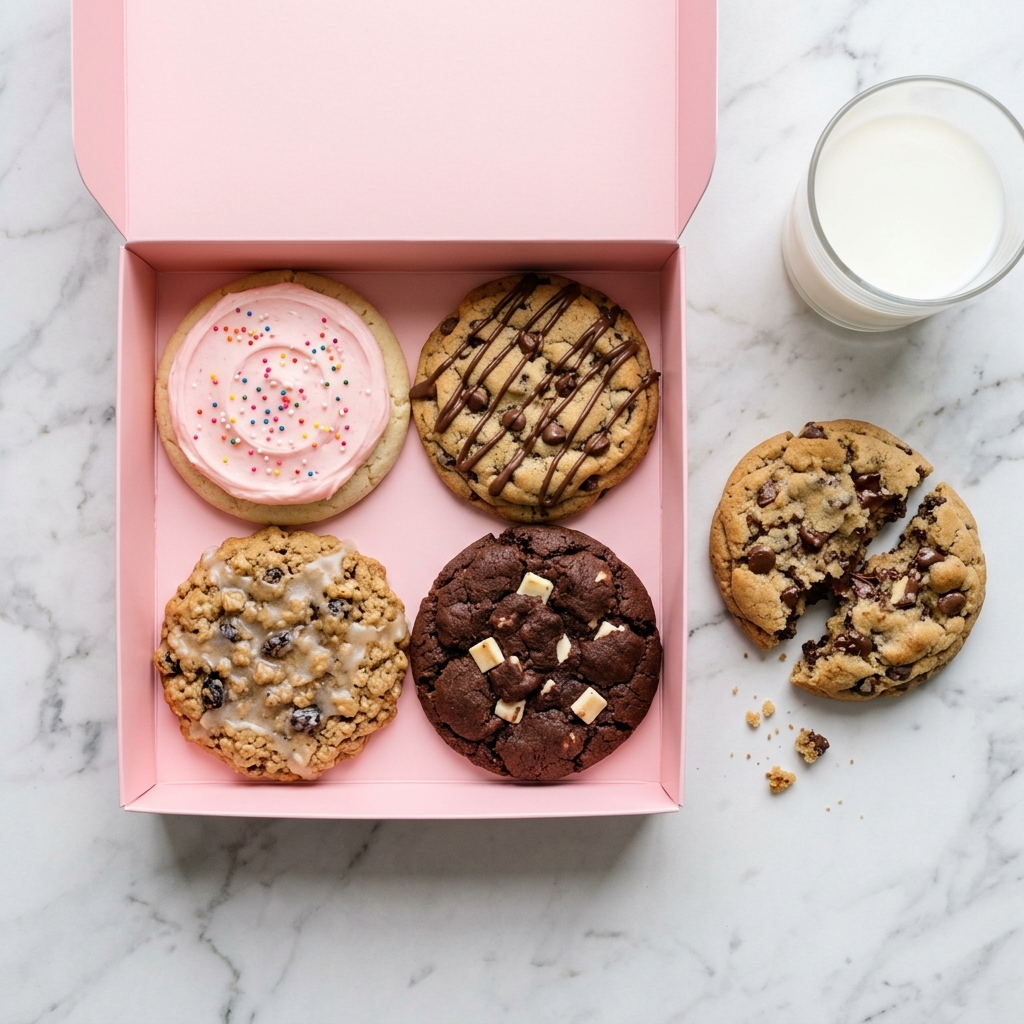
Most people leave with a box of four, which raises one practical question.
Warm cookies keep at room temperature for a couple of days in a sealed container, exactly like any baked good. No refrigeration needed and no pregnancy concern.
Chilled cookies should go in the fridge when you get home and be eaten within a day or two. They are a dairy dessert rather than a biscuit, so treat them like cheesecake.
Freezing works for the baked ones if you want to make a box last, and a frozen cookie thawed at room temperature is fine.
Reheating is where people overthink it. A few seconds in a microwave to warm a baked cookie is fine. There is no undercooked ingredient to worry about, so the only risk is melting the frosting.
The summary: order whatever flavour you want, ask if a dough topping looks raw, keep the chilled ones cold, and treat the size as the real decision rather than the safety. If you are weighing up other sweet options, our ice cream guide and chocolate guide cover the rest.
Clinical Sources & Research
This article is general information and does not replace advice from your midwife, GP or dietitian. Flavours rotate weekly, so check ingredients for anything unfamiliar.
Meet the Editorial Team
The researchers and experts behind PregnancyPlate.

Fiza Izra
Founder & Tech Researcher
A UK-based mother of 3 with a background in tech and data synthesis, Fiza brings real-world experience navigating hyperemesis gravidarum and postnatal depression. She engineers complex clinical guidelines (NHS, ACOG) into accessible tools, ensuring rigorous fact-checking with deep empathy.

Emma Davies
Senior Nutrition Editor
A mum and writer, Emma runs our food safety desk. She is the one who rings the restaurant to ask how long the lettuce sits out, checks every claim against CDC, FDA and NHS guidance, and rewrites the answer until it is usable at 9pm in a drive-thru queue.