Is Sweetgreen Safe During Pregnancy? Salad Bars, Cold Lines and What to Order
At a salad chain the question is the cold ingredients, not the cooking. Why timing matters more than avoidance, which cheeses to swap, and how to build the bowl.
In this article
Editorial note: This article is researched from official public health and pregnancy food safety guidance, then edited by the PregnancyPlate team for clarity. It is not medical advice. If you are worried about symptoms or a specific exposure, contact your midwife, GP or healthcare provider.
The Fast Answer: A salad chain is the one place in this series where the pregnancy question is about the cold ingredients rather than the cooking. Leafy greens and chilled toppings are ready to eat, which is the category listeria lives in. The fix is timing rather than avoidance: order at busy times when the line is turning over, skip anything that looks tired, check the cheese, and it's one of the better lunches you can eat while pregnant.
Track your nutrition in seconds in the PregnancyPlate AppSafety is step one. Nutrition helps your baby thrive.
Knowing a meal is safe does not tell you whether you are getting enough iron, folate, calcium and choline. PregnancyPlate tracks all of it from a photo of your plate.
- See nutrient progress
- Scan meals instantly
- Nourish with confidence
 Scan to download
Open with iPhone camera
Scan to download
Open with iPhone camera
Every other restaurant guide comes down to whether the food is hot enough. A salad place inverts that, because almost nothing is cooked to order and the whole meal is assembled from a chilled line.
That sounds worse than it is. Leafy greens are also one of the best things you can eat in pregnancy, and the risks here are manageable with a couple of habits.
Why Raw Greens Need Thought
Leafy greens are a recurring source of foodborne illness, not because anyone handles them badly but because they're grown in open fields, eaten raw, and never get a cooking step that would kill bacteria.
In pregnancy the specific worry is listeria, which unlike most bacteria grows at fridge temperatures. That's why pregnancy guidance focuses on chilled ready-to-eat foods rather than hot ones. Pregnant women are around ten times more likely to develop listeriosis, and it can affect the baby even when the mother feels only mildly unwell.
Bagged and pre-washed greens used by chains are washed at scale before delivery, and washing them again at home does not make them safer. What matters is how long they've been out of refrigeration and how much handling they've had since.
Our restaurant lettuce guide covers the outbreak side of this, which has been a live issue for chains in general.
The Timing Trick
This is the single most useful thing to know, and it costs nothing.
Ingredients sit in chilled wells on the line. At a busy lunchtime those containers are emptied and replaced constantly, so what goes into your bowl was opened minutes ago. At half past three on a quiet afternoon, the same container may have been sitting under the lights since twelve.
So eat at peak times, which is the opposite of what most people do to avoid queues. If you're there off-peak, it's entirely reasonable to ask for a fresh container, or to choose the ingredients that clearly look freshly filled.
Anything that looks wilted, watery at the bottom, or warm rather than cold is worth skipping. Warm is the temperature that causes problems, and a chilled well near a warm kitchen does drift.
The Ingredients, Item by Item
Menus vary by location and rotate seasonally, so use the pattern rather than only the list.
| Ingredient | Verdict | Notes |
|---|---|---|
| Leafy greens, kale, cabbage | Safe fresh | Pre-washed at scale. Skip if wilted or not properly cold. |
| Grilled chicken | Safe | Cooked through, usually added warm. The easiest protein here. |
| Steak | Ask | Often cooked to medium and served pink. Ask for it cooked through or choose another protein. |
| Salmon | Safe cooked | Should be opaque and flake apart, never translucent in the middle. |
| Tofu, roasted vegetables, sweet potato | Safe | Cooked and usually served warm. |
| Feta and parmesan | Safe | Pasteurised in commercial supply. Parmesan is hard and low risk anyway. |
| Goat cheese | Check | Fresh pasteurised goat cheese is fine. The soft white-rinded kind is one UK advice says to avoid uncooked. |
| Blue cheese | Swap it | Mould-ripened. Fine under US advice if pasteurised, avoided under UK advice. |
| Avocado and guacamole | Safe | No pregnancy concern, and a good source of folate. |
| Dressings | Safe | Commercial products made with pasteurised egg. Ask if any are made fresh in house. |
| Raw sprouts, if offered | Avoid | Bacteria can grow inside the seed where washing cannot reach. |
| Nuts, seeds, grains, beans | Safe | No concerns, and they add iron and fibre. |
| Warm grain bowls | Safe | Hot base with cold toppings. A good middle option. |
The pattern: anything cooked is straightforward, anything chilled depends on freshness, and two cheeses are worth a question.
Salad Chains in One Box
- Go at busy times. Turnover is the safety mechanism.
- Skip anything wilted or not properly cold.
- Blue and rinded goat cheese are the two to swap.
- Warm bowls are the lower-risk version of the same meal.
- Eat it soon, not three hours later at your desk.
The Cheese Question, Settled
Two cheeses come up, and they have different answers.
Feta and parmesan are fine. Feta in commercial supply is made from pasteurised milk, and parmesan is a hard cheese, which is the lowest risk category there is.
Goat cheese depends on the type. Fresh, soft, crumbly goat cheese made from pasteurised milk is fine. The kind with a white bloomy rind is a mould-ripened cheese, and UK guidance advises avoiding those uncooked in pregnancy even when pasteurised. At a chain it's usually the crumbly fresh kind, but it's a fair question to ask.
Blue cheese is the simplest to just swap out, for the same mould-ripened reason. Our pregnancy cheese guide sets out the UK and US positions side by side, and if you've already eaten some and are worrying, our guide to accidentally eating unpasteurised cheese is the calm version.
Why This Is Genuinely Good Food in Pregnancy
Once the handling is sorted, this is one of the better lunches available to you.
Folate. Dark leafy greens are among the best natural sources, and folate is the nutrient most directly tied to your baby's neural tube development. It doesn't replace your folic acid supplement, but it adds to the total. Our guide to folate versus folic acid explains how the two work together.
Iron with vitamin C built in. Spinach, kale, chickpeas and beans bring plant iron, which absorbs poorly on its own and dramatically better alongside vitamin C. A salad with peppers, tomatoes or a citrus dressing does that pairing automatically. Our iron guide covers why that matters so much in the second half of pregnancy.
Fibre. Pregnancy slows digestion, and constipation is one of the most common complaints. A bowl built on vegetables, grains and beans does more for that than any supplement.
Protein you choose. Being able to double the chicken or add extra beans makes it easy to hit a proper protein target at lunch, which is the meal where most people miss it.
Should You Just Avoid Salad Altogether?
Some people decide that the simplest answer in pregnancy is no raw salad for nine months. It is worth arguing against that.
The actual risk from a properly handled salad is very low. Listeria infections in pregnancy are uncommon, and most cases trace back to specific high-risk foods like unpasteurised soft cheese, cold cured meat and pre-packed items eaten near their expiry rather than to fresh salad served in a busy restaurant.
Meanwhile the cost of avoiding vegetables for nine months is real. Folate, fibre, potassium and vitamin C all come disproportionately from exactly the foods people cut out when they get nervous, and constipation and low iron are far more likely to affect your pregnancy than a rare infection.
Proportion is the useful idea here. Handle the genuinely higher-risk items carefully, and eat the vegetables.
Nausea, Aversions and Cold Food
A practical note, because this menu suits some pregnancy phases much better than others.
In the first trimester, cold food is often easier than hot, simply because it produces less smell. A cold bowl can be one of the few things that goes down when a hot plate is unbearable. That makes a salad chain genuinely useful during weeks where cooking is impossible.
On the other hand, strong raw flavours like red onion, vinegar-heavy dressings and bitter leaves can be exactly the wrong thing during aversions. Milder bases, a creamier dressing and more grain than leaf usually go down better on a bad day.
By the third trimester the problem changes again. A large bowl of raw vegetables is filling in a way that is uncomfortable when there is no room left, so a smaller bowl with a warm base and more protein tends to work better than a big salad.
Building the Best Bowl
If you want a default order rather than a decision every time.
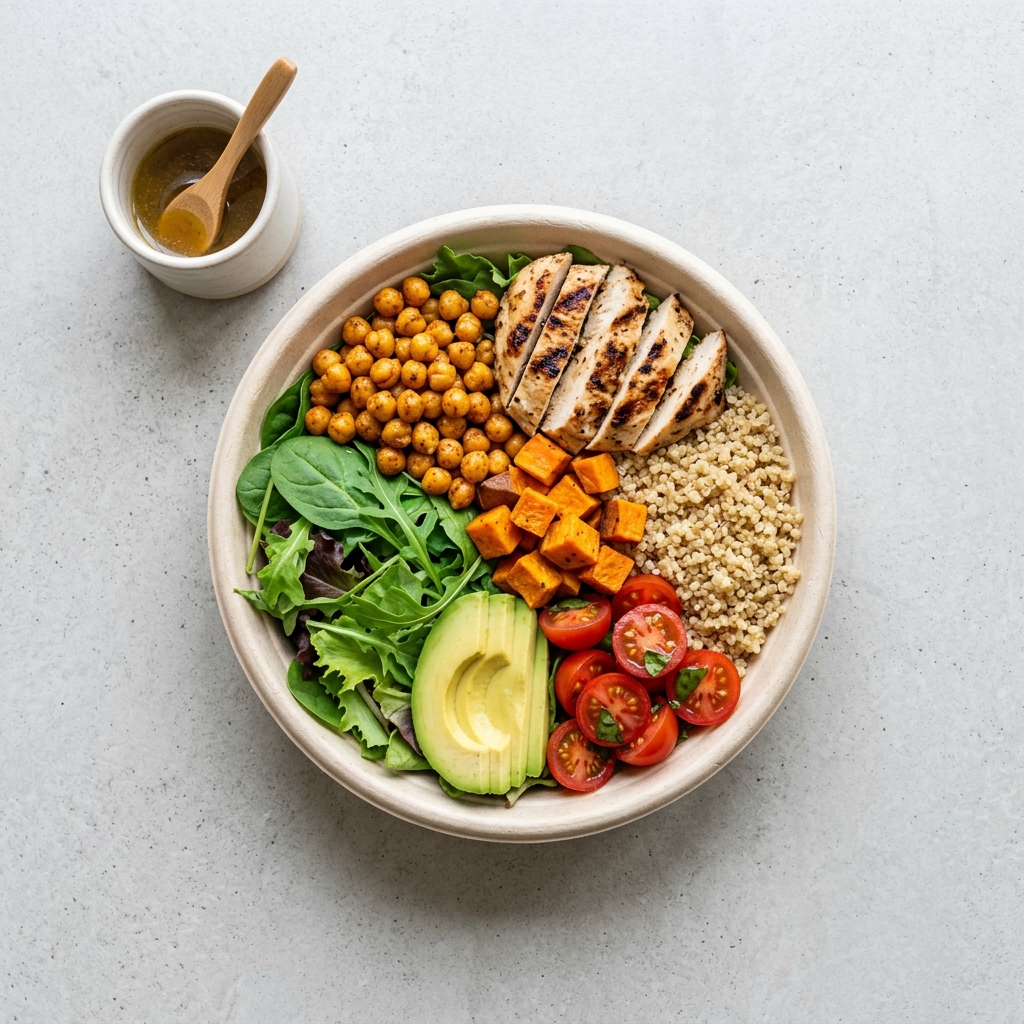
Base: half greens, half warm grains. The warm element lowers the proportion of chilled ready-to-eat food and makes it more filling.
Protein: grilled chicken, salmon or tofu, and consider doubling it.
Add for iron: chickpeas, beans, roasted sweet potato or seeds.
Add for vitamin C: tomatoes, peppers, or a citrus-based dressing, which unlocks the iron from everything else.
Skip: blue cheese, raw sprouts, and anything that looks like it has been sitting.
That combination covers folate, iron, protein and fibre in one bowl, which is more than most lunches manage. Our second trimester lunch ideas use the same logic at home, and our work lunch guide covers the packed version.
One last thing worth asking about at the counter, since it takes a second and settles most doubts: whether any dressing is made in house that day rather than coming from a sealed commercial container. House-made caesar and similar creamy dressings are the only realistic place a raw egg could appear on this kind of menu, and staff generally know the answer.
Takeaway, Delivery and Desk Lunches
This is where a salad stops being the safe option.
A bowl that sits in a delivery bag for forty minutes, or in a warm office until two o'clock, has spent that entire time in the temperature range where bacteria multiply. Cold food needs to stay cold in a way hot food does not need to stay hot.
If you're ordering delivery, eat it as soon as it arrives. If you're collecting it for later, get it into a fridge. The two hour rule applies to cold ready-to-eat food just as it does to leftovers, and our leftovers guide has the timings.
Dressing on the side helps for a different reason: undressed leaves hold up far better than dressed ones, which go limp within the hour.
The summary: go at lunchtime rather than mid-afternoon, swap the blue cheese, add a warm element, and eat it soon after it's made. Done that way, a salad chain is one of the most nutritionally useful meals in this whole series.
Clinical Sources & Research
This article is general information and does not replace advice from your midwife, GP or obstetrician. Menus and ingredients vary by location and season. If you develop a fever or flu-like symptoms after eating chilled ready-to-eat food, contact your maternity team.
Meet the Editorial Team
The researchers and experts behind PregnancyPlate.

Fiza Izra
Founder & Tech Researcher
A UK-based mother of 3 with a background in tech and data synthesis, Fiza brings real-world experience navigating hyperemesis gravidarum and postnatal depression. She engineers complex clinical guidelines (NHS, ACOG) into accessible tools, ensuring rigorous fact-checking with deep empathy.

Emma Davies
Senior Nutrition Editor
A mum and writer, Emma runs our food safety desk. She is the one who rings the restaurant to ask how long the lettuce sits out, checks every claim against CDC, FDA and NHS guidance, and rewrites the answer until it is usable at 9pm in a drive-thru queue.