Pregnancy Food Safety at Home: Your Fridge, Defrosting and Use-By Dates
Most food poisoning happens at home, not in restaurants. Four habits cover nearly all of it, starting with a fridge that is almost certainly too warm.
In this article
Editorial note: This article is researched from official public health and pregnancy food safety guidance, then edited by the PregnancyPlate team for clarity. It is not medical advice. If you are worried about symptoms or a specific exposure, contact your midwife, GP or healthcare provider.
The Fast Answer: Most pregnancy food advice is about what to order. Far more food poisoning happens at home. Four things do nearly all the work: keep your fridge at 5°C or below, which most home fridges are not; defrost in the fridge rather than on the counter; cool leftovers fast and refrigerate within two hours; and treat use-by dates as a hard limit, unlike best-before dates, which are about quality.
Track your nutrition in seconds in the PregnancyPlate AppSafety is step one. Nutrition helps your baby thrive.
Knowing a meal is safe does not tell you whether you are getting enough iron, folate, calcium and choline. PregnancyPlate tracks all of it from a photo of your plate.
- See nutrient progress
- Scan meals instantly
- Nourish with confidence
 Scan to download
Open with iPhone camera
Scan to download
Open with iPhone camera
Pregnancy food safety is usually discussed as a list of foods: this cheese, that fish, those cold meats. The kitchen itself gets almost no attention, which is odd, because that is where most of the risk actually sits.
None of what follows is difficult. It is mostly four habits that take no extra time once they are habits.
Your Fridge Is Probably Too Warm
This is the one worth acting on today, because it is invisible and it affects everything in there.
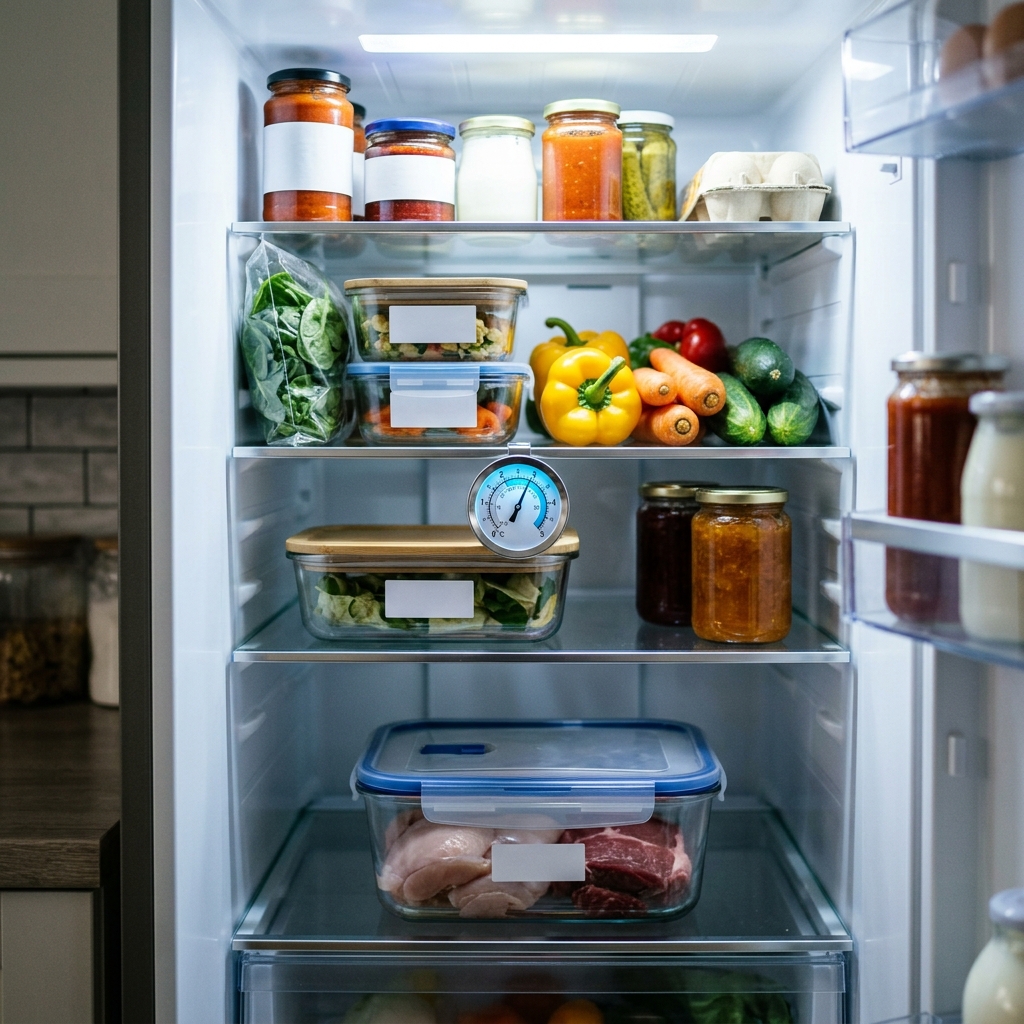
A fridge needs to run at 5°C or below. Surveys of home fridges repeatedly find a large share running warmer than that, often because the dial has never been checked, the fridge is overfilled, or the door seal has gone.
It matters in pregnancy more than usual because listeria grows at fridge temperatures, unlike most food poisoning bacteria, and it grows faster the warmer the fridge is. That is precisely why pregnancy guidance focuses on chilled ready-to-eat foods like soft cheese, pre-made salads, cooked meats and smoked fish.
What to do: buy a fridge thermometer, which costs very little, and put it in the middle shelf rather than the door. Adjust the dial until it reads 5°C or less. Check it again in a few days.
Two related habits. Do not overfill the fridge, since air needs to circulate, and do not leave the door open while you decide what to eat. Both push the temperature up more than people expect.
Defrosting, Which Is Where People Improvise
The second habit, and the one most often done the quick way.
Defrosting on the worktop means the outside of the food spends hours at room temperature while the middle is still frozen. That outer layer is exactly where bacteria multiply, and it can be several hours before the centre thaws.
The safe methods: in the fridge overnight, which needs planning but requires nothing of you; in cold water in a sealed bag, changing the water every half hour; or in the microwave if you are cooking it immediately afterwards.
Large items need real time. A frozen chicken or a turkey can take a day or more in the fridge, which is why the thing to decide is not how to defrost it but when to take it out.
Food defrosted in the microwave or in water should be cooked straight away rather than left. Food defrosted in the fridge can wait a day. And never refreeze raw food that has been thawed unless you cook it first, though you can freeze a cooked dish made from thawed ingredients.
Cooling Leftovers Properly
The third habit, and the one that causes most domestic food poisoning.
Cooked food should be refrigerated within two hours, and within one hour in hot weather. The gap between coming off the heat and going in the fridge is when bacteria multiply fastest, and a large pot cools far more slowly than it feels like it should.
Speed the cooling up rather than waiting: divide food into shallow containers, take meat off the bone, and stand a hot pot in a sink of cold water for a few minutes before it goes in. A deep casserole left on the hob can stay in the danger zone for hours.
Rice deserves a specific mention, because it behaves differently. Uncooked rice can carry spores that survive cooking, and if cooked rice is left at room temperature those spores produce a toxin that reheating does not destroy. Cool rice fast, keep it no more than a day, and reheat once until piping hot. Our guide to rice and pasta leftovers covers it properly.
Reheat anything once, not twice, and until it is steaming throughout rather than warm at the edges. Our leftovers guide has the timings by food type.
The Kitchen in One Box
- Fridge at 5°C or below. Buy a thermometer and check.
- Defrost in the fridge, never on the counter.
- Leftovers chilled within two hours, in shallow containers.
- Use-by is a hard limit. Best-before is about quality.
- Raw meat on the bottom shelf, separate board, wash hands after.
Use-By Versus Best-Before
These two labels mean completely different things and get treated as if they are the same.
Use-by is about safety. It appears on perishable foods like meat, fish, dairy and ready meals. Food should not be eaten after its use-by date even if it looks and smells fine, because listeria in particular does not announce itself by taste or smell. In pregnancy this is one to follow strictly rather than judge by eye.
Best-before is about quality. It appears on tins, pasta, biscuits and frozen food. Past that date the food may be less good but is not unsafe.
One extra point that catches people: "once opened, use within three days" on a packet overrides the use-by date on the front. An opened pack of cooked meat or a tub of hummus has its own shorter clock once air gets in.
Freezing stops the clock, so freezing something on its use-by date is fine, and the countdown restarts when you thaw it.
Cross-Contamination, Briefly
Less dramatic than the other three, but worth the thirty seconds it takes.
Store raw meat and fish on the bottom shelf of the fridge, in a sealed container, so nothing can drip onto food below. This is the single most common fridge mistake.
Use a separate board for raw meat, or do your vegetables first and the meat last.
Wash your hands after handling raw meat, eggs or unwashed vegetables, and before eating. Soap and water beats gel, particularly since alcohol gel does not deal with norovirus.
Wash fruit and vegetables that will be eaten raw, including the skins of anything you cut through, like melons. Bagged pre-washed salad does not need rewashing.
Do not wash raw chicken. It splashes bacteria around the sink and worktop, and cooking handles it anyway.
Batch Cooking and Freezing Safely
Worth its own note, because batch cooking is the single most useful habit in late pregnancy and it involves every rule above at once.
Cool before freezing. Putting a hot dish straight into the freezer raises the temperature of everything around it, which is a problem for the food already in there. Cool it quickly in shallow containers first, then freeze.
Freeze in portions, not in one block. It freezes faster, thaws faster and you only defrost what you need, which removes the temptation to refreeze.
Label with the date. Most cooked dishes keep around three months in a home freezer, and nothing is more useless than an unidentified tub.
Freeze things fresh, not on their last day. Freezing pauses the clock but does not improve anything.
Our slow cooker guide and meal prep routine both build around this, and the freezer stock you make now is the thing you will be most grateful for later.
Pregnancy Makes Some of This Harder
Worth acknowledging rather than pretending otherwise.
In the first trimester, the smell of a fridge can be unbearable, and food gets left rather than dealt with. Nausea also makes you less inclined to cook from raw, which is partly why convenience and chilled foods feature more in early pregnancy, and those are the ones that depend most on a cold fridge.
Exhaustion does the rest. Leftovers sit on the hob because standing up again feels impossible, and that is the most common version of the two hour problem.
Two things genuinely help. Ask someone else to deal with the leftovers, which is a reasonable thing to delegate. And keep more shelf-stable food in, so a bad evening does not depend on something in the fridge being still good. Our no-kitchen guide has a list of what keeps without refrigeration, and our grocery list covers the wider shop.
If Something Has Gone Wrong
Most of the time nothing happens, and retrospective worry changes nothing.
Watch for vomiting, diarrhoea, cramps or fever in the days after. Fluids matter more than food while you are unwell.
Fever with flu-like aches is the one to call about rather than wait out, because listeria can appear days or even weeks later and often presents as flu rather than food poisoning. Mention what you ate when you call, because it changes what your team tests for. Our food poisoning in pregnancy guide has the symptom timelines.
The wider point is that these four habits remove most of the risk you actually have control over, which is more than any list of banned cheeses will do. Our eating out guide covers the half of the problem that happens outside your kitchen.
Clinical Sources & Research
This article is general information and does not replace advice from your midwife, GP or obstetrician. If you develop a fever or flu-like symptoms after eating something you are unsure about, contact your maternity team rather than waiting.
Meet the Editorial Team
The researchers and experts behind PregnancyPlate.

Fiza Izra
Founder & Tech Researcher
A UK-based mother of 3 with a background in tech and data synthesis, Fiza brings real-world experience navigating hyperemesis gravidarum and postnatal depression. She engineers complex clinical guidelines (NHS, ACOG) into accessible tools, ensuring rigorous fact-checking with deep empathy.

Emma Davies
Senior Nutrition Editor
A mum and writer, Emma runs our food safety desk. She is the one who rings the restaurant to ask how long the lettuce sits out, checks every claim against CDC, FDA and NHS guidance, and rewrites the answer until it is usable at 9pm in a drive-thru queue.