Weaning on a Budget: What to Skip and What Actually Matters
Weaning has an industry attached to it and almost none of it is necessary. What to skip, the cheapest iron sources, and support you may be entitled to.
In this article
Editorial note: This article is researched from official public health and pregnancy food safety guidance, then edited by the PregnancyPlate team for clarity. It is not medical advice. If you are worried about symptoms or a specific exposure, contact your midwife, GP or healthcare provider.
The Fast Answer: Weaning costs almost nothing if you ignore the industry built around it. Babies eat teaspoons, so the cheapest approach is simply your own food, unsalted and mashed. Frozen vegetables are as nutritious as fresh and cost a fraction. Tinned lentils and beans are the cheapest iron there is. And if money is tight, check whether you qualify for Healthy Start, which many eligible families never claim.
Track what your baby is eating in the PregnancyPlate AppYour next meal, a little less guesswork.
Scan your plate for pregnancy food-safety guidance and a nutrition breakdown. Keep your meals and nutrient progress in one place.
 Scan with your iPhone
to get the app
Walk down the baby aisle and weaning looks expensive. Pouches, jars, special cereals, steamer-blenders, branded storage pots, snack packs shaped like animals.
Almost none of it is necessary, and some of it is worse than the free alternative. Here is what actually costs money and what does not.
The Cheapest Approach Is the Best One
Convenient, because they turn out to be the same thing.
Current guidance is to move babies onto family food as quickly as they can manage it, and family food is by definition already in your kitchen. From around six months a baby can eat versions of what you eat, unsalted, chopped or mashed appropriately.
That means the ideal weaning strategy costs you nothing extra. Cook your dinner, take out a portion before you season it, mash or chop it. Our 4 week weaning plan builds toward exactly that by week four.
Remember the quantities too. In the early months a baby eats one or two teaspoons a meal. The idea that this requires a separate shopping budget does not survive contact with how little actually goes in.
What to Skip
Baby food makers. A steamer and blender in one, doing the job of a saucepan and any blender you already own. The most expensive unnecessary purchase in the category.
Baby rice. Bland, low in iron, and largely a hangover from when weaning started at four months. Porridge oats do the same job for less.
Pouches as a default. Fine occasionally and genuinely useful when out. As an everyday staple they are expensive per gram, they train sucking rather than chewing, and many are mostly fruit even when the front of the packet suggests vegetables.
Branded baby snacks. Puffs, melts and biscuits are among the most expensive food per kilo you can buy. A breadstick, a rice cake or a piece of fruit does the same job.
Toddler and follow-on milks. Not necessary. Cow's milk from twelve months is far cheaper and better.
Branded storage pots. Ice cube trays cost a fraction and hold a better portion size, which our baby food freezer guide covers.
What is worth buying, and it is a short list: a couple of soft-tipped spoons, two or three suction-base bowls, a full-coverage bib with sleeves, some ice cube trays, and a highchair where your baby can sit upright with their feet supported. Second-hand is fine for the highchair. That is the entire necessary kit, and it comes to very little.
Where to Spend Instead
The one nutrient worth actively budgeting for is iron, since a baby's own stores run down from around six months and vegetable purees contain very little.
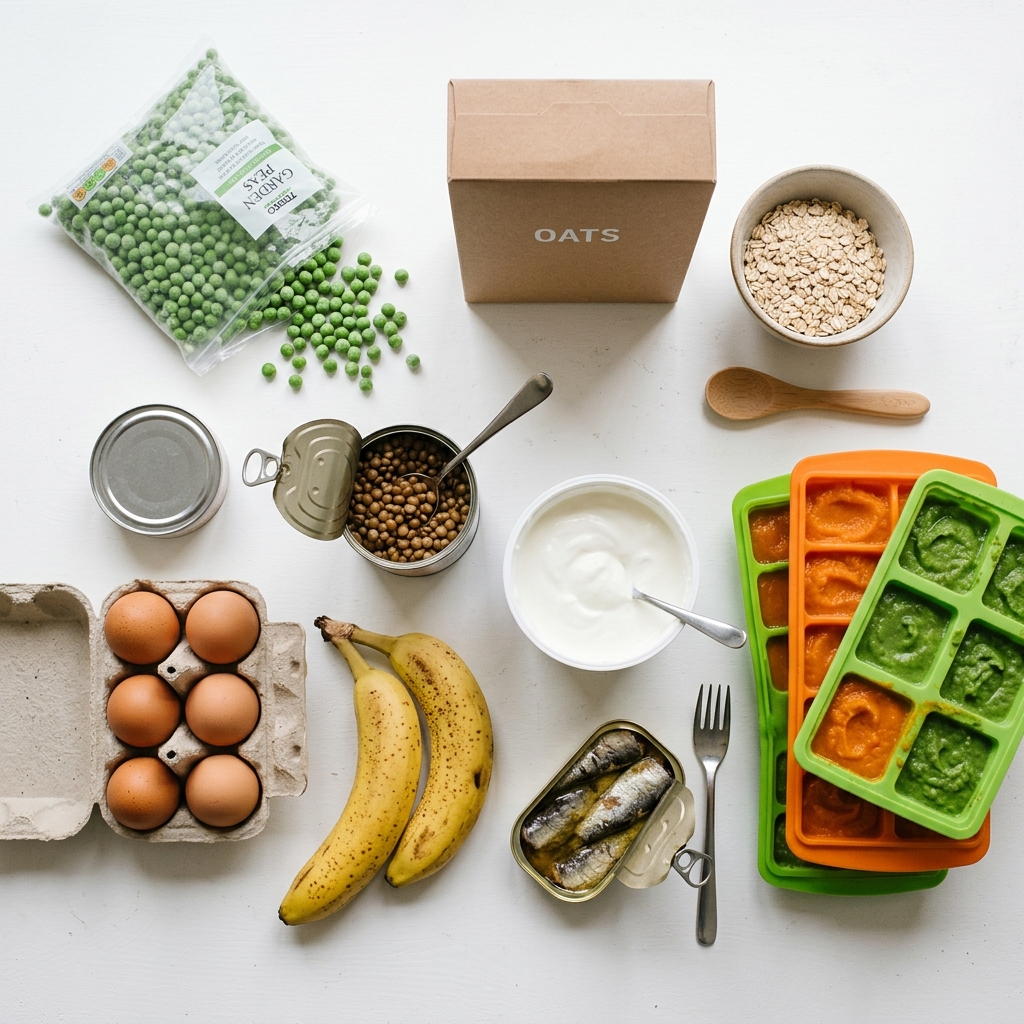
The cheapest iron sources are, conveniently, some of the cheapest food in the shop:
- Tinned lentils, chickpeas and beans. Pennies per portion, no preparation, and they mash easily.
- Dried red lentils. Cheaper still, and they cook down to the right texture in fifteen minutes.
- Eggs. Iron, choline and protein, and among the cheapest proteins available.
- Frozen spinach. Cheaper than fresh, no waste, and it keeps indefinitely.
- Tinned sardines and mackerel. Iron, calcium and omega-3 for very little.
- Fortified porridge oats and breakfast cereals. Check the iron figure on the box.
- Cheaper cuts of red meat, slow cooked until soft. Mince and braising cuts work better here than steak anyway.
Pair plant iron with something containing vitamin C in the same meal, which substantially increases absorption. Tomatoes, peppers or a little fruit. Our first 100 foods list flags which foods carry what.
Budget Weaning in One Box
- Family food, unsalted. The cheapest approach and the recommended one.
- Frozen vegetables are as nutritious as fresh, cheaper, and never wasted.
- Tinned lentils and beans are the cheapest iron available.
- Skip: baby food makers, baby rice, daily pouches, toddler milks.
- Check Healthy Start. Many eligible families never claim it.
Frozen Is Not the Compromise
Worth stating plainly, because people treat frozen vegetables as the budget fallback rather than a genuinely equal option.
Frozen vegetables are picked and frozen quickly, which preserves nutrients well. In some cases they compare favourably with fresh produce that has spent days in transit and more days in your fridge drawer.
For weaning specifically they have a practical advantage that matters more than the price: no waste. A bag of frozen peas lets you cook a tablespoon at a time. A fresh bunch of something rots while your baby goes through a fortnight of refusing it, which our weaning approaches guide notes is entirely normal.
Frozen fruit is the same story, and frozen fish is usually cheaper than the counter with no nutritional difference.
Batch Cooking Is the Biggest Saving
Not a product, and it does more for the weekly cost than any swap on the shelf.
Cooking once and freezing in portions means you buy in larger, cheaper quantities and waste almost nothing. A bag of dried red lentils, a bag of frozen vegetables and an afternoon produces weeks of meals for a couple of pounds. The equivalent in pouches would run into the tens.
It also solves the waste problem that quietly costs the most. Babies refuse things unpredictably, and fresh food bought for a baby who has gone off it goes in the bin. Frozen cubes simply wait.
Ice cube trays are the only equipment needed, and our freezer system guide covers the storage and reheating rules.
Shopping Tricks That Genuinely Work
Small things, and they compound over the months weaning takes.
Buy the loose vegetables rather than pre-chopped or pre-steamed. You are paying several times over for someone else having cut a carrot.
Check the reduced section for vegetables and fruit. Slightly past-best produce is perfect for cooking down and freezing the same day.
Buy own-brand. Tinned tomatoes, lentils, beans and frozen vegetables are essentially identical across price tiers, and the ingredient list usually says so.
Large tubs, not pots. A big tub of full-fat plain yogurt costs a fraction of the same volume in individual baby-branded pots, and has less sugar.
Buy in season where you can, and freeze the surplus when something is cheap.
Ignore the baby aisle entirely for anything other than a bib. Almost everything you need is in the ordinary aisles at ordinary prices.
Support You May Be Entitled To
Worth checking properly, because take-up is well below eligibility.
Healthy Start is a UK scheme providing a prepaid card for milk, fruit, vegetables and pulses, plus free vitamins. It is available to families on certain benefits, and to all pregnant women under 18 regardless of income. Apply through the NHS Healthy Start website.
Free vitamins. The scheme includes vitamin drops for children from birth to four, which covers the vitamin D that is recommended for all babies anyway.
Your health visitor can point you toward local schemes, food banks with baby provision, and children's centres. Asking is routine and they would far rather you did.
If money is genuinely tight, tell your health visitor. There is more local support than is ever advertised, and it exists to be used.
The Weekly Shop, Adjusted
Practically, weaning adds very little to a normal shop. Buy the family food you were buying anyway, then add:
Frozen peas, spinach and mixed vegetables. Tinned lentils and beans. Porridge oats. Eggs. A bag of bananas. Full-fat plain yogurt in a large tub rather than individual pots, which costs considerably less per portion. Frozen berries.
That is most of a weaning diet, and it is a handful of pounds rather than a separate budget. Our pregnancy grocery list covers the adult version of the same principle.
One last thing worth saying, because the marketing works hard to suggest otherwise: babies fed home-mashed lentils and frozen peas are not getting a lesser start than babies fed organic pouches. In several respects, including texture progression and flavour exposure, they are getting a better one.
If You Are Formula Feeding Too
Worth a note, because formula is usually the largest baby cost and there is a lot of unhelpful advice about it.
All first infant formula sold in the UK must meet the same compositional regulations, so the cheapest own-brand meets identical standards to the most expensive. Price differences reflect branding and optional added ingredients rather than a nutritional floor. There is no requirement to buy an expensive brand.
Follow-on milk from six months is not necessary either. First infant formula is suitable for the whole first year, and switching is usually a marketing prompt rather than a nutritional one.
If you are struggling to afford formula, speak to your health visitor rather than watering feeds down or switching to cow's milk early. Both are genuinely unsafe, and there is local support available.
Clinical Sources & Research
Meet the Editorial Team
The researchers and experts behind PregnancyPlate.

Fiza Izra
Founder & Tech Researcher
A UK-based mother of 3 with a background in tech and data synthesis, Fiza brings real-world experience navigating hyperemesis gravidarum and postnatal depression. She engineers complex clinical guidelines (NHS, ACOG) into accessible tools, ensuring rigorous fact-checking with deep empathy.

Emma Davies
Senior Nutrition Editor
A mum and writer, Emma runs our food safety desk. She is the one who rings the restaurant to ask how long the lettuce sits out, checks every claim against CDC, FDA and NHS guidance, and rewrites the answer until it is usable at 9pm in a drive-thru queue.
Make sense of every plate.
Scan your plate for pregnancy food-safety guidance and a nutrition breakdown. Keep your meals and nutrient progress in one place.
Scan with your iPhoneto get the app