Thanksgiving While Pregnant: Turkey, Stuffing, Eggnog and the Two Hour Rule
Stuffing cooked inside the bird is the classic risk and traditional eggnog is made with raw egg. Plus why food sitting out all afternoon matters most.
In this article
Editorial note: This article is researched from official public health and pregnancy food safety guidance, then edited by the PregnancyPlate team for clarity. It is not medical advice. If you are worried about symptoms or a specific exposure, contact your midwife, GP or healthcare provider.
The Fast Answer: Thanksgiving is an easy meal to eat safely in pregnancy, with three things worth knowing. Stuffing cooked inside the bird is the classic risk, because it has to reach the same temperature as the turkey and often does not. Traditional eggnog is made with raw egg, though shop-bought cartons are pasteurised. And the food sitting out for hours matters more than anything on the table, since a long afternoon is exactly how leftovers go wrong.
Track your nutrition in seconds in the PregnancyPlate AppSafety is step one. Nutrition helps your baby thrive.
Knowing a meal is safe does not tell you whether you are getting enough iron, folate, calcium and choline. PregnancyPlate tracks all of it from a photo of your plate.
- See nutrient progress
- Scan meals instantly
- Nourish with confidence
 Scan to download
Open with iPhone camera
Scan to download
Open with iPhone camera
A roast dinner is mostly cooked food served hot, which is the safest shape a meal can take. Thanksgiving is unusual because of how long it goes on and how much of it is made in advance.
Here is what actually needs attention, and what you can stop worrying about.
Turkey and the Stuffing Problem
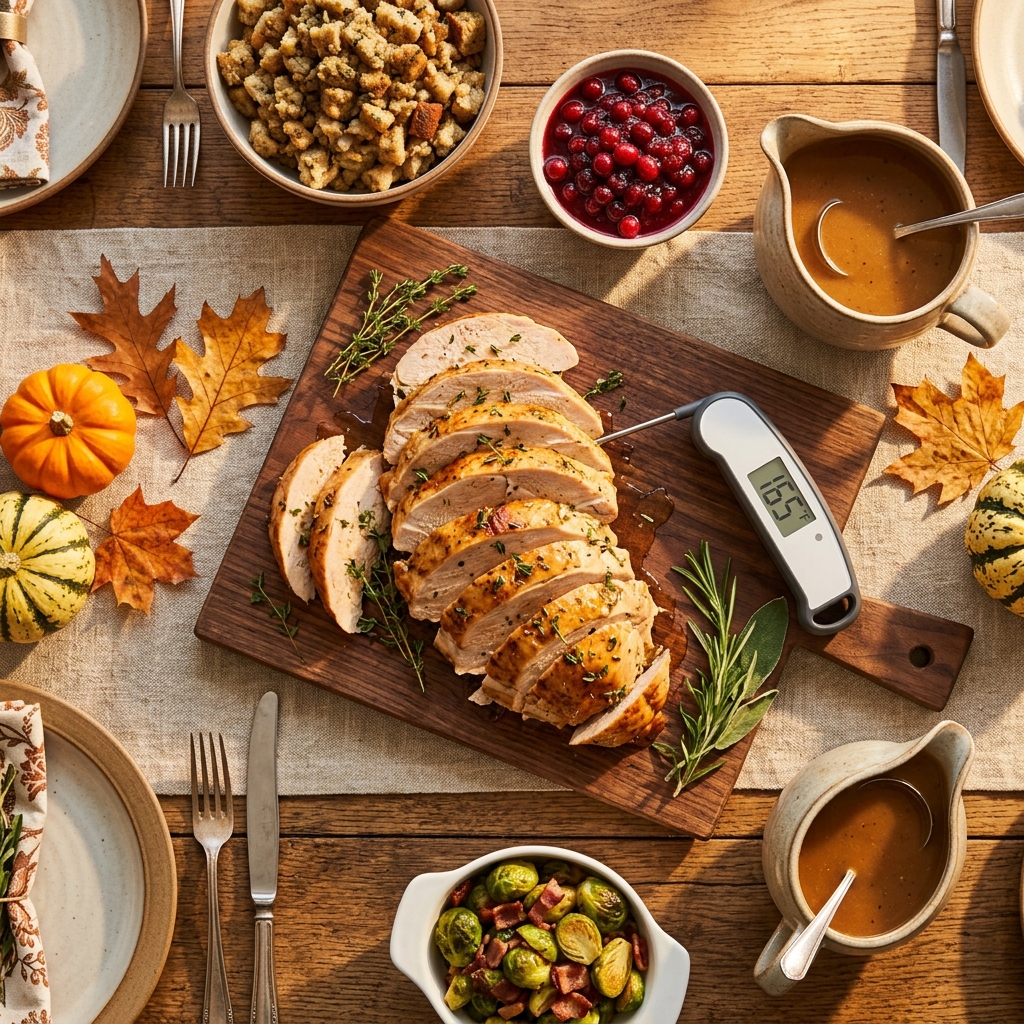
The bird itself is straightforward. Poultry needs to reach 74°C (165°F) in the thickest part of the thigh, away from the bone, and a thermometer is the only reliable way to know.
Stuffing is where it gets interesting. When stuffing is cooked inside the cavity, it has to reach that same 165°F to be safe, because it has absorbed raw turkey juices throughout cooking. The problem is that the stuffing is the slowest part of the whole bird to heat, so a turkey can be perfectly cooked while the stuffing in the middle has not got there.
That is why food safety agencies recommend cooking stuffing in a separate dish. It reaches temperature easily, the turkey cooks more evenly, and the entire question disappears.
If someone else is cooking and the stuffing came out of the bird, it is reasonable to ask whether it was temperature checked, or to take the stuffing from a side dish if there is one. If you cannot find out, the stuffing is the one item to skip rather than the turkey.
Pink turkey near the bone is usually normal, the same pigment effect that confuses people with chicken wings. Firm, opaque meat with clear juices and a verified temperature is what matters, not colour. Our guide on undercooked poultry covers what to do if you are unsure after the fact.
Eggnog, and the One Raw Egg Item
Worth knowing because it catches people every year.
Traditional homemade eggnog is made with raw egg, sometimes with alcohol added as a preservative, which does not make it safe. Raw egg carries a salmonella risk, which is why pregnancy guidance in the US says to cook eggs until firm.
Commercially produced eggnog in a carton is pasteurised and therefore fine. So is any homemade version made with a cooked custard base, which some recipes use.
So the answer depends entirely on where it came from. Shop-bought, non-alcoholic: fine. Someone's family recipe in a punch bowl: ask, and skip it if nobody knows. Our runny eggs guide explains the reasoning, and note that the UK position differs because of the British Lion scheme.
The same applies to anything else built on raw egg, including some homemade mousses, tiramisu and certain dressings.
The Table, Item by Item
Most of it is genuinely fine. The table makes it quicker to scan.
| Dish | Verdict | Notes |
|---|---|---|
| Roast turkey | Safe | Cooked to 74°C (165°F). Lean protein and a good iron source in the dark meat. |
| Stuffing cooked separately | Safe | The recommended method, and the easy answer. |
| Stuffing cooked in the bird | Ask | Must reach 165°F itself. Skip if nobody checked. |
| Gravy from drippings | Safe hot | Boiled during making. Take it steaming rather than from a jug that has sat. |
| Roast potatoes, vegetables, casseroles | Safe | Cooked through and served hot. |
| Cranberry sauce | Safe | Cooked or commercially produced. No concerns. |
| Pumpkin and pecan pie | Safe | The custard is baked, which cooks the egg. |
| Whipped cream and ice cream | Safe | Made with pasteurised dairy. |
| Cheese board | Check | Hard cheese fine. Blue and mould-ripened are the ones UK advice avoids uncooked. |
| Charcuterie and cold cured meat | Skip cold | Fine cooked into a dish, not sliced cold from a board. |
| Shrimp cocktail | Safe if cold and fresh | Prawns are cooked. The issue is a chilled dish sitting out. |
| Homemade eggnog | Ask | Raw egg unless made with a cooked base. |
| Alcohol in dishes | Generally fine | Most cooks off in long cooking. Trifles and unheated sauces retain more. |
Thanksgiving in One Box
- Stuffing from a side dish, not from inside the bird.
- Eggnog from a carton, not from a family recipe.
- Eat early, while everything is properly hot.
- Leftovers refrigerated within two hours, not after the film.
- Skip the cold charcuterie, keep the cheese board simple.
The Two Hour Rule Is the Real Risk
If there is one thing to take from this piece, it is this rather than anything on the menu.
Thanksgiving food typically comes out at two, gets picked at through the afternoon, and goes in the fridge when someone remembers. Perishable food should not sit at room temperature for more than two hours, and a warm dining room shortens that further.
Bacteria multiply fastest between fridge temperature and properly hot, which is exactly where a table of food sits an hour after serving. This is how most domestic food poisoning happens, and it is entirely avoidable.
What to do: eat your plate when the food is first served rather than grazing for three hours, and get the leftovers into the fridge within two hours of the meal coming out. Carve the turkey off the bone before refrigerating so it cools faster, and use shallow containers rather than one deep bowl.
Reheat leftovers once, until steaming hot throughout. Cold turkey from the fridge is fine if it was chilled promptly, which our cold cooked poultry guide explains. Our leftovers guide has the full timings.
The Cheese Board and the Buffet Table
The two parts of the day that follow buffet rules rather than roast dinner rules.
Cheese. Hard cheeses like cheddar and parmesan are fine. Soft pasteurised cheeses like cream cheese and mozzarella are fine. Blue and soft mould-ripened cheeses like brie and camembert are the ones UK guidance says to avoid uncooked, while US guidance accepts them if pasteurised. Baked brie is fine under both, since cooking resolves it. Our cheese guide sets out both positions.
Charcuterie. Cold cured meats are the one clear skip. They are fine cooked into a dish. Our cured meat guide explains why.
Dips and cold starters follow the same clock as everything else. Take some early, and treat the bowl as finished once it has been out for a couple of hours. Our buffet guide covers the general rules.
Turkey Is Actually a Good Pregnancy Food
Worth saying, because these guides can read as a list of restrictions.
Protein. A modest serving covers a large share of a day's protein, and protein is the thing most people under-eat when appetite is unpredictable.
Iron. The dark meat, meaning thigh and leg, carries considerably more iron than the breast, and it is heme iron, the form your body absorbs best. Pregnancy roughly doubles your iron requirement to around 27mg a day. Our iron guide explains why the animal form matters so much.
Choline and zinc, both of which matter for development and both of which turn up in poultry.
Pair it with something containing vitamin C, which the cranberry sauce and vegetables do for you, and a Thanksgiving plate is genuinely one of the better meals of the year nutritionally. The things that undo it are the quantity and the salt rather than the food itself.
If You Are Doing the Cooking
A few practical points for your own kitchen, which remove most of the questions above.
Thaw the turkey in the fridge, not on the counter. A frozen bird needs roughly 24 hours per 2kg, so it needs planning days ahead. Thawing at room temperature leaves the outside sitting warm for hours while the middle is still frozen.
Do not wash the turkey. It spreads bacteria around the sink and worktop and does nothing cooking will not do.
Use a thermometer, which costs very little and removes all the guesswork from the single most important step.
Cook the stuffing separately, for the reasons above.
Cool leftovers fast by carving the meat off the bone and using shallow containers. A whole carcass in the fridge cools too slowly to count.
If you want to get ahead, most sides freeze well and can be made days in advance, which also means less standing in a hot kitchen on the day.
Eating Comfortably, Not Just Safely
The part that will actually affect your evening.
Heartburn. A large, rich, late meal is close to the worst combination once the baby is pressing upwards. Smaller portions, eating earlier, and staying upright afterwards help more than avoiding any single dish. Our heartburn guide ranks the triggers.
Capacity. In the third trimester there is simply less room. A smaller plate now and a second small plate an hour later works far better than one enormous one, and nobody will notice.
Salt. Brined turkey, gravy and stuffing together carry a lot of sodium, which shows up as swollen fingers and ankles by the evening. Water alongside genuinely helps, and our swelling guide covers the rest.
Blood sugar. If you have gestational diabetes, this is a day to plan rather than improvise. Protein and vegetables first, a smaller portion of the starches, and dessert after the meal rather than instead of it. Our gestational diabetes meal plan covers the approach.
When Someone Else Is Cooking
Most of this is easier in your own kitchen. At someone else's house you have less control and more social friction.
Two questions cover nearly everything: was the stuffing cooked in the bird, and is the eggnog shop-bought. Both are normal things to ask while helping in the kitchen, and neither needs a speech about pregnancy.
Beyond that, serve yourself early, take from dishes that are still steaming, and build a plate from roast meat and vegetables, which is almost always the safest and best part of the meal anyway.
If the hosting is new to you this year, our general eating out guide has the four questions that work anywhere, and our autumn food safety guide covers the cider and caramel apple season that comes just before.
Clinical Sources & Research
This article is general information and does not replace advice from your midwife, GP or obstetrician. If you develop a fever or flu-like symptoms after a meal you are unsure about, contact your maternity team rather than waiting.
Meet the Editorial Team
The researchers and experts behind PregnancyPlate.

Fiza Izra
Founder & Tech Researcher
A UK-based mother of 3 with a background in tech and data synthesis, Fiza brings real-world experience navigating hyperemesis gravidarum and postnatal depression. She engineers complex clinical guidelines (NHS, ACOG) into accessible tools, ensuring rigorous fact-checking with deep empathy.

Emma Davies
Senior Nutrition Editor
A mum and writer, Emma runs our food safety desk. She is the one who rings the restaurant to ask how long the lettuce sits out, checks every claim against CDC, FDA and NHS guidance, and rewrites the answer until it is usable at 9pm in a drive-thru queue.